

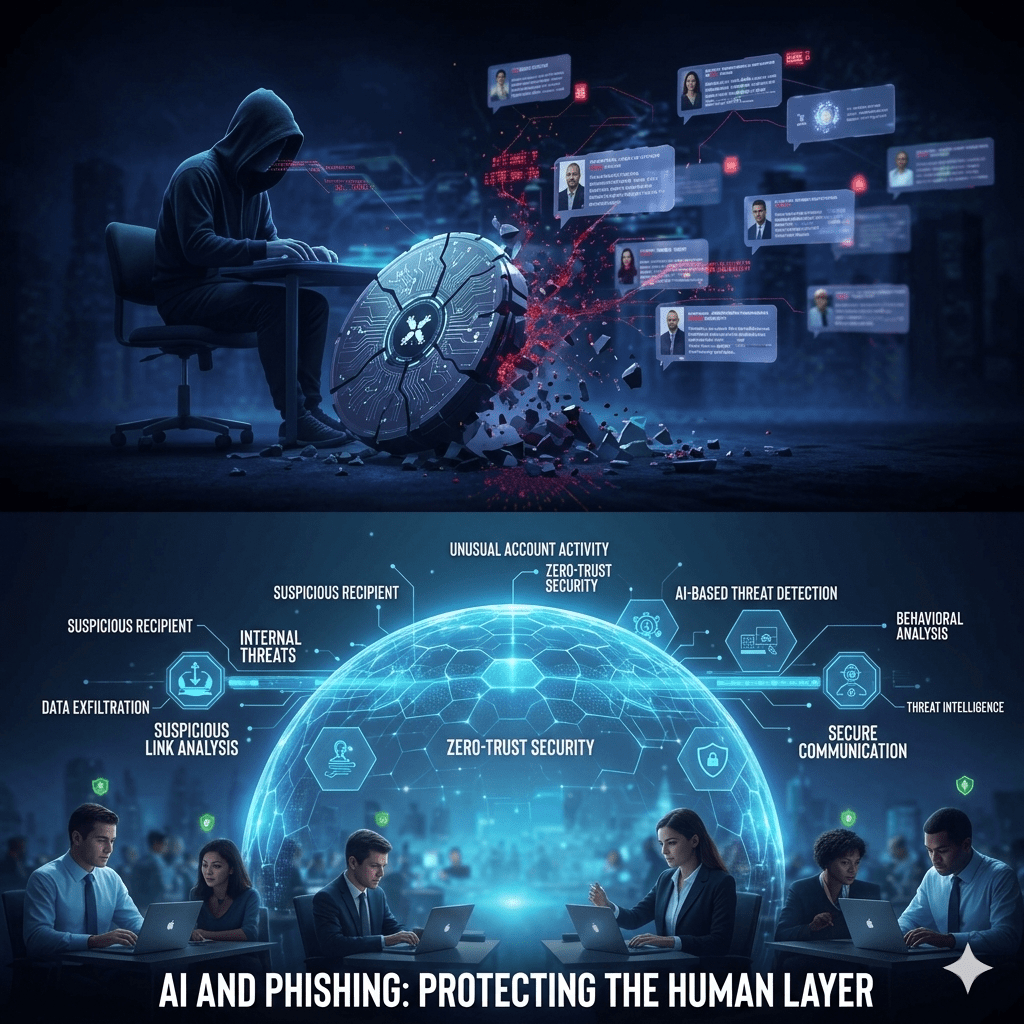
AI phishing attacks are increasingly sophisticated, making AI phishing attacks a major concern for businesses and cybersecurity teams. AI Phishing Attacks use emails, messages, and voice calls that are localized, timed, and personalized with a level of precision traditional security controls were never designed to handle.
At Mindcore Technologies, we are seeing a clear shift. Phishing is no longer a volume problem. It is a credibility problem. Attackers are using AI to remove the mistakes that users were trained to look for.
This article explains how AI is reshaping phishing, why legacy defenses are failing, and what businesses must do to adapt.
The Hard Truth About Modern Phishing
Attackers no longer need to guess.
With AI, they can:
- Write perfect emails in any language
- Mimic executive tone and style
- Reference real projects, vendors, or events
- Adapt messages in real time based on responses
The result is phishing that looks legitimate, relevant, and urgent.
How AI Has Changed Phishing Attacks
1. AI Eliminates the “Red Flags” Users Were Trained On
Traditional phishing relied on:
- Poor grammar
- Generic language
- Obvious urgency
AI removes those signals entirely.
We now see:
- Polished, professional writing
- Context-aware requests
- Accurate formatting and branding
- Industry-specific language
User awareness training that focuses on spelling mistakes is now outdated.
2. Hyper-Personalized Phishing at Scale
Modern AI phishing attacks leverage automation to create hyper-personalized messages, increasing the likelihood of successful AI phishing attacks.
Attackers can:
- Scrape LinkedIn, company websites, and social media
- Generate tailored messages for specific roles
- Reference real colleagues, vendors, or systems
This is no longer spear phishing done manually. It is automated, targeted phishing at scale.
3. AI-Powered Business Email Compromise
AI phishing attacks have elevated business email compromise, allowing attackers to mimic executives and manipulate workflows more effectively.
AI enables attackers to:
- Mimic executive writing styles
- Generate realistic financial requests
- Respond intelligently to follow-up questions
Finance, HR, and operations teams are prime targets because the messages sound exactly like internal communication.
4. Multi-Channel Phishing Campaigns
AI phishing attacks now occur across multiple channels, including email, SMS, collaboration tools, and voice calls, making AI phishing attacks more pervasive and harder to detect.
We now see coordinated attacks using:
- SMS
- Collaboration tools
- Voice calls using AI-generated speech
Attackers move fluidly between channels to build trust and urgency.
5. Real-Time Adaptation
AI phishing attacks adapt in real time to user responses, making AI phishing attacks highly dynamic and difficult to prevent using traditional controls.
If a user hesitates or asks questions, the attacker can:
- Adjust tone
- Add details
- Increase pressure
- Change tactics
This adaptability dramatically increases success rates.

Why Traditional Defenses Are Failing
Most phishing defenses were built for yesterday’s attacks.
Email Filters
AI-generated phishing looks legitimate, passes reputation checks, and often avoids known malicious indicators.
Signature-Based Detection
There is no consistent payload to match. Each message is unique.
User Awareness Training
Training focused on “spot the typo” or “hover over the link” does not prepare users for realistic, contextual deception.
The New Phishing Kill Chain
Modern phishing attacks often follow this pattern:
- AI-generated message builds trust
- Credentials are harvested or sessions hijacked
- Access is established using valid credentials
- Lateral movement begins
- Financial fraud, ransomware, or data theft follows
The phishing email is just the entry point.
What Actually Stops AI-Driven Phishing
Stopping AI-powered phishing requires shifting focus from messages to outcomes and behavior.
1. Strong Identity Controls
Phishing succeeds because credentials still matter.
Effective defenses include:
- Enforcing phishing-resistant MFA
- Reducing reliance on passwords
- Monitoring anomalous logins
If stolen credentials cannot be used, phishing loses power.
2. Email Security That Focuses on Behavior
Modern email security must:
- Analyze intent, not just content
- Detect impersonation patterns
- Identify abnormal sender behavior
Static filtering is no longer enough.
3. Session Protection and Conditional Access
AI phishing often leads to session hijacking.
Controls should include:
- Session expiration enforcement
- Device trust checks
- Location-based access policies
Valid credentials alone should not grant access.
4. Financial and Process Controls
Phishing often targets workflows, not systems.
Effective safeguards include:
- Dual approval for financial actions
- Out-of-band verification
- Clear escalation paths
Process controls are just as important as technical ones.
5. Monitoring for Post-Phish Activity
The real damage happens after the click.
IT must monitor for:
- Unusual access patterns
- Privilege escalation attempts
- Abnormal data access
- Lateral movement
Early detection limits impact.
6. Updated Training Focused on Reality
Training must evolve.
Effective programs focus on:
- Context-based deception
- Urgency manipulation
- Executive impersonation
- Multi-channel attacks
Users need to understand how they are being manipulated, not just what phishing looks like.
Why This Matters More Than Ever
AI lowers the barrier to entry for attackers while raising the bar for defenders.
Phishing is no longer:
- Cheap
- Obvious
- Random
It is strategic, targeted, and highly effective.
Organizations that rely on legacy controls will continue to see breaches that “came out of nowhere.”
How Mindcore Technologies Helps Defend Against AI-Driven Phishing
Mindcore helps organizations adapt to modern phishing threats through:
- Advanced email security strategy
- Identity and access hardening
- Phishing-resistant MFA deployment
- Conditional access and session controls
- Security monitoring and response
- Realistic, role-based security training
We focus on stopping phishing where it actually succeeds, not just where it starts.
Final Takeaway
AI has permanently changed phishing. The problem is no longer identifying bad emails. The problem is preventing attackers from turning successful deception into real damage.
Organizations that shift toward identity protection, behavioral detection, and strong process controls will stay ahead. Those that continue to rely on outdated assumptions will keep asking the same question after every incident.
Frequently Asked Questions
How is AI changing phishing attacks?
AI is making phishing attacks more personalized, convincing, and difficult to detect. Attackers now use AI to create realistic emails, messages, and voice calls that mimic trusted individuals and legitimate business communication.
Why are traditional phishing defenses becoming less effective?
Traditional defenses rely heavily on detecting spelling errors, suspicious links, or known malicious patterns. AI-generated phishing campaigns often avoid these indicators by producing polished, context-aware, and highly customized messages.
What is AI-powered business email compromise?
AI-powered business email compromise involves attackers using AI to imitate executive writing styles, financial requests, and internal communication patterns. These attacks are designed to trick employees into transferring money, sharing credentials, or approving unauthorized actions.
What are the best ways to prevent AI-driven phishing attacks?
Organizations should implement phishing-resistant MFA, behavioral-based email security, session protection, conditional access policies, and strong financial approval processes. Continuous monitoring and modern security awareness training are also critical.
Why is identity protection important against AI phishing?
Modern phishing attacks often succeed by stealing valid credentials or hijacking active sessions. Identity protection controls help prevent attackers from using compromised accounts to access systems, escalate privileges, or move laterally within networks.
AI-Driven Cybersecurity Expertise from Matt Rosenthal
Matt Rosenthal, CEO of Mindcore Technologies, has more than 30 years of experience helping organizations strengthen cybersecurity defenses against evolving threats. His expertise in identity security, phishing prevention, access control strategies, threat detection, and operational resilience helps businesses adapt to modern AI-driven cyberattacks. His leadership focuses on proactive cybersecurity architectures that reduce risk through phishing-resistant authentication, behavioral monitoring, conditional access controls, and security awareness strategies designed for today’s rapidly changing threat landscape.

