

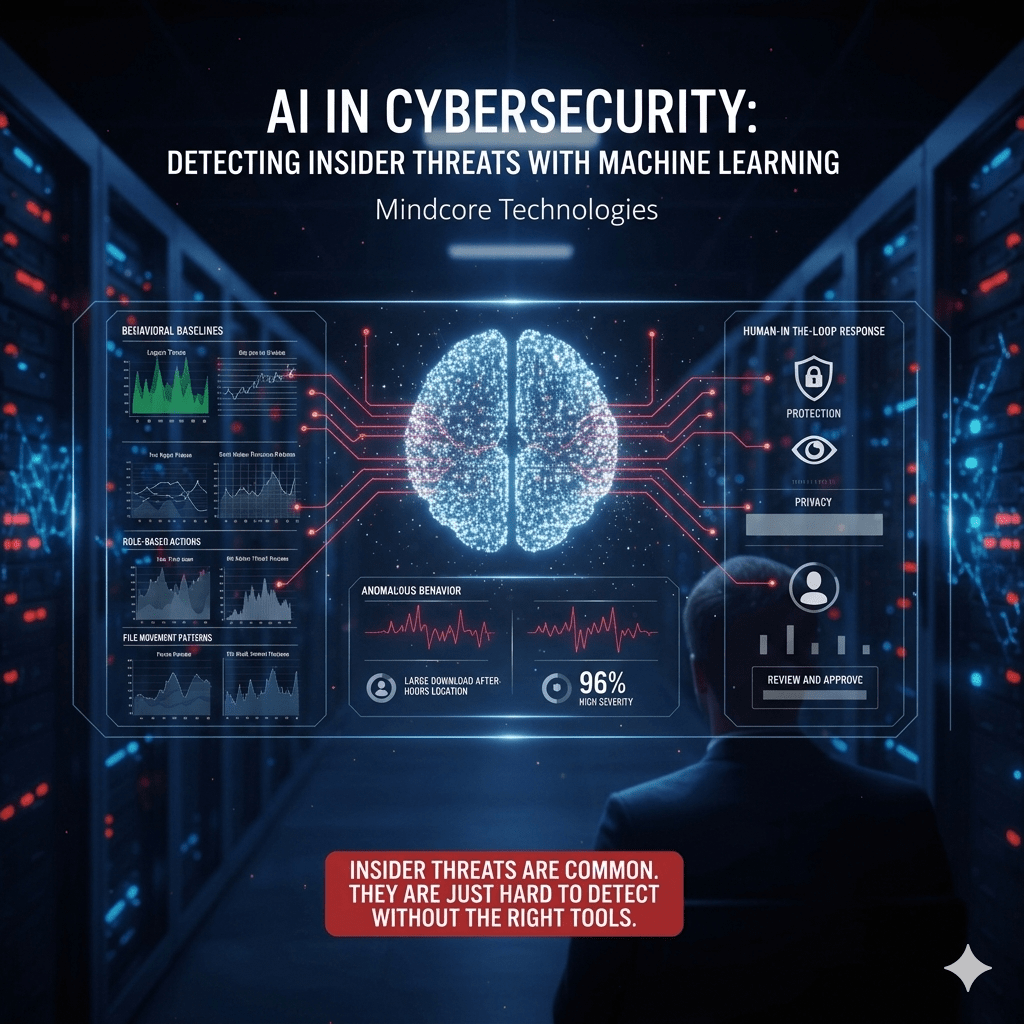
Insider threats are not rare edge cases. They are one of the most consistent causes of data loss, fraud, and security incidents across industries. The uncomfortable reality is that insiders already have access, credentials, and trust. Traditional security tools were never designed to question legitimate users behaving badly, or carelessly.
At Mindcore Technologies, we see insider threats as a visibility and context problem, not a firewall problem. This is where machine learning fundamentally changes what cybersecurity teams can see and respond to.
This article explains how AI and machine learning detect insider threats, why legacy approaches fall short, and how organizations can act before damage occurs.
Why Insider Threats Are So Hard to Detect
Insider threats do not look like attacks.
They often involve:
- Valid credentials
- Approved devices
- Normal business hours
- Legitimate applications
From a traditional security perspective, nothing looks wrong.
Insider incidents usually come from:
- Disgruntled employees
- Financially motivated insiders
- Negligent users
- Compromised accounts behaving “normally”
Static rules cannot separate malicious intent from normal work.
Why Traditional Insider Threat Controls Fail
Most organizations rely on:
- Access controls
- Log reviews
- Manual investigations
- Post-incident audits
These methods fail because:
- They assume bad activity is obvious
- They lack behavioral context
- They trigger alerts too late
By the time something is flagged, data is already gone.
What Machine Learning Changes
Machine learning does not look for known bad actions. It looks for deviation from normal behavior.
Instead of asking:
“Is this action allowed?”
Machine learning asks:
“Is this action consistent with how this user normally behaves?”
That shift is critical.
How Machine Learning Detects Insider Threats
1. Establishing Behavioral Baselines
Machine learning builds a baseline for each user by observing:
- Login times and locations
- Typical applications used
- Normal data access patterns
- File movement behavior
- Network activity
This baseline is unique per user and role.
2. Detecting Anomalous Behavior
Once a baseline exists, AI looks for deviations such as:
- Unusual login locations
- Accessing data outside normal scope
- Sudden spikes in file downloads
- Uncharacteristic use of admin tools
None of these actions are automatically malicious. The risk comes from pattern change, not the action itself.
3. Contextual Risk Scoring
Machine learning combines signals to assess risk:
- Time of activity
- Sensitivity of accessed data
- Deviation severity
- Historical behavior
This reduces false positives and prioritizes real threats.
4. Identifying Slow, Intentional Abuse
The most damaging insiders act slowly.
Machine learning excels at detecting:
- Gradual data exfiltration
- Repeated minor policy violations
- Persistent but subtle misuse
These patterns are almost invisible to manual review.
5. Differentiating Negligence from Malice
Not every insider threat is intentional.
AI helps distinguish:
- Accidental policy violations
- Training gaps
- System misconfiguration
- Malicious intent
This allows proportional response instead of overreaction.
Why Insider Threat Detection Requires AI
Insider threat detection fails without:
- Continuous monitoring
- Long-term trend analysis
- Behavioral correlation
Humans cannot analyze this volume of activity manually. Machine learning can.
Common Insider Threat Scenarios We See
- Employees downloading large datasets before resignation
- Users accessing systems unrelated to their role
- Compromised accounts behaving subtly differently
- Privileged users expanding access quietly
- Contractors exceeding approved scope
These rarely trigger traditional alerts.
What AI Does Not Replace
Machine learning supports decision-making. It does not replace it.
AI should not:
- Automatically punish users
- Make disciplinary decisions
- Act without human review
Human oversight remains essential for fairness, accuracy, and accountability.
Ethical and Privacy Considerations
Insider threat detection must be handled carefully.
Best practices include:
- Clear purpose limitation
- Data minimization
- Transparent monitoring policies
- Human-in-the-loop review
Security without trust creates resistance and shadow IT.
What Actually Stops Insider Threat Damage
Detection alone is not enough.
Effective programs include:
- Least-privilege access
- Segmentation of sensitive systems
- Strong identity controls
- Clear offboarding processes
- Rapid response and containment
AI identifies risk. Controls limit impact.
How Mindcore Technologies Uses AI for Insider Threat Detection
Mindcore helps organizations detect insider threats responsibly through:
- Machine learning-based behavior analysis
- Identity and access monitoring
- Data access anomaly detection
- Privileged activity oversight
- Human-reviewed alerting and response
- Privacy-conscious implementation
We focus on early detection, proportional response, and trust-preserving security.
A Simple Reality Check for Leaders
You are vulnerable to insider threats if:
- All access looks trusted by default
- Monitoring is purely rule-based
- Data access is not behaviorally analyzed
- Insider incidents are discovered after the fact
Insider threats are not rare. They are just hard to see without the right tools.
Final Takeaway
Machine learning gives cybersecurity teams the missing capability they have always needed for insider threats: context. By understanding normal behavior and spotting meaningful deviations, AI allows organizations to intervene early, reduce damage, and respond fairly.
The goal is not surveillance. The goal is risk-aware visibility that protects the organization without eroding trust.

