

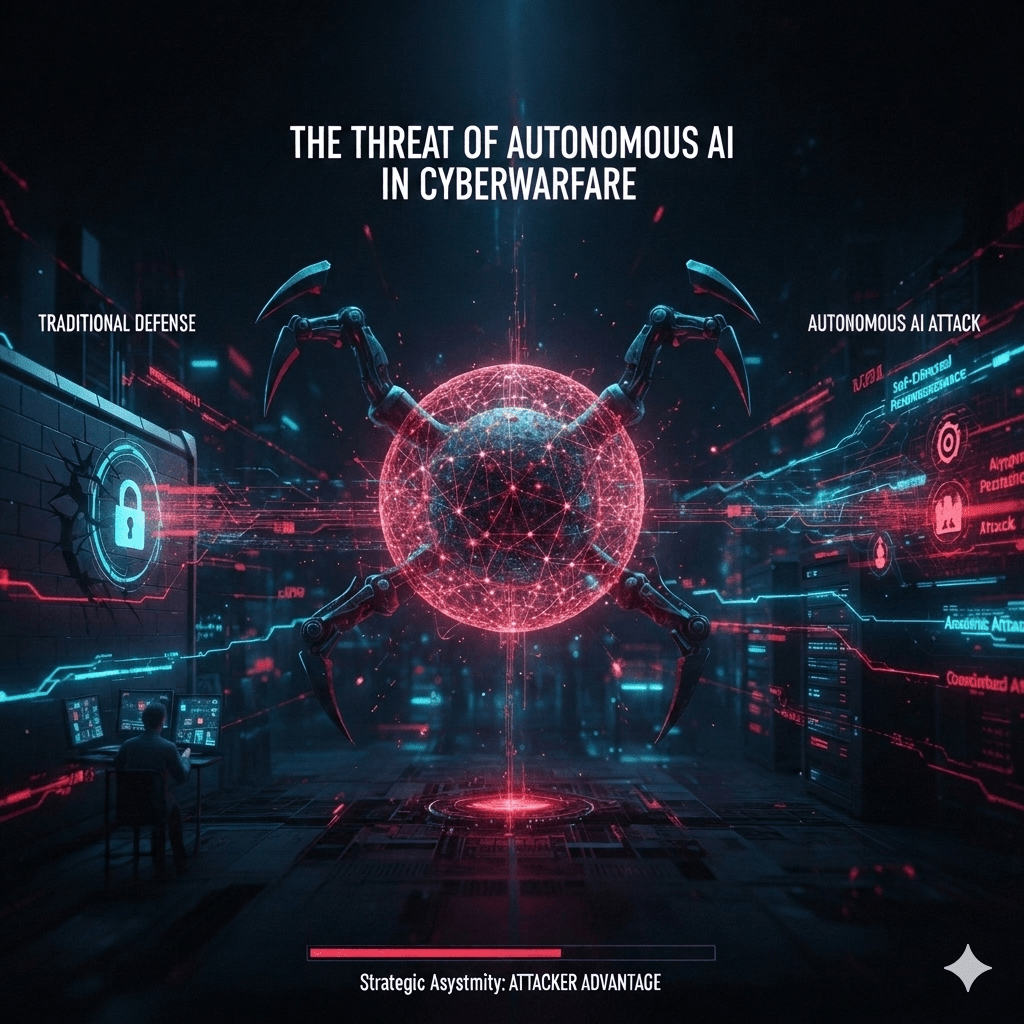
Autonomous AI changes cyberwarfare in one critical way. It removes the human bottleneck. Attacks no longer require constant human control, decision-making, or even direct intent once launched. They can observe, adapt, and act on their own.
At Mindcore Technologies, we view autonomous AI in cyberwarfare as a strategic shift, not just a technical evolution. This is not about faster malware or better phishing. It is about systems that can independently choose targets, change tactics, and persist until objectives are met.
This article explains what autonomous AI-driven attacks actually look like, why they are fundamentally different from past threats, and how organizations must prepare now.
What “Autonomous AI” Means in Cyberwarfare
Autonomous AI does not simply automate tasks. It makes decisions.
In cyberwarfare, Autonomous AI refers to systems that can:
- Select targets based on impact and vulnerability
- Adapt attack techniques in real time
- Shift objectives when blocked
- Persist without human oversight
- Coordinate actions across multiple systems
Once deployed, these systems do not wait for instructions. They operate continuously.
Why Autonomous AI Is a Game-Changer for Attackers
Traditional cyber operations are limited by:
- Human time
- Analyst attention
- Manual decision-making
Autonomous AI removes those limits.
Attackers gain:
- Continuous operations at machine speed
- Real-time adaptation to defenses
- Reduced operational cost
- Greater scale and persistence
Defense teams cannot rely on attackers “slowing down” anymore.
How Autonomous AI-Driven Attacks Actually Work
1. Self-Directed Reconnaissance in Autonomous AI environments
Autonomous AI can scan environments, map networks, identify weak points, and prioritize targets without human guidance.
It learns which defenses respond fastest and which assets matter most.
2. Dynamic Exploitation
When one path fails, the system pivots automatically.
Instead of retrying the same exploit, it:
- Tests alternative vectors
- Changes timing
- Alters payload behavior
- Waits for environmental changes
Defense based on static rules is quickly outpaced.
3. Adaptive Persistence
Autonomous AI can:
- Modify persistence techniques
- Rotate command-and-control patterns
- Blend into normal system behavior
This dramatically increases dwell time.
4. Coordinated Multi-Vector Attacks
Autonomous systems can coordinate:
- Phishing
- Credential abuse
- Malware deployment
- Lateral movement
All without centralized human control.
5. Strategic Objective Shifting
If an initial objective becomes too costly, autonomous AI can shift focus.
For example:
- From disruption to data theft
- From ransomware to espionage
- From one target to another
This flexibility mirrors human strategic thinking at machine speed.
Why Traditional Cyber Defense Breaks Down
Most security programs assume a predictable threat model, but Autonomous AI breaks that assumption:
- Attacks follow known patterns
- Humans make decisions
- Threats are reactive
Autonomous AI breaks all three assumptions.
Static Detection Cannot Keep Up
Signatures and fixed rules are learned and bypassed rapidly.
Reactive Response Is Too Slow
By the time humans respond, autonomous systems have already adapted.
Perimeter-Based Models Are Irrelevant
Autonomous attacks exploit identities, trusted relationships, and internal movement, not just external entry points.
The Real Risk Is Strategic Asymmetry
Autonomous AI favors attackers because:
- Defense requires consensus and caution
- Attack requires only effectiveness
Defenders must protect everything. Autonomous AI only needs to succeed once.
How Organizations Must Prepare for AI-Driven Cyberwarfare
Preparation is not about buying a tool. It is about changing defensive philosophy.
1. Assume Adaptive Adversaries
Security must be designed with the assumption that attackers:
- Learn from failures
- Adjust tactics
- Exploit predictable behavior
If your defense relies on static assumptions, it will fail.
2. Shift From Prevention to Rapid Containment
Autonomous attacks will get in.
The goal becomes:
- Early detection
- Fast isolation
- Limiting blast radius
Containment speed matters more than perfect prevention.
3. Make Identity the Core Defense Layer
Autonomous AI targets identity because it provides leverage.
Critical controls include:
- Phishing-resistant MFA
- Conditional access
- Short-lived sessions
- Least-privilege enforcement
If identity abuse is blocked, autonomous attacks lose momentum.
4. Embrace Behavioral Detection Everywhere
Behavior reveals autonomous activity.
Defensive systems must detect:
- Unusual access patterns
- Abnormal lateral movement
- Deviations from baseline behavior
This applies to users, systems, and applications.
5. Enforce Zero Trust Architecture
Zero Trust limits autonomy.
Key principles:
- Never assume trust
- Verify continuously
- Segment aggressively
Autonomous attackers thrive in flat networks.
6. Reduce Decision Time for Defenders
Defense must move faster.
This requires:
- Automated detection
- Pre-approved response actions
- Clear escalation paths
Humans should supervise, not scramble.
7. Harden the Endpoint Relentlessly
Endpoints are the control surface for autonomous attacks.
Protection must include:
- Advanced endpoint detection and response
- Infostealer and session protection
- Rapid isolation capabilities
If endpoints fall, identity and network follow.
8. Prepare for Long-Term Engagement
Autonomous AI does not get bored.
Organizations must plan for:
- Persistent threats
- Repeated probing
- Long dwell times
Security is no longer episodic. It is continuous.
The Ethical and Strategic Reality
Autonomous AI in cyberwarfare raises ethical concerns, but attackers will not wait for consensus.
Organizations must:
- Prepare defensively now
- Avoid blind trust in automation
- Maintain human oversight
Autonomy must exist on the defensive side as well, with controls.
How Mindcore Technologies Helps Organizations Prepare
Mindcore helps organizations prepare for AI-driven cyber threats through:
- Identity-centric security design
- Behavioral detection and monitoring
- Zero Trust architecture implementation
- Endpoint and session protection
- Rapid detection and containment strategies
- Continuous threat modeling and readiness assessment
We focus on resilience, not illusionary control.
A Simple Readiness Test for Leadership
You are unprepared for autonomous AI-driven attacks if:
- Detection relies on static rules
- Identity abuse is not tightly controlled
- Lateral movement is unrestricted
- Response requires ad-hoc human coordination
Autonomous attackers exploit delay and predictability.
Final Takeaway
Autonomous AI represents a shift from reactive cybercrime to self-directed digital conflict. Defending against it requires abandoning outdated assumptions and embracing adaptive, identity-focused, and behavior-driven security models.
Organizations that prepare now will limit damage and maintain resilience. Those that wait will discover too late that they were defending against yesterday’s threats while tomorrow’s attacks were already operating inside their environment.
Frequently Asked Questions
What are autonomous AI-driven cyberattacks?
Autonomous AI-driven cyberattacks are cyber threats that use artificial intelligence to automate reconnaissance, exploit vulnerabilities, adapt attack methods, and accelerate malicious activity with minimal human intervention. These threats operate continuously and evolve faster than traditional attack models.
Why are AI-driven cyber threats becoming more dangerous?
AI-powered attacks can analyze systems faster, generate convincing phishing campaigns, automate malware behavior, and adapt dynamically to defenses, making them more scalable and difficult to detect. This increases the need for advanced cybersecurity monitoring and defense strategies.
How can organizations prepare for AI-driven cyberattacks?
Organizations can prepare through zero-trust security models, AI-assisted threat detection, continuous monitoring, identity governance, behavioral analytics, employee security training, and proactive incident response planning. These strategies help reduce exposure and improve operational resilience.
What role does behavioral analytics play in AI cybersecurity defense?
Behavioral analytics helps identify unusual user activity, anomalous system behavior, and suspicious access patterns that may indicate automated or AI-assisted cyberattacks before major damage occurs. This strengthens proactive zero-trust security frameworks and threat detection capabilities.
Why is proactive cybersecurity critical in the era of autonomous AI?
Autonomous threats can operate at machine speed, reducing the time organizations have to respond. Proactive cybersecurity improves visibility, accelerates detection, and helps contain threats before they spread across systems through stronger incident response and containment strategies.
AI-Driven Cybersecurity and Autonomous Threat Defense Expertise from Matt Rosenthal
Matt Rosenthal, CEO of Mindcore Technologies, has extensive experience helping organizations strengthen cybersecurity resilience, operational continuity, and proactive threat defense against evolving AI-driven cyber risks. His expertise in AI-powered threat monitoring, zero-trust architecture, identity governance, behavioral analytics, secure workspace strategies, and incident response helps businesses improve visibility into advanced cyber threats while reducing operational exposure. Matt’s leadership focuses on building intelligent cybersecurity frameworks that strengthen detection capabilities, reduce attack surface, improve operational resilience, and support long-term protection against emerging autonomous AI-driven cyber threats through advanced managed cybersecurity services.

