

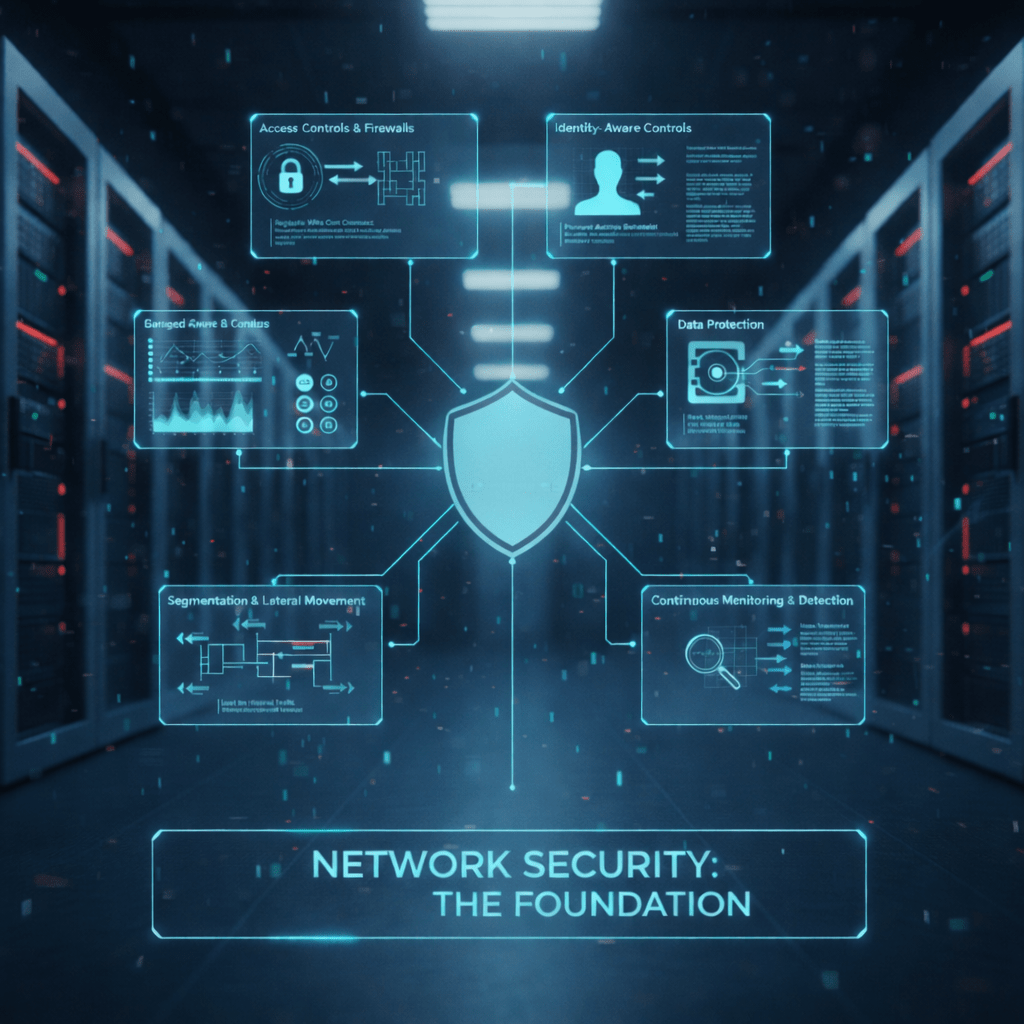
What Is Network Security? Network security is the practice of controlling how data, users, devices, and systems interact inside and outside your environment, ensuring that business operations remain secure and resilient.When organizations suffer breaches, ransomware, or outages, the root cause is almost always a breakdown in network security design, not a single missed alert.
At Mindcore Technologies, we define network security as the foundation that everything else depends on. Identity, cloud security, endpoint protection, and even AI-driven defenses fail when the underlying network is poorly secured.
This article explains what network security actually is, why it matters more than ever, and what businesses get wrong when they treat it as a background IT function.
What Network Security Actually Is
To understand What Is Network Security, it is the practice of protecting the integrity, availability, and confidentiality of data as it moves across networks and connected systems.
It includes controls that:
- Regulate who can connect
- Restrict what systems can communicate
- Monitor traffic for abuse or anomalies
- Prevent unauthorized access and movement
Network security is not one tool. It is a layered system of controls that work together to reduce risk.
What Network Security Protects
A properly secured network protects:
- Business-critical applications
- Sensitive data
- Internal systems and servers
- Cloud services
- Remote workers and devices
Without network security, every connected system becomes a potential entry point.
Why Network Security Is More Important Than Ever
Knowing What Is Network Security is more critical than ever because modern networks include cloud platforms, hybrid workforces, mobile devices, and third-party integrations that create complex attack surfaces.
Today’s business environments include:
- Cloud platforms and SaaS tools
- Remote and hybrid workers
- Mobile devices and personal endpoints
- Third-party integrations
- Internet-facing services
Attackers exploit complexity. Network security is what keeps that complexity from becoming chaos.
How Network Security Protects Businesses in Practice
1. Prevents Unauthorized Access
Implementing What Is Network Security properly ensures that controls limit who can connect and from where, reducing unauthorized access and potential breaches.
This includes:
- Firewalls and access rules
- Secure remote access
- Network authentication
Unauthorized users should never reach internal systems.
2. Limits Lateral Movement
Most damage happens after initial access.
Strong network security:
- Segments systems by function and sensitivity
- Restricts internal traffic paths
- Prevents attackers from moving freely
Containment is critical once something goes wrong.
3. Protects Sensitive Data
Data is constantly moving across networks.
Network security helps:
- Prevent unauthorized data access
- Detect suspicious data transfers
- Block exfiltration attempts
If data can leave freely, extortion and theft become inevitable.
4. Supports Business Continuity
Security incidents cause downtime.
Network security:
- Reduces the scope of incidents
- Prevents network-wide outages
- Helps maintain service availability
Stable networks protect productivity and revenue.
5. Enables Monitoring and Detection
You cannot respond to what you cannot see.
Network security provides:
- Traffic visibility
- Alerting on suspicious behavior
- Integration with detection and response tools
Visibility turns networks into active defense layers.
What Network Security Is Not
Network security is not:
- Just a firewall
- Just antivirus software
- Just blocking the internet
- Just an IT responsibility
It is a business risk management function.
Why Traditional Network Security Fails
Many organizations rely on outdated assumptions:
- Internal traffic is trusted
- Firewalls only belong at the perimeter
- Once logged in, users are safe
- Networks do not need constant monitoring
Modern attacks exploit these assumptions.
Attackers use:
- Stolen credentials
- Encrypted traffic
- Trusted applications
- Legitimate access paths
If the network trusts too much, attackers blend in.
What Modern Network Security Must Include
1. Segmentation
Flat networks are dangerous.
Effective network security:
- Separates critical systems
- Restricts east-west traffic
- Limits blast radius automatically
Segmentation is one of the most powerful controls available.
2. Identity-Aware Controls
Access should depend on who, not just where.
Modern networks enforce:
- User and device identity validation
- Conditional access rules
- Least-privilege connectivity
Identity is now the primary control plane.
3. Encrypted Traffic Inspection
Most malicious activity is encrypted.
Network security must:
- Inspect encrypted sessions safely
- Enforce policy within HTTPS
- Avoid blind spots created by encryption
Ignoring encrypted traffic creates risk.
4. Continuous Monitoring
Networks are dynamic.
Security requires:
- Ongoing traffic analysis
- Behavioral monitoring
- Alerting on abnormal patterns
Security is continuous, not periodic.
5. Integration With Other Security Layers
Network security works best when integrated with:
- Identity and access management
- Endpoint detection and response
- Cloud security controls
- Incident response workflows
Silos create gaps attackers exploit.
Common Network Security Mistakes We See
- Flat internal networks
- Overly permissive access rules
- No monitoring of internal traffic
- Outdated hardware and configurations
- No regular review of network policies
These issues often exist quietly for years.
How Network Security Impacts Compliance and Trust
Many regulations require:
- Controlled access
- Monitoring and logging
- Data protection
- Incident response readiness
Weak network security leads to:
- Compliance failures
- Audit findings
- Customer trust erosion
Security architecture matters to regulators and customers alike.
How Mindcore Technologies Approaches Network Security
Mindcore Technologies helps organizations design and manage network security that supports modern business operations by focusing on:
- Identity-centric network architecture
- Zero Trust segmentation
- Secure remote access design
- Encrypted traffic inspection
- Continuous monitoring and alerting
- Incident response integration
We treat network security as foundational infrastructure, not an afterthought.
A Simple Reality Check for Business Leaders
Your network security is weak if:
- Internal traffic is largely unrestricted
- Access is trusted after login
- Segmentation is minimal or nonexistent
- Monitoring is limited or ignored
- Incidents would spread quickly
Attackers exploit whatever the network allows.
Final Takeaway
What Is Network Security? It is the backbone of modern cybersecurity, controlling access, limiting damage, protecting data, and enabling visibility across increasingly complex business environments. Without strong network security, every other security investment is undermined.
Organizations that invest in modern, identity-aware, segmented network security dramatically reduce risk and improve resilience. Those that rely on outdated designs will continue to experience breaches that feel sudden but were quietly enabled for years.
Frequently Asked Questions
What is network security?
Network security is the practice of protecting computer networks, connected devices, applications, and data from unauthorized access, cyberattacks, misuse, and operational disruption.
Why is network security important for businesses?
Network security is important because businesses rely on digital systems, cloud services, remote access, and connected infrastructure that can be targeted by cyber threats such as ransomware, phishing, and unauthorized intrusion. Organizations using modern cybersecurity strategies improve operational resilience and reduce exposure to evolving attacks.
What are the core components of network security?
Core network security components include firewalls, identity-based access controls, encryption, endpoint protection, intrusion detection systems, network segmentation, and continuous monitoring. These layered controls help reduce unauthorized access and improve visibility across network environments.
How does network security help reduce cyber risk?
Network security helps reduce cyber risk by limiting unauthorized access, detecting suspicious activity, protecting sensitive data, restricting lateral movement, and improving incident response visibility. Organizations implementing Zero Trust security frameworks strengthen containment and reduce implicit trust across systems.
Why is continuous monitoring important in network security?
Continuous monitoring helps organizations identify vulnerabilities, detect anomalies, improve operational visibility, and respond to cyber threats before they escalate into major operational disruptions. Businesses using managed IT monitoring services can strengthen detection and response capabilities across complex environments.
Network Security and Cybersecurity Strategy Expertise from Matt Rosenthal
Matt Rosenthal, CEO of Mindcore Technologies, has extensive experience helping organizations strengthen network security, cybersecurity resilience, and operational continuity across modern digital environments. His expertise in zero-trust architecture, network segmentation, identity governance, secure remote access, threat monitoring, infrastructure scalability, and operational risk management helps businesses reduce exposure to evolving cyber threats while improving operational visibility and infrastructure reliability. Matt’s leadership focuses on building proactive cybersecurity frameworks that strengthen network resilience, reduce enterprise risk, improve operational continuity, and support scalable long-term business growth.

