

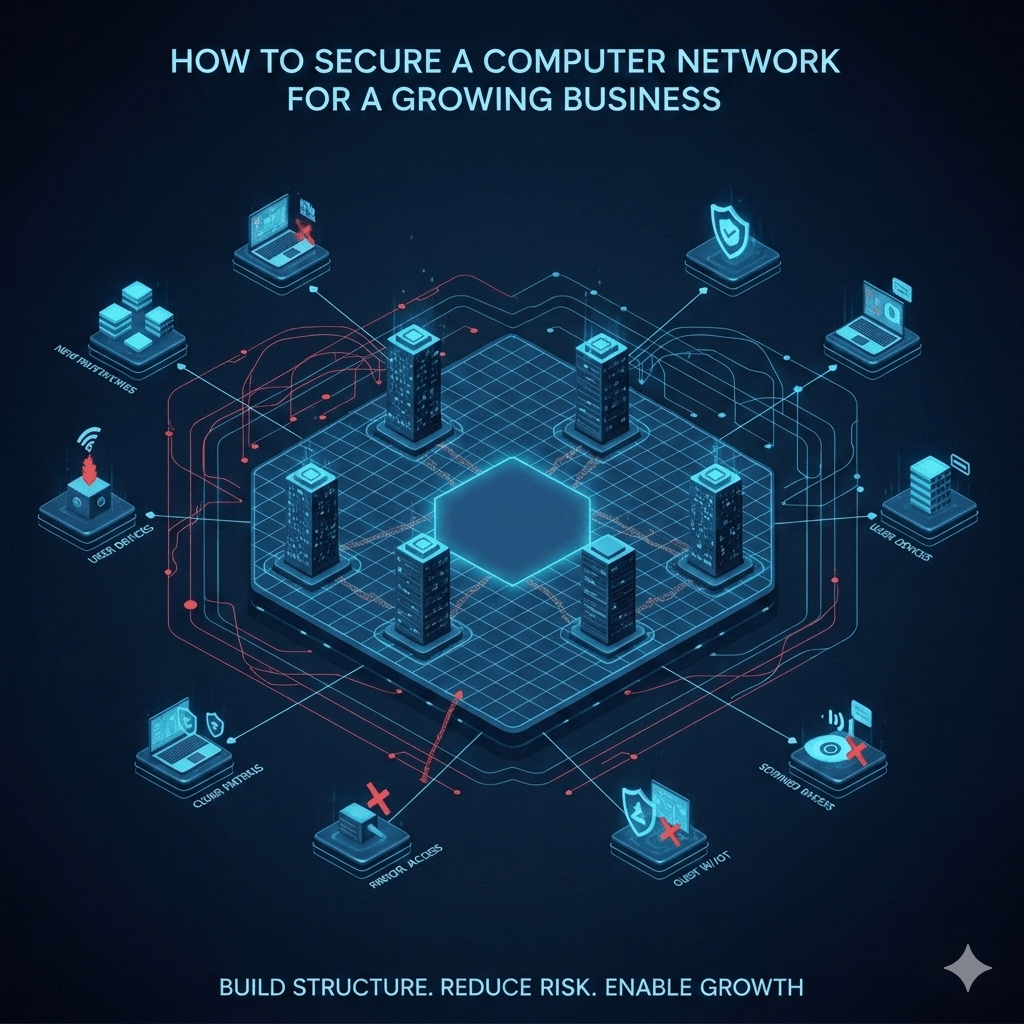
Growth breaks insecure networks when organizations are learning how to secure a computer network effectively. The moment a business adds new employees, cloud platforms, remote access, or third-party tools, weaknesses that were once tolerable become dangerous. Most breaches in growing businesses happen during expansion, not during stability.
At Mindcore Technologies, we see the same pattern repeatedly: a network designed for ten users quietly collapses under the risk of fifty. The issue is not lack of tools. It is lack of architecture.
This guide explains how growing businesses should secure their computer networks in a way that supports scale, reduces risk, and avoids painful rework later.
Why Growing Businesses Are Targeted
Attackers actively target growing companies because:
- Security often lags behind hiring
- Networks expand faster than policies
- Access is rarely reviewed
- Internal trust grows unchecked
Growth increases complexity. Complexity increases attack surface.
Start With Network Structure, Not Tools
Before adding new security products, understanding how to secure a computer network starts with fixing the foundation.
A secure network must be:
- Structured
- Segmented
- Identity-aware
- Observable
Without structure, additional tools create noise, not protection.
1. Segment the Network Early
Flat networks are the biggest mistake growing businesses make.
Segmentation ensures:
- Employees cannot access systems they do not need
- Servers are isolated from user devices
- One compromised system does not expose everything
At minimum, separate:
- User devices
- Servers and infrastructure
- Critical business systems
- Guest and IoT devices
Segmentation limits blast radius and simplifies growth.
2. Tie Network Access to Identity
Shared access does not scale safely.
Growing businesses must, when defining how to secure a computer network, eliminate shared credentials and enforce identity-based access:
- Eliminate shared credentials
- Tie access to individual user identity
- Enforce least privilege
Network access should depend on:
- Who the user is
- What device they are using
- Where and how they are connecting
Identity-based access prevents former employees and compromised credentials from becoming permanent risks.
3. Secure Remote and Hybrid Access Properly
Growth almost always introduces remote work.
Secure remote access requires:
- Encrypted connections
- Phishing-resistant authentication
- Device posture checks
- Restricted access paths
VPNs alone are not enough if everything behind them is trusted.
4. Harden Wi-Fi as Part of the Network Perimeter
Wi-Fi is not a convenience feature. It is an entry point.
For growing businesses:
- Use WPA3 or WPA3-Enterprise
- Separate guest and internal Wi-Fi
- Rotate credentials or use identity-based authentication
- Monitor connected devices
Many ransomware attacks begin with weak wireless access.
5. Control Outbound Traffic
Data theft and ransomware extortion depend on outbound access.
Secure networks:
- Restrict unnecessary outbound connections
- Monitor abnormal data movement
- Block known malicious destinations
Outbound control reduces attacker leverage even after compromise.
6. Inspect and Monitor Network Traffic
When learning how to secure a computer network, you cannot secure what you cannot see.
Growing businesses need:
- Centralized logging
- Traffic visibility across segments
- Alerts for abnormal behavior
Monitoring allows early detection before damage spreads.
7. Keep Firewall Rules Clean and Intentional
As businesses grow, firewall rules sprawl.
Best practices include:
- Regular rule reviews
- Removing temporary or unused rules
- Aligning rules with business function
- Enforcing segmentation through firewalls
Messy rules create hidden access paths attackers exploit.
8. Design for Change, Not Perfection
Growth guarantees change.
Secure networks should:
- Be easy to extend
- Support new users without redesign
- Enforce policy automatically
- Avoid hard-coded trust
Security that cannot adapt will be bypassed or disabled.
Common Network Security Mistakes Growing Businesses Make
We frequently see:
- Trusting internal traffic by default
- Expanding VPN access without segmentation
- Reusing Wi-Fi passwords indefinitely
- Adding cloud tools without network visibility
- Delaying security until “later”
These issues compound quickly as headcount increases.
How Network Security Supports Business Growth
Well-designed network security:
- Reduces downtime
- Prevents business-disrupting incidents
- Simplifies onboarding and offboarding
- Improves performance and reliability
- Supports compliance and audits
Security enables growth instead of slowing it down.
How Mindcore Technologies Helps Growing Businesses Secure Networks
Mindcore Technologies works with growing businesses to build scalable, secure network foundations through:
- Network architecture assessments
- Segmentation and Zero Trust design
- Identity-based access enforcement
- Secure Wi-Fi and remote access deployment
- Firewall optimization and monitoring
- Ongoing governance and scaling support
We design networks that grow safely, not networks that need to be rebuilt later.
A Simple Growth Readiness Check
Your network is not ready for growth if:
- Internal systems trust everything
- Access is shared or static
- Segmentation is minimal
- Monitoring is limited
- One compromise would spread quickly
These risks increase with every new hire.
Final Takeaway
Understanding how to secure a computer network for a growing business is about building structure before complexity overwhelms control. Growth exposes weak assumptions, especially around trust, access, and visibility.
Businesses that secure their networks early gain resilience, flexibility, and confidence as they scale. Those that delay security often face costly incidents that stall growth at the worst possible time.
Frequently Asked Questions
How can a growing business secure its computer network?
Implement firewalls, endpoint protection, VPNs, access controls, patch management, encrypted communications, and employee cybersecurity training. These measures help protect data and systems as the organization scales Cybersecurity Services.
Why is network segmentation important for growing businesses?
Segmentation isolates sensitive systems, limits lateral movement, and reduces the impact of potential breaches. This containment helps protect critical data and operations Zero-Trust Design.
How does patch management contribute to network security?
Patch management ensures software, operating systems, and firmware are up to date. Keeping systems patched reduces vulnerabilities that attackers can exploit Managed IT Services.
What role does employee training play in network security?
Training helps staff recognize phishing attempts, social engineering, unsafe downloads, and policy violations. Well-informed employees reduce accidental exposure or credential compromise Phishing Awareness.
What measures should businesses take as they scale to maintain security?
Implement identity management, multi-factor authentication, continuous monitoring, cloud security practices, vendor oversight, and regular audits. These steps ensure security keeps pace with organizational growth Cloud & Infrastructure Management.
Matt Rosenthal’s Expertise in Securing Networks for Growing Businesses
Matt Rosenthal, CEO of Mindcore Technologies, brings decades of cybersecurity, IT infrastructure, cloud, and operational leadership experience. He helps organizations implement firewalls, access controls, endpoint protection, patching, employee training, monitoring, and vendor oversight. Under his leadership, businesses scale securely, reduce risk, and maintain operational continuity as IT infrastructure grows Cybersecurity Services.

