

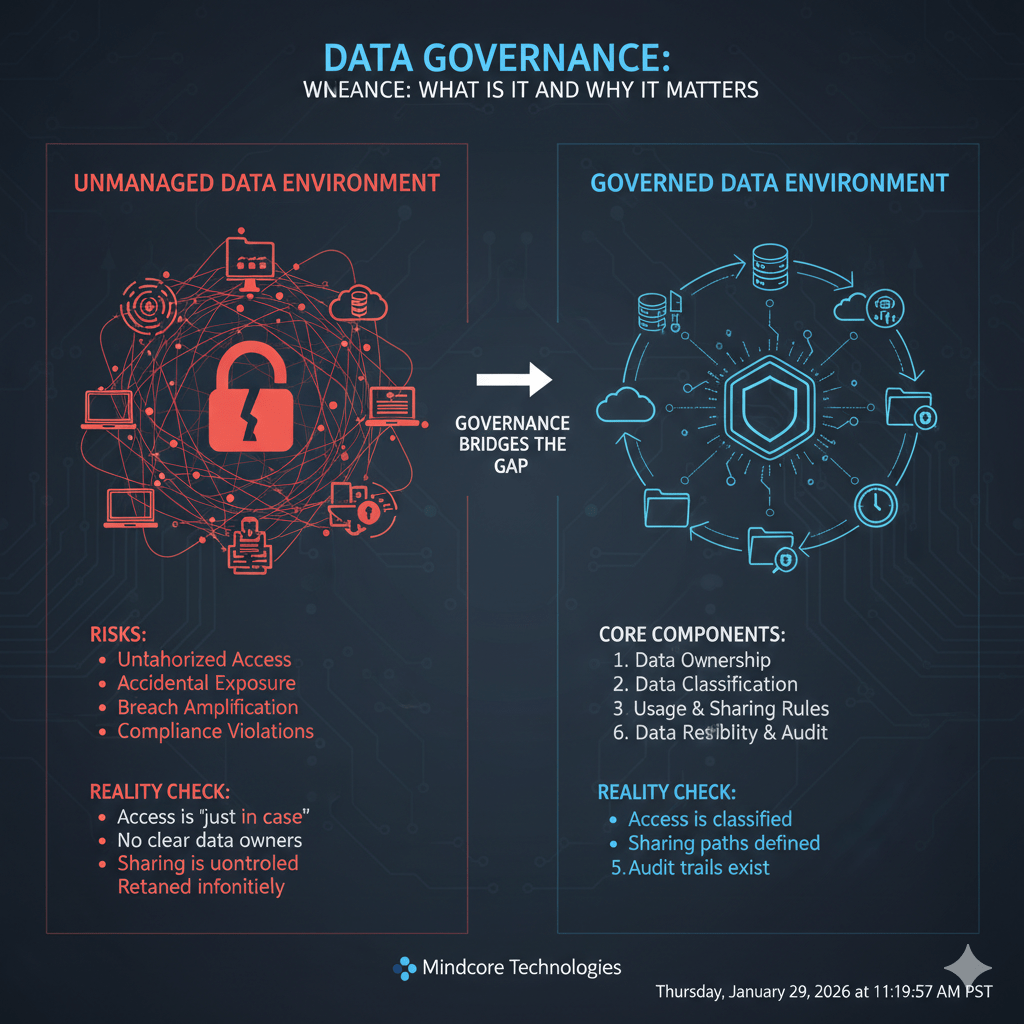
Data governance is not a compliance exercise and it is not a policy binder. It is the operating discipline that determines who can access data, how it is used, where it lives, and how long it exists. When governance is weak, data spreads faster than control, and security tools are forced to defend chaos.
At Mindcore Technologies, most breaches and regulatory failures we see are not caused by sophisticated attackers. They are caused by organizations that lost control of their own data long before an attacker showed up.
This is what data governance actually is, and why it matters far earlier than most businesses realize.
The Hard Truth About Data Governance
Whether you design data governance or not, it already exists.
If:
- Data is shared informally
- Access is granted “just in case”
- Files live across multiple platforms
- No one owns specific datasets
If your team cannot clearly answer core questions, it highlights why knowing what is data governance is crucial to prevent unmanaged access and exposure.
What Data Governance Really Means (Plain Language)
Data governance is the framework that defines:
- Who owns specific data
- Who is allowed to access it
- How it can be used and shared
- Where it is permitted to live
- How long it is retained
- How access and usage are monitored
If your organization cannot answer those questions consistently, governance is missing.
Why Data Governance Matters More Than Ever
Modern environments changed the rules.
Businesses now operate with:
- Cloud platforms and SaaS tools
- Remote and hybrid users
- Third-party integrations
- Massive data duplication
- Rapid role changes
Data moves faster than approvals. Governance is what restores control.
The Real Risks of Poor Data Governance
Weak data governance leads directly to:
- Unauthorized internal access
- Accidental data exposure
- Breach amplification
- Compliance violations
- Inability to prove what was accessed
Most “security incidents” are actually governance failures, not tool failures.
The Core Components of Effective Data Governance
1. Data Ownership
The failure:
No one is accountable for the data.
What governance requires:
- Clear owners for critical datasets
- Owners approve access and retention
- Ownership follows business responsibility, not IT convenience
Recognizing what is data governance clarifies why assigning data ownership, access rules, and retention responsibilities is essential to prevent arbitrary decision-making.
2. Data Classification
The failure:
All data is treated the same.
What governance requires:
- Identify sensitive and regulated data
- Classify data by business impact
- Apply stricter controls to higher-risk data
You cannot protect what you have not defined.
3. Access Governance
The failure:
Access accumulates and is never removed.
What governance requires:
- Role-based access tied to job function
- Least privilege by default
- Regular access reviews
- Immediate access removal on role change or exit
Access is the primary breach vector.
4. Data Usage and Sharing Rules
The failure:
Data is shared through links, exports, and personal accounts.
What governance requires:
- Approved sharing methods
- Clear internal and external sharing rules
- Monitoring of data movement
Uncontrolled sharing bypasses security entirely.
5. Data Retention and Disposal
The failure:
Data is kept forever “just in case.”
What governance requires:
- Defined retention periods
- Automated or enforced deletion
- Secure disposal of expired data
You cannot breach data that no longer exists.
6. Visibility and Auditability
The failure:
Organizations cannot answer who accessed what and when.
What governance requires:
- Centralized logging
- Audit trails for access and sharing
- Regular review of access behavior
If you cannot audit it, you cannot govern it.
Data Governance vs Data Security (Why Both Matter)
- Data security protects systems and access paths
- Data governance controls data behavior after access is granted
Security tools enforce controls. Governance defines what those controls should enforce. Understanding what is data governance alongside security explains why protection of systems alone cannot prevent misuse—governance dictates how data is properly managed after access.
Most breaches occur inside secure systems, through legitimate access that was never governed properly.
What Data Governance Looks Like in Practice
Organizations with strong governance have:
- Clear data ownership
- Limited and reviewed access
- Defined sharing boundaries
- Reduced data sprawl
- Faster breach response
- Easier compliance audits
Organizations without it rely on trust and luck.
Why Growing Businesses Feel Governance Pain First
As companies scale:
- Employees change roles frequently
- Vendors gain access
- Data volume explodes
- Regulatory pressure increases
Security tools scale quickly. Governance discipline often does not. That gap creates exposure.
How Data Governance Prevents Breaches Before They Start
Strong governance:
- Limits how much data any one account can reach
- Reduces internal attack surface
- Shrinks breach blast radius
- Improves detection and response accuracy
Governance does not stop attackers. It stops unnecessary exposure.
How Mindcore Technologies Helps Organizations Implement Data Governance
Mindcore helps growing businesses implement practical data governance by:
- Defining data ownership and classification
- Designing identity-based access models
- Enforcing least privilege with automation
- Securing cloud and SaaS data flows
- Implementing access visibility and auditability
- Aligning governance with compliance requirements
We focus on operational governance, not paperwork.
A Simple Governance Reality Check
You lack effective data governance if:
- No one owns your critical data
- Access is granted “temporarily” and never reviewed
- Sharing links are uncontrolled
- Data is retained indefinitely
- You cannot explain why someone has access
These conditions are common and correctable.
Final Takeaway
Learning what is data governance empowers organizations to maintain control over data ownership, access, usage, and accountability, reducing risk and simplifying compliance as they scale. It defines ownership, access, usage, and accountability. Without it, even the best security tools fail to prevent exposure because they are enforcing unclear rules.
Organizations that invest in practical data governance reduce breach risk, simplify compliance, and gain operational clarity. Those that ignore it usually discover its importance only after data is already exposed.
Frequently Asked Questions
What is data governance?
Data governance is the framework that defines how data is owned, accessed, used, shared, retained, and monitored across an organization to maintain control, accountability, and compliance.
Why is data governance important for businesses?
Data governance helps organizations reduce data exposure, improve accountability, strengthen compliance readiness, control access permissions, and maintain visibility into how sensitive information is handled.
What are the core components of data governance?
Core components include data ownership, data classification, access governance, sharing policies, retention and disposal rules, centralized logging, and auditability.
How does poor data governance increase cybersecurity risk?
Weak governance can lead to excessive access permissions, uncontrolled sharing, data sprawl, poor visibility, and compliance violations, increasing the likelihood of accidental exposure or internal misuse.
How does data governance differ from data security?
Data security protects systems and access paths using technical controls, while data governance defines the rules and accountability surrounding who should access data and how it should be used after access is granted.
Data Governance and Operational Security Expertise from Matt Rosenthal
Matt Rosenthal, CEO of Mindcore Technologies, has extensive experience helping organizations strengthen data governance, cybersecurity resilience, and operational accountability across modern cloud and hybrid environments. His expertise in identity governance, least-privilege access controls, compliance readiness, cloud security, audit visibility, and zero-trust architecture helps businesses reduce unnecessary exposure while improving operational clarity and long-term resilience. His leadership focuses on building integrated governance and security frameworks that improve data control, strengthen compliance alignment, reduce enterprise risk, and support scalable business growth.

