

What Are VoIP Phones? VoIP phones are not just upgraded desk phones; they are network-connected endpoints that process voice as digital data. That means they inherit the same risks as any other device on your network.
Understanding What Are VoIP Phones is crucial because when businesses treat them like traditional analog phones, security gaps emerge that can lead to toll fraud or network compromise. And those gaps can lead to toll fraud, call interception, or even broader network exposure.
At Mindcore Technologies, we approach VoIP phones as IT infrastructure, not telecom accessories. They require the same discipline applied to servers and workstations.
What Are VoIP Phones?
What Are VoIP Phones? These devices use Voice over Internet Protocol to transmit calls over an IP network instead of traditional copper lines.
They typically fall into two categories:
- Hardware IP phones
Physical desk phones connected via Ethernet to your network. - Softphones
Software-based phones installed on laptops, desktops, or mobile devices.
Both convert voice into digital packets and transmit them through your router and internet connection.
Unlike analog systems, VoIP phones depend entirely on your network configuration.
How VoIP Phones Work
VoIP phones operate through a structured technical process:
- Voice capture and digitization
The microphone converts sound into digital data. - Compression using codecs
Reduces bandwidth usage while maintaining clarity. - Packet transmission
Data travels across your internal network and out to your VoIP provider. - Reassembly at the receiving endpoint
The audio is reconstructed in near real time.
Performance and security depend on network stability and proper configuration.
Why VoIP Phones Introduce Security Risk
VoIP phones are internet-connected endpoints. That creates exposure.
Common risks include:
- SIP credential compromise
Weak passwords allow attackers to register unauthorized devices. - Toll fraud
Attackers generate international calls through compromised systems. - Eavesdropping
Unencrypted voice traffic can be intercepted. - Denial-of-service attacks
Overwhelming VoIP infrastructure to disrupt operations. - Network pivoting
Poorly segmented VoIP devices can become entry points into internal systems.
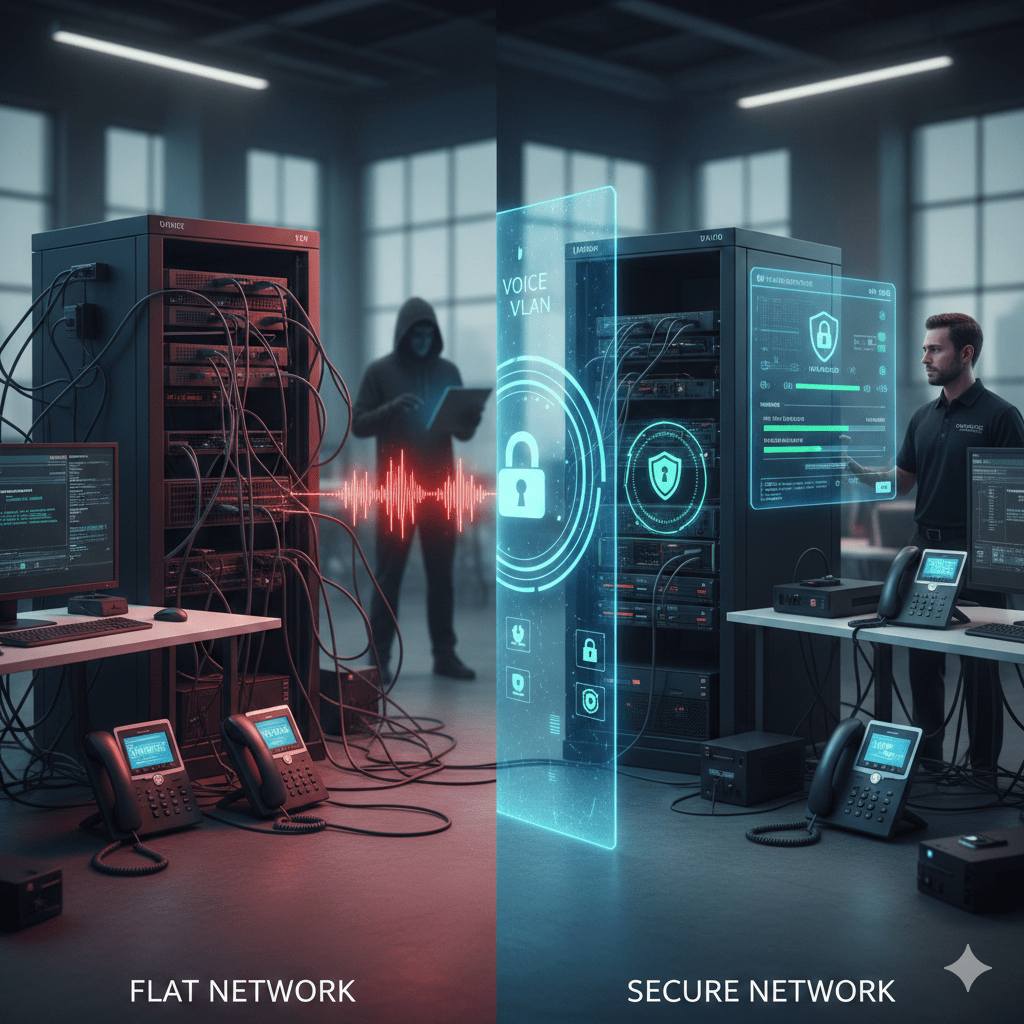
These risks increase when VoIP phones are deployed on flat networks.
How Businesses Should Secure VoIP Phones
Businesses that understand What Are VoIP Phones know that securing them requires layered controls across the device, network, and management platform.
1. Segment Voice Traffic from Data Traffic
VoIP phones should never sit on the same flat network as general devices.
Businesses must:
- Create a dedicated voice VLAN
Separating voice traffic from user data. - Restrict inter-VLAN communication strictly
Limiting what voice devices can reach. - Block unnecessary outbound traffic from phones
Phones should communicate only with approved VoIP servers. - Monitor voice VLAN traffic patterns
Detecting abnormal behavior early.
Segmentation limits blast radius if a device is compromised.
2. Harden VoIP Phone Authentication
Default configurations are dangerous.
Security should include:
- Changing default device passwords immediately
Factory credentials are widely known. - Using strong SIP authentication credentials
Preventing brute-force attacks. - Restricting device registration to known IP ranges
Blocking unauthorized external registration attempts. - Disabling unused services and web interfaces
Reducing attack surface.
Unsecured device credentials are a common breach path.
3. Encrypt Voice Traffic
Voice conversations may contain sensitive information.
Businesses should:
- Enable TLS for signaling traffic
Protecting call setup information. - Enable SRTP (Secure Real-Time Transport Protocol)
Encrypting the actual voice stream. - Avoid legacy or insecure codecs
Older protocols may lack proper security support. - Ensure firewall rules allow secure encrypted channels only
Blocking unsecured fallback options.
Encryption prevents interception and manipulation.
4. Secure the VoIP Management Platform
VoIP phones are only as secure as the system managing them.
Businesses must:
- Enforce multi-factor authentication for admin access
Protecting management portals. - Restrict international dialing permissions
Minimizing toll fraud risk. - Monitor administrative login attempts
Identifying brute-force activity. - Apply firmware updates consistently
Patching known vulnerabilities.
Management console compromise often leads to large financial losses.
5. Configure Quality of Service (QoS) Correctly
While QoS improves performance, it also prevents instability.
Proper configuration should:
- Prioritize voice packets over non-critical traffic
Maintaining call clarity. - Prevent bandwidth saturation from degrading calls
Protecting communication reliability. - Monitor jitter, latency, and packet loss metrics
Identifying performance bottlenecks.
Performance issues often mask underlying configuration problems.
6. Implement Redundancy for Business Continuity
VoIP depends on connectivity.
Businesses should:
- Deploy secondary internet connections
Automatic failover prevents phone outages. - Implement cloud-based call rerouting
Redirecting calls to mobile devices during disruption. - Use UPS battery backup for networking equipment
Preventing short power interruptions from disabling phones. - Test failover procedures regularly
Ensuring resilience works under pressure.
Phone downtime directly impacts revenue and reputation.
Common VoIP Security Mistakes
Businesses often create risk by:
- Leaving SIP ports exposed to the internet
- Using default passwords on devices
- Allowing unrestricted international dialing
- Deploying VoIP on flat networks
- Ignoring firmware updates
- Failing to monitor call patterns
VoIP security failures are usually configuration-related, not technology-related.
How Mindcore Technologies Secures Business VoIP Environments
Mindcore helps businesses secure VoIP deployments by:
- Conducting network readiness assessments
Identifying bandwidth and segmentation gaps. - Designing dedicated voice VLAN architecture
Protecting against lateral movement. - Configuring firewalls and SIP exposure correctly
Reducing attack surface. - Hardening VoIP management platforms
Enforcing strong authentication controls. - Implementing redundancy and failover strategies
Protecting uptime and continuity.
VoIP must be engineered, not simply installed.
A Practical VoIP Security Readiness Check
Your VoIP environment is high-risk if:
- Default passwords remain unchanged
- No VLAN segmentation exists
- SIP ports are broadly exposed
- International dialing is unrestricted
- No call pattern monitoring is in place
- Internet redundancy is absent
These weaknesses are preventable.
Final Takeaway
What Are VoIP Phones? They are network-connected communication devices that rely entirely on infrastructure stability and proper security configuration to provide reliable business communication. When secured properly, they provide scalable, flexible, and cost-effective business communication.
When deployed without segmentation, encryption, authentication hardening, and redundancy planning, they introduce financial, operational, and security risk.
Businesses that treat VoIP phones as part of their core IT infrastructure gain reliability and protection. Those that treat them as simple desk phones remain exposed.

