

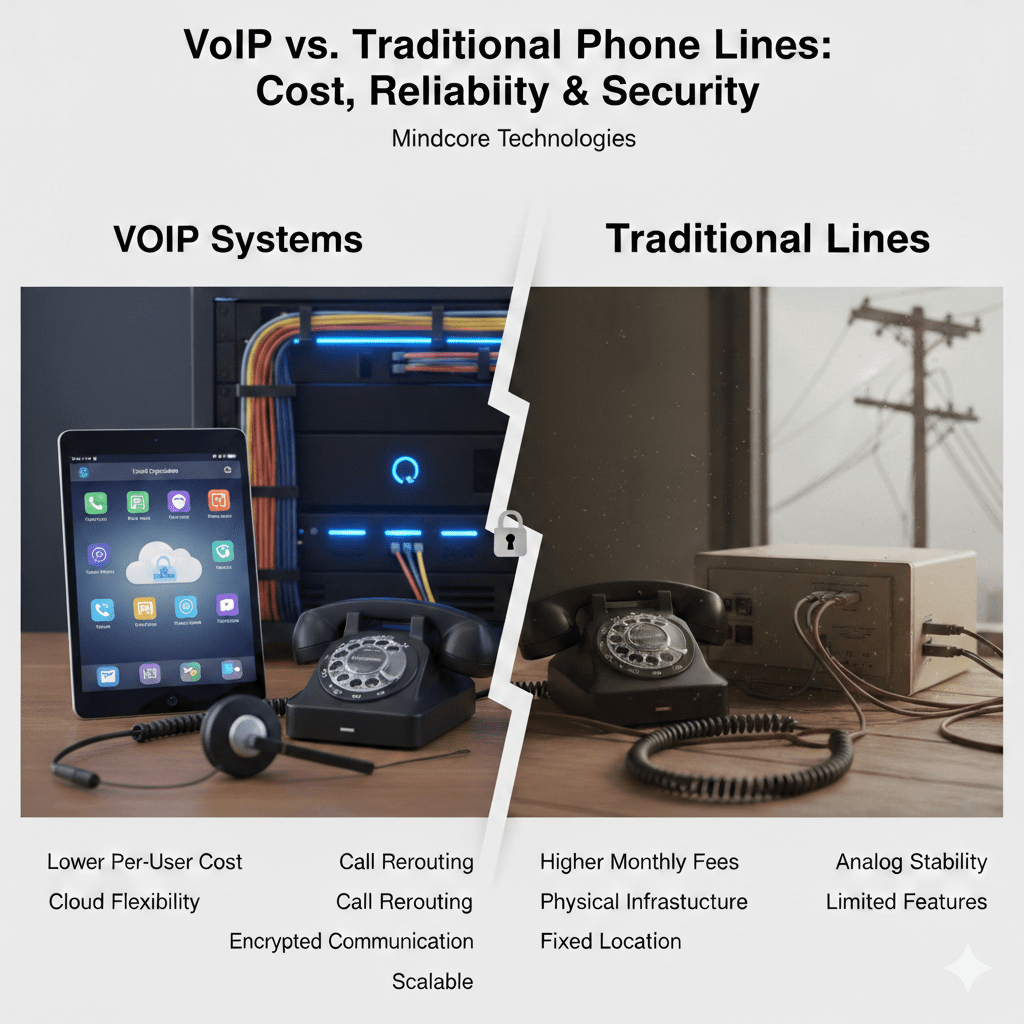
Choosing between VoIP and traditional phone lines is not just a pricing decision. It is an infrastructure decision that affects uptime, security exposure, scalability, and long-term operational cost.
Many businesses focus only on monthly savings. The smarter evaluation compares cost structure, failure points, and risk profile.
At Mindcore Technologies, we assess communication systems the same way we assess servers or networks. The right choice depends on how your business operates and how resilient your infrastructure is.
Cost Comparison: Upfront vs Ongoing Expenses
Traditional Phone Lines (PSTN or Analog Systems)
Traditional systems rely on physical copper lines and carrier contracts.
Cost characteristics include:
- Higher monthly line charges
Each line typically carries its own recurring fee. - Installation and wiring expenses
New lines require physical infrastructure work. - Limited scalability without hardware upgrades
Adding users may require additional PBX equipment. - Higher long-distance charges
Especially for multi-location businesses.
Traditional systems often appear predictable but become expensive as companies grow.
VoIP Systems
VoIP uses your internet connection instead of physical phone lines.
Cost characteristics include:
- Lower per-user monthly costs
Especially with cloud-based platforms. - Reduced hardware investment
Minimal physical infrastructure required. - Scalable licensing models
Users can be added or removed easily. - Consolidated communication expenses
Voice and data share infrastructure.
However, VoIP may require:
- Network upgrades
- Business-grade firewalls
- Internet redundancy
The savings are real, but only if infrastructure is prepared properly.
Reliability Comparison: What Happens During Failure
Reliability is where many businesses misunderstand the trade-offs.
Traditional Phone Lines
Advantages:
- Operate independently of internet connectivity
Calls continue during internet outages. - Power from the carrier in some configurations
Basic lines may work during local power failures. - Less sensitive to internal network congestion
Voice travels on dedicated circuits.
Limitations:
- Limited redundancy flexibility
Failover often requires separate circuits. - Harder to reroute calls during building outages
Physical location matters. - Slower scaling for disaster recovery
Infrastructure changes are manual.
Traditional lines are stable but less flexible.
VoIP Systems
Advantages:
- Call rerouting to mobile devices during outages
Calls can follow employees anywhere. - Cloud-hosted failover options
System resilience does not depend on one building. - Geographic flexibility
Employees can work from alternate locations instantly.
Limitations:
- Dependent on internet stability
No internet equals no calls. - Sensitive to bandwidth congestion
Poor network configuration degrades quality. - Requires UPS and backup planning
Networking equipment needs power redundancy.
VoIP reliability depends on network maturity.
Security Comparison: Exposure and Risk
Security is often overlooked in phone system decisions.
Traditional Phone Lines
Security characteristics:
- Not internet-exposed by default
Lower risk of remote hacking. - Limited digital attack surface
Harder to exploit remotely.
However:
- Physical tapping is possible
Though rare in business environments. - Limited logging and monitoring capabilities
Harder to audit calls.
Traditional systems are less exposed digitally but less observable.
VoIP Systems
VoIP introduces internet-based risk.
Common risks include:
- Toll fraud
Compromised credentials used for international calling. - SIP port scanning and brute-force attacks
Exposed services attract automated attacks. - Eavesdropping if encryption is disabled
Unencrypted voice traffic can be intercepted. - Denial-of-service attacks
Overwhelming VoIP servers to disrupt operations.
However, VoIP can be secured properly by:
- Enforcing strong administrative authentication
- Encrypting signaling and voice traffic
- Segmenting voice VLANs
- Restricting SIP exposure
- Monitoring call pattern anomalies
VoIP is secure when engineered properly. Insecure when treated casually.
Scalability and Growth Considerations
Traditional Lines:
- Physical expansion required
- Hardware limitations
- Slower provisioning
- Higher incremental costs
VoIP:
- Rapid user provisioning
- Multi-location integration
- Easy integration with CRM and analytics
- Flexible licensing models
For growing businesses, VoIP offers far greater agility.
Performance Considerations
Traditional lines:
- Consistent voice quality
- Independent of internal bandwidth
- Limited advanced features
VoIP systems:
- Require Quality of Service configuration
- Sensitive to jitter, latency, and packet loss
- Offer advanced features like call analytics and integration
Performance stability depends on proper network design.
Which Is Right for Your Business?
Traditional lines may make sense if:
- Your internet connection is unstable
- Your infrastructure is not modernized
- You require minimal advanced features
- You operate in a highly rural or bandwidth-limited area
VoIP is the stronger choice if:
- You support remote or hybrid teams
- You want scalability without hardware overhaul
- You need CRM and analytics integration
- You are modernizing your IT infrastructure
Communication should align with operational goals.
How Mindcore Technologies Helps Businesses Decide
Mindcore evaluates communication systems by:
- Conducting network readiness assessments
Measuring bandwidth, latency, and hardware capacity. - Designing segmented voice networks
Protecting security and performance. - Configuring QoS and firewall rules properly
Ensuring stable call quality. - Implementing redundancy strategies
Protecting uptime during outages. - Hardening VoIP systems against fraud and intrusion
Reducing attack surface.
The right decision depends on infrastructure maturity and growth plans.
Final Takeaway
VoIP and traditional phone lines differ significantly in cost structure, reliability dependencies, and security exposure.
Traditional systems offer predictable stability but limited flexibility and scalability. VoIP offers advanced features, cost efficiency, and mobility, but requires strong network design and security configuration.
The correct choice is not about which is newer. It is about which aligns with your infrastructure readiness, operational flexibility needs, and risk tolerance.

