

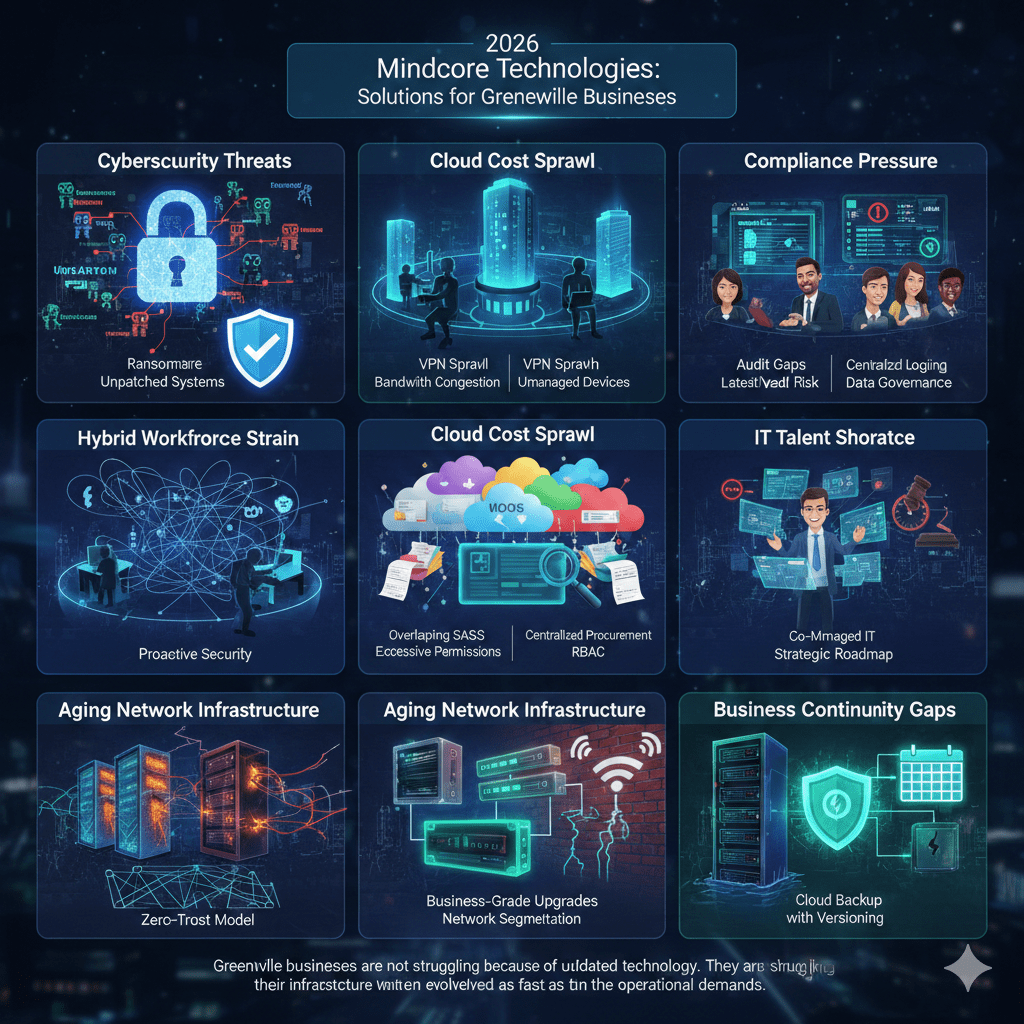
Greenville businesses are not struggling because of outdated technology. They are struggling because their infrastructure has not evolved as fast as their operational demands.
In 2026, the biggest IT problems are not basic hardware failures. They are architectural weaknesses, identity mismanagement, cloud sprawl, cybersecurity exposure, and performance bottlenecks caused by hybrid work.
At Mindcore Technologies, we see the same patterns across growing organizations. The companies that solve these issues early scale smoothly. The ones that ignore them experience downtime, compliance risk, and escalating costs.
Below are the most common IT challenges Greenville businesses face and how to address them properly.
1. Rising Cybersecurity Threats Targeting Mid-Sized Businesses
Cybercriminals are no longer focused only on large enterprises. Greenville’s mid-sized companies are increasingly targeted because attackers expect weaker defenses.
The Problem
- Ransomware targeting smaller IT teams
Attackers assume limited monitoring and response capabilities. - Credential theft and phishing campaigns
Compromised accounts allow silent lateral movement. - Unpatched systems and legacy software
Vulnerabilities become easy entry points.
The Solution
- Implement identity-based access controls
Reduce exposure by enforcing least-privilege access. - Deploy endpoint detection and response tools
Detect suspicious activity before it spreads. - Conduct continuous vulnerability management
Patch systems systematically instead of reactively.
Security must shift from reactive to proactive.
2. Hybrid Workforce Infrastructure Strain
Remote and hybrid teams increase complexity for businesses that were built around centralized office environments.
The Problem
- Inconsistent remote access security
VPN sprawl increases exposure. - Bandwidth congestion during peak hours
Cloud applications compete with voice and video traffic. - Unmanaged personal devices
Endpoints become blind spots.
The Solution
- Adopt secure workspace or zero-trust models
Move away from perimeter-based VPN assumptions. - Implement Quality of Service configuration
Prioritize business-critical applications. - Standardize endpoint security policies
Enforce patching and protection across all devices.
Remote enablement requires structured controls.
3. Cloud Cost Sprawl And Governance Gaps
Many Greenville businesses adopted cloud tools quickly without governance frameworks.
The Problem
- Overlapping SaaS subscriptions
Departments purchase tools independently. - Excessive user permissions
Over-permissioned accounts increase breach impact. - Lack of usage visibility
Leaders cannot track consumption or efficiency.
The Solution
- Centralize SaaS and cloud procurement oversight
Reduce duplication and shadow IT. - Implement role-based access control policies
Limit data exposure by design. - Deploy cloud monitoring and cost management tools
Track usage patterns and adjust resources accordingly.
Cloud efficiency requires discipline.
4. Aging Network Infrastructure In Growing Offices
Many Greenville offices expanded headcount without upgrading internal networks.
The Problem
- Outdated switches and routers
Performance degrades under modern workloads. - Weak Wi-Fi coverage in renovated buildings
Structural materials create interference. - No network segmentation
Increases lateral movement risk.
The Solution
- Upgrade to business-grade networking hardware
Support higher throughput and redundancy. - Conduct wireless site surveys
Identify dead zones and interference sources. - Segment networks logically
Separate user, server, guest, and voice traffic.
Network architecture must scale with workforce growth.
5. IT Talent Shortage And Internal Overload
Greenville businesses struggle to hire experienced IT professionals fast enough.
The Problem
- Small internal teams managing complex environments
Burnout and oversight gaps increase. - Delayed patching and maintenance cycles
Operational priorities override preventive work. - No strategic IT roadmap
Technology decisions become reactive.
The Solution
- Adopt co-managed or managed IT partnerships
Extend internal teams without increasing headcount. - Automate monitoring and alerting
Reduce manual oversight burden. - Develop a multi-year IT strategy aligned with business growth
Move from reactive fixes to planned modernization.
Operational maturity requires strategic planning.
6. Compliance Pressure In Regulated Industries
Healthcare, financial services, and professional firms in Greenville face growing regulatory scrutiny.
The Problem
- Incomplete audit trails
Logging gaps weaken compliance posture. - Unclear vendor risk management
Third-party exposure increases liability. - Insufficient data classification policies
Sensitive data is not properly segmented.
The Solution
- Implement centralized logging and monitoring systems
Improve audit readiness. - Conduct third-party risk assessments
Validate vendor security posture. - Apply structured data governance frameworks
Define access and retention rules clearly.
Compliance must be built into architecture.
7. Business Continuity And Disaster Recovery Gaps
Natural disasters, cyber incidents, and infrastructure failures are increasing.
The Problem
- No tested recovery procedures
Backup plans exist only on paper. - Single internet connection dependency
Connectivity failures halt operations. - Unverified cloud backup configurations
Data recovery may fail when needed.
The Solution
- Implement redundant internet connections
Protect uptime during ISP failures. - Test disaster recovery plans quarterly
Validate restoration procedures. - Use cloud-based backup with versioning and immutability
Protect against ransomware encryption.
Continuity requires validation, not assumption.
How Mindcore Technologies Supports Greenville Businesses
Mindcore helps Greenville organizations address these challenges by:
- Conducting IT risk assessments to identify architectural weaknesses.
- Designing secure and segmented network environments.
- Implementing identity-driven security controls.
- Managing cloud governance and cost optimization.
- Providing proactive monitoring and incident response support.
- Developing strategic IT roadmaps aligned with business goals.
Sustainable growth requires structured IT maturity.
Final Takeaway
In 2026, Greenville businesses face IT challenges centered on cybersecurity exposure, hybrid workforce complexity, cloud governance gaps, aging infrastructure, compliance pressure, and resilience weaknesses.
These issues are solvable, but only with structured design, disciplined monitoring, and strategic planning. Businesses that modernize intentionally strengthen uptime, reduce risk, and improve scalability.

