

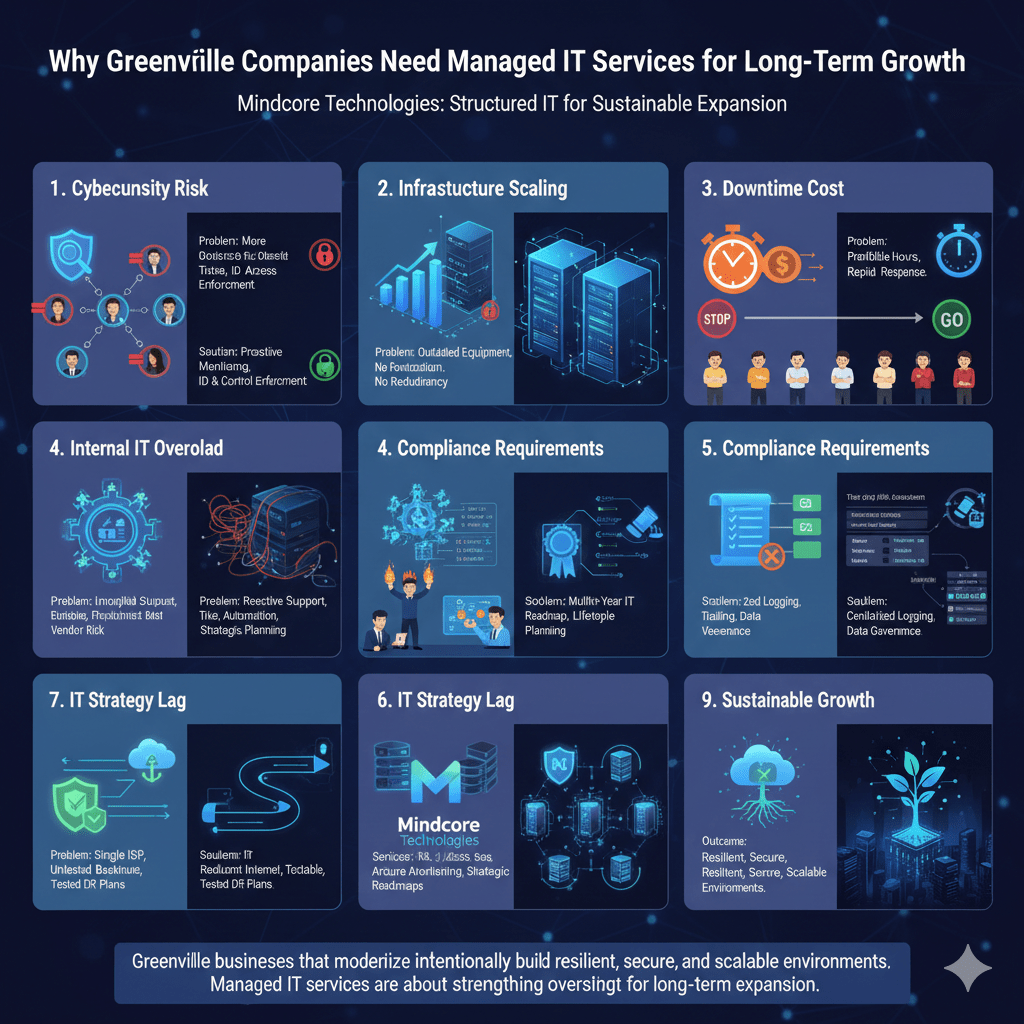
Greenville companies are growing, and investing in Managed IT Services Greenville ensures their IT infrastructure scales securely and efficiently to support expansion. The result is not immediate failure. It is slow performance, security exposure, rising downtime, and reactive decision-making.
Long-term growth requires stable, secure, and scalable technology architecture. Managed IT services provide structured oversight that internal teams often cannot sustain alone.
At Mindcore Technologies, we work with growing businesses that reach a turning point. Either IT becomes strategic, or it becomes a bottleneck.
The Growth Problem Greenville Businesses Face
Many Greenville companies start lean, often with:
- One internal IT generalist managing everything
- A break-fix vendor handling emergencies
- Cloud tools added department by department
- No long-term IT roadmap
That model works during early growth. It fails during expansion.
1. Cybersecurity Risk Increases As Companies Scale
Growth increases digital exposure.
The Problem
- More users and devices
Each new employee expands the attack surface. - Cloud adoption without governance
Rapid SaaS expansion creates identity sprawl. - Inconsistent patching and monitoring
Small teams struggle to maintain oversight.
Why Managed IT Services Help
- Proactive threat monitoring
Continuous oversight detects abnormal activity early. - Structured vulnerability management
Regular patching reduces exploitable weaknesses. - Identity and access control enforcement
Limits internal and external exposure.
Security maturity must scale with headcount.
2. Infrastructure Does Not Automatically Scale With Business
Hiring employees is easy. Scaling infrastructure properly is not.
The Problem
- Outdated network equipment
Performance declines as traffic increases. - No redundancy planning
Single points of failure halt operations. - Improper segmentation
One compromise can impact the entire network.
Why Managed IT Services Help
- Network assessments and modernization planning
Identifies capacity and hardware limitations. - Redundant connectivity implementation
Protects uptime during outages. - Segmentation and architecture design
Reduces risk of lateral movement.
Growth requires structural upgrades, not just bandwidth increases.
3. Downtime Becomes More Expensive Over Time
A five-minute outage in a five-person office is frustrating. In a 50-person organization, it is costly.
The Problem
- Lost billable hours
Productivity halts during disruptions. - Customer experience damage
Delayed responses impact reputation. - Operational inefficiency
Teams wait for reactive fixes.
Why Managed IT Services Help
- Proactive system monitoring
Identifies issues before they escalate. - Automated alerts and rapid response
Reduces mean time to resolution. - Disaster recovery planning and testing
Ensures continuity under stress.
Long-term growth demands operational consistency.
4. Internal IT Teams Become Overloaded
As companies grow, internal IT often shifts from strategic planning to constant troubleshooting.
The Problem
- Reactive support cycles
Fires take priority over improvements. - Delayed strategic projects
Upgrades and modernization stall. - Burnout and turnover risk
Small teams cannot sustain growing complexity.
Why Managed IT Services Greenville Help
- Co-managed support models
Extends internal capacity without replacing it. - Automated monitoring tools
Reduces manual workload. - Strategic planning support
Aligns technology investments with business goals.
Growth requires structured delegation.
5. Compliance Requirements Increase As Companies Mature
Healthcare, legal, financial, and professional firms in Greenville face growing regulatory oversight.
The Problem
- Incomplete logging and audit trails
Gaps weaken compliance posture. - Third-party risk exposure
Vendors introduce additional liability. - Unclear data classification policies
Sensitive information may be overexposed.
Why Managed IT Services Greenville Help
- Centralized logging and monitoring implementation
Improves audit readiness. - Vendor risk assessments
Evaluates third-party security posture. - Data governance framework design
Defines access control and retention standards.
Compliance maturity protects long-term stability.
6. IT Strategy Often Lags Behind Business Strategy
Leadership teams plan revenue growth and expansion carefully. IT planning is often reactive.
The Problem
- Technology decisions made without roadmap alignment
Creates inefficiencies. - Short-term fixes instead of long-term architecture
Increases technical debt. - No lifecycle management planning
Hardware and software age unpredictably.
Why Managed IT Services Help
- Multi-year IT roadmap development
Aligns infrastructure with growth plans. - Lifecycle planning and budgeting
Reduces surprise capital expenditures. - Executive-level IT reporting
Provides leadership with visibility and clarity.
Strategic IT oversight supports sustainable growth.
7. Business Continuity Becomes Mission-Critical
As revenue grows, tolerance for downtime decreases.
The Problem
- Single ISP dependency
Internet outages halt productivity. - Unverified backup systems
Recovery may fail during crisis. - No incident response planning
Delays increase impact.
Why Managed IT Services Greenville Help
- Redundant internet implementation
Protects communication and operations. - Backup testing and validation
Ensures data recovery works in real conditions. - Incident response playbooks
Reduces confusion during events.
Resilience becomes non-negotiable at scale.
How Mindcore Technologies Supports Greenville Businesses
Mindcore supports long-term growth by:
- Conducting comprehensive IT risk assessments to identify architectural gaps.
- Designing secure, segmented, and scalable infrastructure.
- Implementing proactive monitoring and threat detection systems.
- Managing cloud governance and identity controls.
- Developing long-term IT roadmaps aligned with leadership goals.
- Providing strategic advisory support alongside operational oversight.
Managed IT Services Greenville are not about outsourcing responsibility. They are about strengthening oversight.
Final Takeaway
Greenville companies that want sustainable growth must treat IT as infrastructure, not as a reactive support function. As organizations scale, cybersecurity risk, operational complexity, compliance requirements, and downtime costs increase.
By leveraging Managed IT Services Greenville, businesses gain structured oversight, proactive monitoring, scalability planning, and strategic IT alignment for long-term growth. Businesses that invest early build resilient, secure, and scalable environments that support long-term expansion.
Frequently Asked Questions
Why do growing companies need managed IT services?
Growing companies need managed IT services to maintain operational continuity, strengthen cybersecurity, reduce downtime, support scalable infrastructure, and gain access to experienced technical expertise without building large internal IT departments.
How do managed IT services improve business operations?
Managed IT services improve operations through proactive monitoring, faster issue resolution, infrastructure optimization, cloud support, endpoint management, and ongoing technical maintenance. Businesses leveraging managed IT support services improve operational visibility and reduce reactive troubleshooting.
Why is cybersecurity important for businesses in growing markets?
As businesses expand, they handle more data, users, cloud systems, and remote connectivity, increasing exposure to ransomware, phishing, unauthorized access, and operational disruption. Organizations implementing proactive cybersecurity frameworks improve resilience against evolving cyber threats.
What are the benefits of proactive IT support?
Proactive IT support helps identify issues before they become major disruptions, reducing downtime, improving system reliability, and maintaining productivity across business operations. Continuous monitoring and rapid response improve operational continuity as organizations scale.
How can managed IT services support long-term business growth?
Managed IT services support growth by improving infrastructure scalability, strengthening operational visibility, optimizing cloud environments, supporting remote work, and reducing technology-related operational risk. Businesses implementing scalable cloud infrastructure strategies position themselves for sustainable long-term expansion.
Managed IT Services and Infrastructure Strategy Expertise from Matt Rosenthal
Matt Rosenthal, CEO of Mindcore Technologies, has extensive experience helping organizations strengthen IT infrastructure, cybersecurity resilience, and operational continuity across evolving business environments. His expertise in managed IT services, cloud architecture, infrastructure scalability, threat monitoring, identity governance, disaster recovery, and operational risk management helps businesses optimize technology performance while reducing downtime and cybersecurity exposure. Matt’s leadership focuses on building proactive IT strategies that improve operational visibility, strengthen infrastructure reliability, reduce enterprise risk, and support long-term scalable business growth.

