

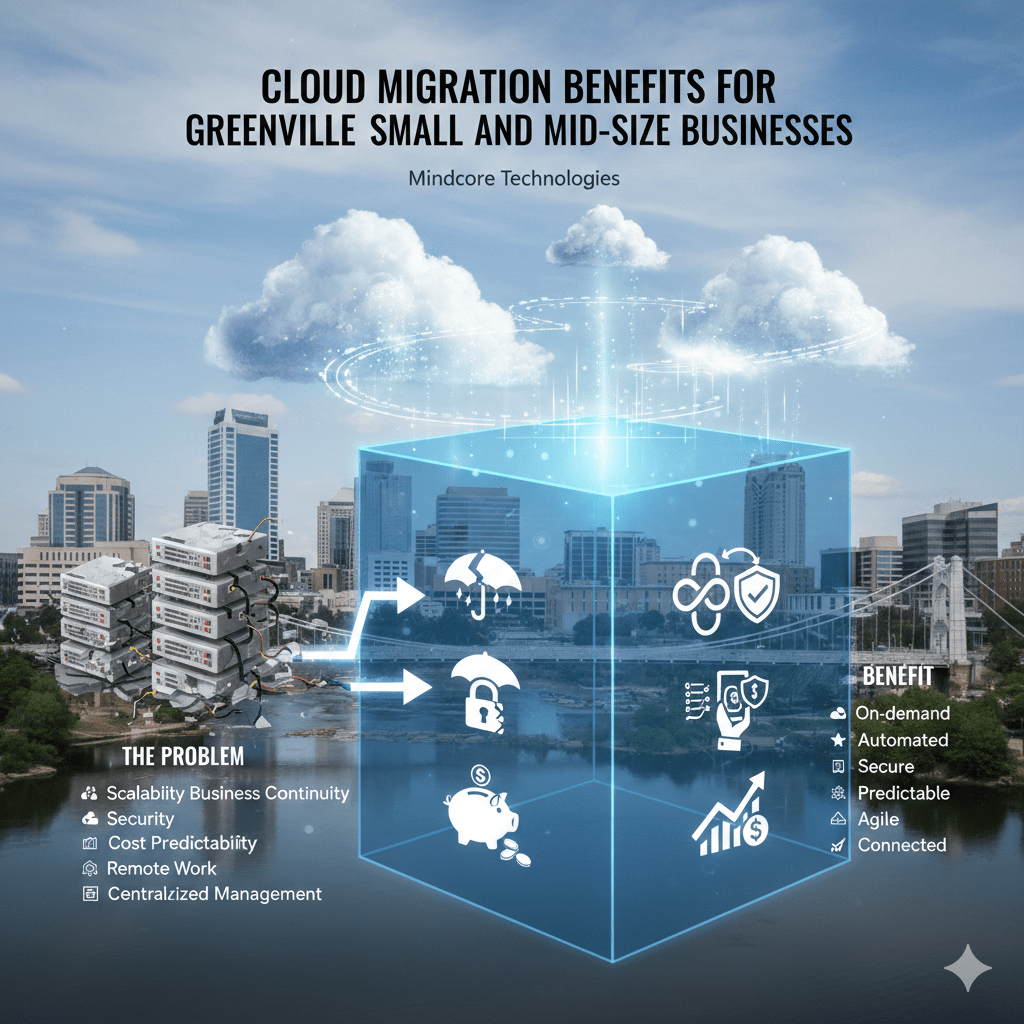
Cloud migration is not about moving files to the internet. It is about shifting your entire infrastructure model from hardware dependency to scalable, service-driven architecture.
For Greenville small and mid-size businesses, cloud migration is often the difference between reactive IT and structured growth.
At Mindcore Technologies, we see companies delay cloud migration because they assume it is disruptive or expensive. The reality is that remaining on aging infrastructure becomes more costly over time.
Below are the real, practical benefits Greenville SMBs gain when cloud migration is done correctly.
1. Scalability Without Hardware Constraints
Growing businesses frequently outgrow their servers before leadership realizes it.
The Problem
- Limited server capacity
Physical servers restrict storage and performance expansion. - Slow deployment of new resources
Purchasing and installing hardware delays growth initiatives. - Overprovisioning to prepare for future growth
Businesses spend capital on capacity they may not immediately use.
The Benefit Of Cloud Migration
- On-demand resource allocation
Compute power and storage can be scaled up instantly during peak demand. - Flexible capacity planning
Businesses only pay for what they actually use. - Faster expansion into new markets
New users and locations can be deployed without new server rooms.
Scalability becomes operational, not physical.
2. Improved Business Continuity And Disaster Recovery
Greenville businesses face risks from weather events, power outages, and cyber incidents.
The Problem
- Single-site infrastructure dependency
Local disasters can halt operations. - Backup systems that are rarely tested
Recovery procedures may fail during crisis. - Manual restoration processes
Downtime increases during recovery.
The Benefit Of Cloud Migration
- Geographically redundant infrastructure
Cloud environments replicate data across multiple regions. - Automated failover capabilities
Systems can switch to backup environments quickly. - Faster data restoration
Recovery times are reduced significantly.
Cloud resilience reduces downtime risk.
3. Enhanced Security Through Centralized Control
Security maturity improves when infrastructure is modernized.
The Problem
- Outdated on-premise firewalls and servers
Legacy systems are harder to secure. - Inconsistent patching practices
Manual updates create vulnerability gaps. - Over-permissioned access to shared resources
Increases breach impact.
The Benefit Of Cloud Migration
- Identity-driven access control
Permissions are managed centrally and enforced consistently. - Automated security updates
Cloud providers maintain infrastructure-level patches. - Advanced monitoring capabilities
Cloud platforms offer visibility into user activity and system health.
Security improves when governance improves.
4. Cost Predictability And Reduced Capital Expenditure
Many Greenville SMBs operate with tight capital budgets.
The Problem
- Large upfront hardware investments
Servers require significant capital outlay. - Unplanned replacement costs
Hardware failures create sudden expenses. - Ongoing maintenance overhead
Power, cooling, and physical space add hidden costs.
The Benefit Of Cloud Migration
- Subscription-based pricing models
Converts capital expenses into predictable operational costs. Businesses considering Microsoft’s cloud should also understand how much Azure costs based on compute, storage, networking, and actual usage. - Reduced hardware lifecycle management
No need to manage server replacement cycles. - Lower maintenance overhead
Eliminates power and cooling infrastructure requirements.
Cost becomes more transparent and manageable.
5. Remote And Hybrid Workforce Enablement
Greenville businesses increasingly rely on distributed teams.
The Problem
- Limited remote access performance
VPN bottlenecks degrade productivity. - Security exposure through broad network access
Remote users may have excessive permissions. - Inconsistent collaboration tools
Disconnected systems reduce efficiency.
The Benefit Of Cloud Migration
- Secure access to applications from anywhere
Employees connect through identity-based authentication. - Reduced dependence on VPN-centric models
Cloud-native tools minimize network exposure. - Integrated collaboration platforms
Teams work within centralized environments.
Cloud platforms naturally support mobility.
6. Faster Innovation And Technology Adoption
Competitive businesses cannot afford slow deployment cycles.
The Problem
- Long hardware procurement timelines
Delays new initiatives. - Limited testing environments
Innovation requires available infrastructure. - Manual configuration processes
Slows development and deployment.
The Benefit Of Cloud Migration
- Rapid environment provisioning
New systems can be deployed in minutes. - Flexible development sandboxes
Teams can test new tools safely. - Elastic infrastructure scaling
Projects can expand or contract dynamically.
Cloud enables agility.
7. Improved Visibility And Centralized Management
As businesses grow, oversight becomes harder.
The Problem
- Fragmented systems across departments
Limited centralized visibility. - Shadow IT adoption
Departments implement tools independently. - Limited usage analytics
Leadership lacks operational clarity.
The Benefit Of Cloud Migration
- Centralized dashboards and reporting
Improves visibility into usage and performance. - Access control oversight
Ensures consistent policy enforcement. - Resource monitoring tools
Helps prevent cost sprawl and inefficiencies.
Governance improves operational control.
Common Cloud Migration Mistakes Greenville Businesses Must Avoid
Cloud migration only delivers benefits when planned properly.
Avoid:
- Lift-and-shift migrations without architecture review
Moving inefficient systems to the cloud does not fix inefficiency. - Ignoring identity governance
Cloud access must follow least-privilege principles. - Failing to monitor cost consumption
Uncontrolled scaling leads to budget overruns. - Skipping network readiness assessments
Internet performance directly impacts cloud usability.
Cloud success depends on structured planning.
How Mindcore Technologies Supports Greenville Cloud Migration
Mindcore helps Greenville SMBs migrate strategically by:
- Conducting infrastructure assessments to determine readiness.
- Designing secure cloud architecture aligned with compliance requirements.
- Implementing identity-based access controls to reduce exposure.
- Configuring monitoring and cost governance frameworks.
- Developing phased migration roadmaps to minimize disruption.
Migration must align with business growth goals.
Final Takeaway
For Greenville small and mid-size businesses, cloud migration provides scalability, resilience, security improvements, predictable costs, and workforce flexibility. However, the benefits are realized only when migration is planned, governed, and monitored properly.
Cloud adoption is not a technology trend. It is a strategic growth decision.

