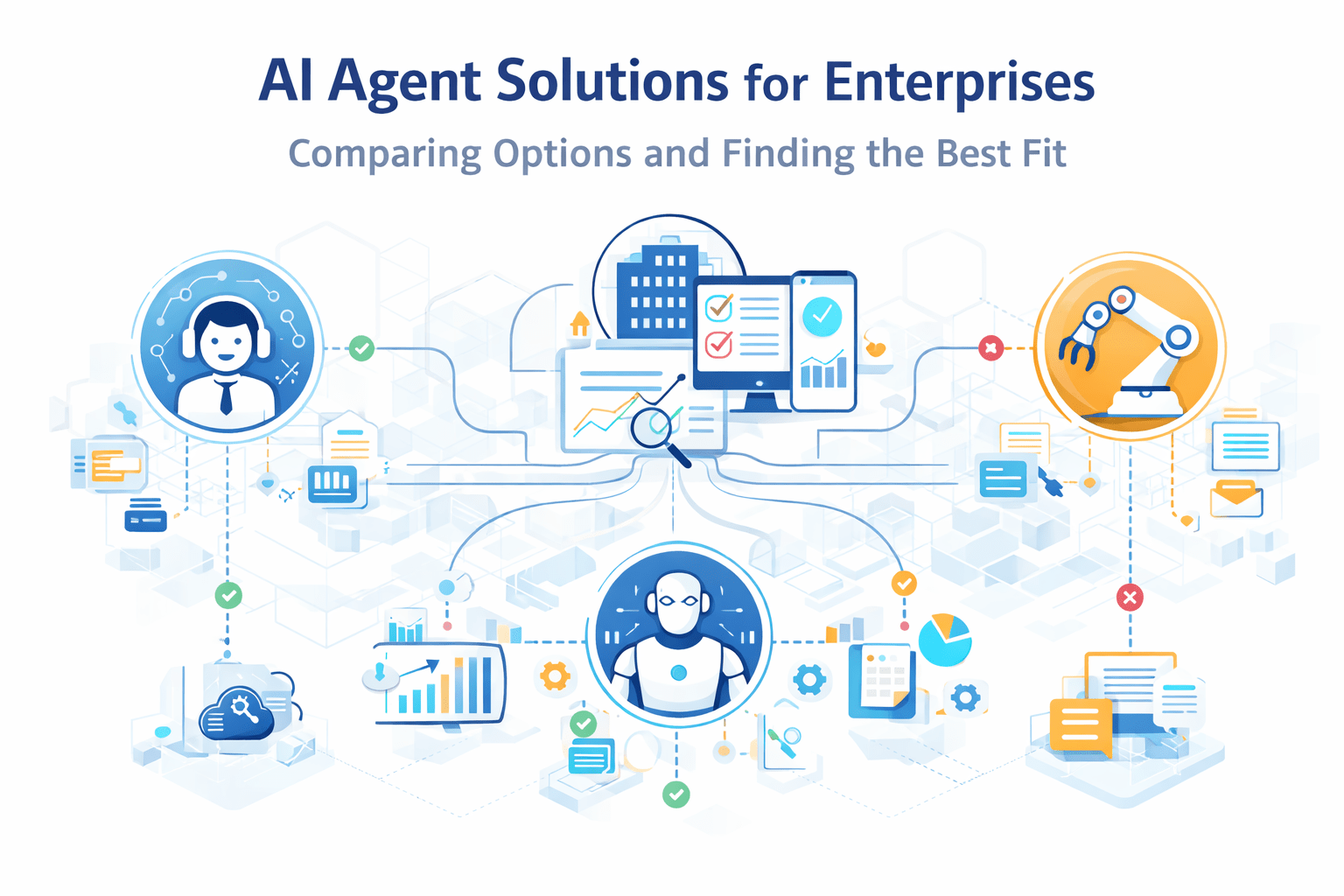
Not all AI agents are built for enterprise environments. Many platforms are optimized for productivity enhancements, not operational infrastructure. Enterprise organizations require AI agents that can integrate securely across systems, scale across departments, operate under governance discipline, and withstand compliance scrutiny.
The strategic foundation for evaluating enterprise AI architecture is outlined in The Complete Guide to AI Agents for Enterprise Business Operations, where AI agents are positioned as structured operational infrastructure rather than isolated tools.
Choosing the best fit requires disciplined comparison.
Category 1: Workflow Automation Agents
These agents focus on structured task execution.
Common capabilities:
• Trigger multi-step workflows across departments
Automate approval chains and operational tasks.
• Integrate with ERP, CRM, and HRIS platforms
Synchronize system actions.
• Execute conditional logic sequences
Improve process consistency.
Evaluation considerations:
• Depth of workflow orchestration
• API integration flexibility
• Role-based access enforcement
• Logging transparency
Workflow scalability and orchestration depth are also examined in AI Agents for Business: A Comprehensive Guide to Automated Operations.
Category 2: Data Aggregation and Reporting Agents
These agents focus on analytics consolidation.
Core capabilities:
• Aggregate cross-platform KPIs
Accelerate executive dashboards.
• Normalize inconsistent data formats
Improve reporting accuracy.
• Generate automated performance summaries
Reduce manual analysis workload.
Evaluation considerations:
• Real-time vs batch processing capability
• Integration with BI tools
• Data permission scoping
• Executive reporting customization
Strategic alignment of reporting acceleration is explored in How to Build AI-Powered Enterprise Operations Strategy.
Category 3: Compliance and Governance Agents
These agents monitor internal enforcement.
Capabilities include:
• Track access control anomalies
Strengthen internal oversight.
• Generate automated compliance documentation
Simplify audit preparation.
• Monitor policy enforcement gaps
Reduce regulatory exposure.
Security and governance validation is detailed in Enterprise AI Compliance: Securing AI Agents in Corporate Environments.
Category 4: Hybrid Multi-Agent Platforms
Some providers offer orchestrated AI ecosystems.
Features often include:
• Centralized AI agent management dashboards
Simplify oversight.
• Cross-agent workflow chaining
Enable complex automation.
• Role-based administrative control layers
Limit misuse.
• Real-time activity logging integration
Strengthen defensibility.
Comparison frameworks are expanded in How to Choose the Right AI Agents for Your Enterprise Organization.
Critical Enterprise Comparison Criteria
When comparing AI agent solutions, executives should evaluate:
• Security Architecture Compatibility
Can the solution integrate within existing security controls?
• Access Governance Enforcement
Does the agent operate under RBAC restrictions?
• API Permission Transparency
Are integrations tightly scoped and auditable?
• Scalability Across Departments
Can the platform support multi-department orchestration?
• Centralized Monitoring Integration
Are logs exportable to enterprise SIEM?
• Compliance Documentation Support
Can the system generate audit-ready records?
Integration complexity risk is further addressed in Top AI Integration Challenges Facing Enterprise Organizations Today.
Enterprise Fit vs. Vendor Marketing
Common pitfalls in solution selection include:
• Overemphasis on demo performance
• Ignoring governance architecture
• Underestimating integration complexity
• Selecting tools without workflow mapping
• Deploying pilots without scalability validation
Vendor evaluation standards are reinforced in AI Agent Providers: What Business Leaders Should Look for in Partners.
Matching AI Agent Type to Enterprise Objective
Executives should align solution type with objective.
• Operational efficiency improvement
Deploy workflow automation agents.
• Executive reporting acceleration
Deploy data aggregation agents.
• Compliance monitoring enhancement
Deploy governance agents.
• Enterprise-wide automation scaling
Deploy hybrid multi-agent orchestration platforms.
Implementation sequencing is detailed in The Ultimate AI Agent Implementation Checklist for Business Executives.
Enterprise-Level Outcomes of Strategic Comparison
Organizations that evaluate AI agents structurally observe:
• Reduced integration friction
• Lower compliance exposure
• Faster deployment scalability
• Improved operational transparency
• Stronger executive reporting clarity
• Sustainable automation governance
Selection discipline reduces long-term risk.
Key Takeaways
Enterprise AI agent solutions must be compared based on security architecture compatibility, access governance enforcement, API permission transparency, scalability, centralized monitoring integration, and compliance documentation capability. By aligning AI agent type with operational objectives and evaluating providers through governance-driven criteria rather than marketing demonstrations, enterprises build scalable automation infrastructure that enhances efficiency, strengthens compliance posture, and supports long-term operational resilience.