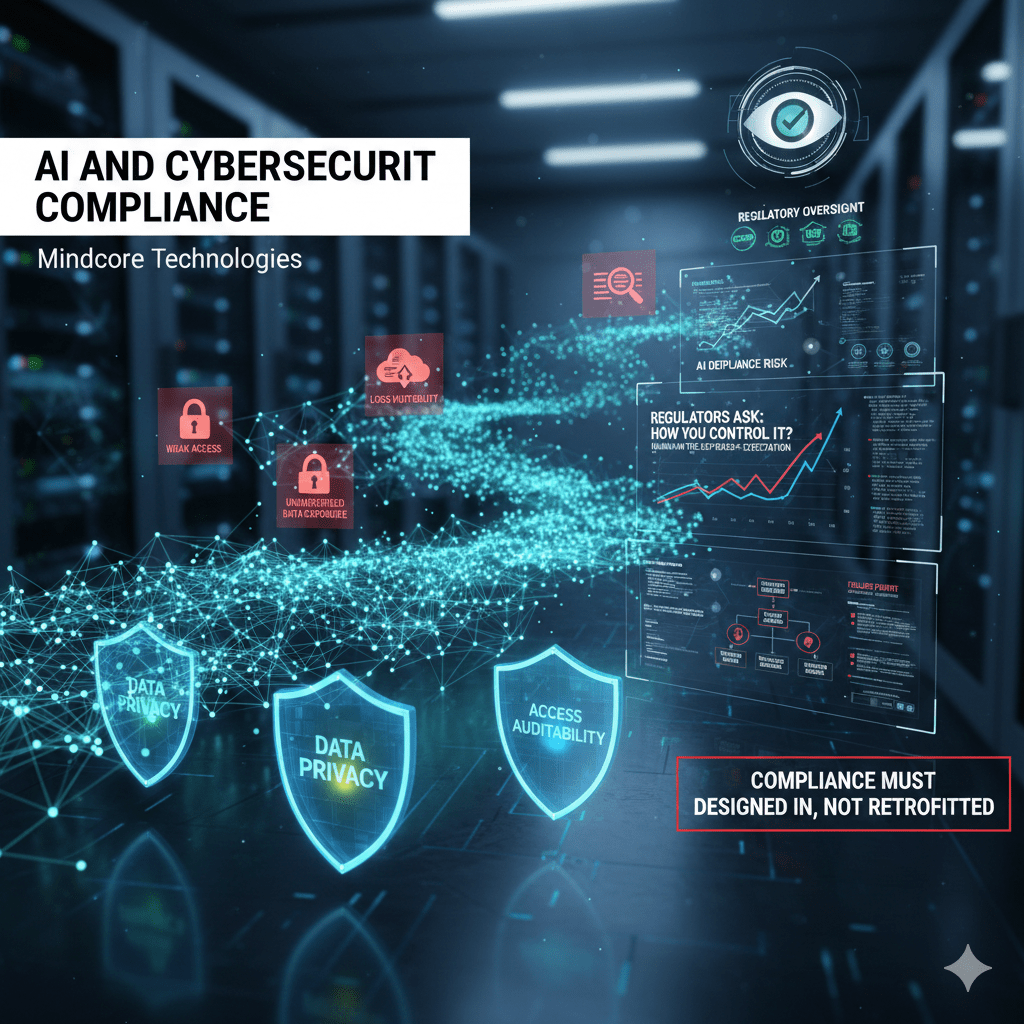
AI did not create new compliance obligations. It changes how quickly organizations can violate existing ones. Most regulatory failures tied to AI are not caused by malicious intent. They are caused by poor visibility, weak governance, and misplaced trust in automated systems.
At Mindcore Technologies, we see compliance break down when AI is deployed faster than controls can adapt. Regulators are not asking whether you use AI. They are asking how you control it, audit it, and limit its impact.
This guide explains how AI intersects with cybersecurity compliance, where regulators are focusing, and how organizations can stay compliant while still innovating.
The Compliance Reality Check
Cybersecurity regulations already require organizations to:
- Protect sensitive data
- Control access
- Monitor activity
- Detect and respond to incidents
- Maintain auditability
AI complicates all five.
AI systems:
- Increase data movement
- Introduce opaque decision-making
- Create new logs and artifacts
- Automate actions at scale
Compliance risk grows when these changes are not governed deliberately.
Why Regulators Are Paying Close Attention to AI
Regulators care less about AI models and more about outcomes.
Their concerns include:
- Unauthorized data exposure
- Lack of accountability for automated decisions
- Inability to explain system behavior
- Excessive access granted to AI systems
- Delayed detection of security incidents
AI accelerates failures that compliance frameworks were designed to prevent.
Where AI Commonly Breaks Compliance
1. Data Privacy and Protection Failures
AI systems often ingest more data than necessary, violating data minimization principles.
Common issues:
- Sensitive data fed into models without classification
- Prompts and outputs stored indefinitely
- Third-party AI platforms receiving regulated data
2. Weak Access Controls
AI systems are frequently granted broad access “for convenience.”
This violates:
- Least-privilege requirements
- Segregation of duties
- Access review standards
3. Loss of Auditability
Many AI workflows are not logged properly.
Compliance failures occur when organizations:
- Cannot trace AI decisions
- Cannot show who approved actions
- Cannot reconstruct incidents
No audit trail means no defensible compliance position.
4. Automated Actions Without Oversight
AI-triggered actions can:
- Change configurations
- Access sensitive systems
- Respond to incidents
Without human approval, accountability disappears.
5. Third-Party Risk Blind Spots
AI vendors often become hidden processors of sensitive data.
Compliance issues arise when:
- Vendor controls are not assessed
- Data residency is unclear
- Retention policies are undefined
How Existing Regulations Apply to AI
AI is not exempt from cybersecurity regulation.
Most frameworks already apply directly.
Data Protection Regulations
Privacy laws still require:
- Purpose limitation
- Data minimization
- Access controls
- Breach notification
AI does not change these obligations.
Security Frameworks
Security standards require:
- Risk assessment
- Monitoring and detection
- Incident response
- Continuous improvement
AI increases scope but not exemptions.
Industry-Specific Regulations
Highly regulated industries face additional scrutiny.
Regulators expect:
- Explainable controls
- Strong governance
- Clear accountability
AI systems that cannot be explained create compliance exposure.
What Regulators Expect From AI-Enabled Organizations
Regulators are converging on a few consistent expectations.
1. Clear AI Governance
Organizations must define:
- Approved AI use cases
- Ownership and accountability
- Acceptable data sources
- Prohibited activities
AI without governance is considered unmanaged risk.
2. Risk Assessments That Include AI
Risk assessments must address:
- Data exposure
- Automated decision impact
- Security failure scenarios
- Third-party dependencies
If AI is not included in risk assessments, compliance posture is incomplete.
3. Strong Identity and Access Controls
AI systems must operate under:
- Least privilege
- Role-based access
- Regular access reviews
AI should never have unrestricted access by default.
4. Auditability and Logging
Organizations must be able to show:
- What the AI accessed
- What it produced
- What actions were taken
- Who approved decisions
If it cannot be audited, it cannot be defended.
5. Human Oversight for High-Risk Decisions
AI should not operate autonomously in:
Human-in-the-loop controls are becoming a regulatory expectation.
6. Vendor and Supply Chain Due Diligence
AI vendors must be treated like any other critical provider.
This includes:
- Security assessments
- Data handling reviews
- Contractual protections
- Ongoing monitoring
Outsourcing AI does not outsource compliance responsibility.
The Biggest Compliance Mistake We See
Organizations assume compliance will “catch up later.”
This leads to:
- Uncontrolled AI sprawl
- Data exposure
- Failed audits
- Emergency rollbacks
- Regulatory scrutiny
Compliance must be designed in, not retrofitted.
How Mindcore Technologies Helps Organizations Stay Compliant
Mindcore helps organizations deploy AI while maintaining strong cybersecurity compliance through:
- AI risk assessments and governance design
- Data classification and access controls
- Identity-centric security architecture
- Audit logging and monitoring strategy
- Vendor risk evaluation
- Incident response alignment
- Ongoing compliance posture management
We align AI adoption with regulatory reality, not marketing promises.
A Simple Compliance Readiness Check
You are exposed if:
- AI tools access sensitive data without restriction
- You cannot explain AI-driven decisions
- AI actions are not logged
- Vendors are not assessed
- There is no formal AI governance
Regulators will not accept “we didn’t know” as an answer.
Final Takeaway
AI is not incompatible with cybersecurity compliance, but it raises the bar for discipline, visibility, and accountability.
Organizations that treat AI as a regulated system, not a shortcut, will pass audits, reduce risk, and innovate safely. Those that rush deployment without governance will face compliance failures that are difficult and expensive to unwind.
The regulatory landscape is not waiting for AI to mature. Compliance expectations are already here.