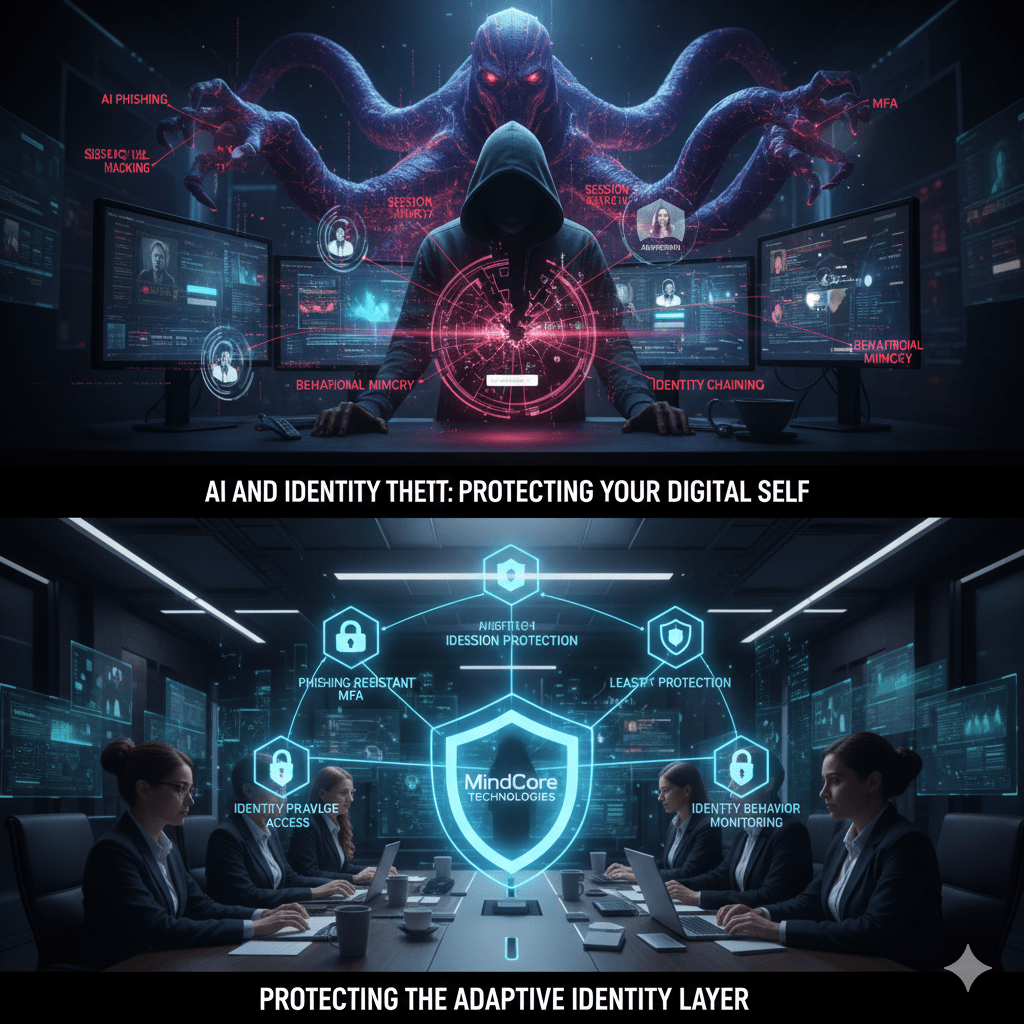
Identity theft has moved beyond stolen passwords and credit card numbers. AI has turned digital identity into a high-value, continuously exploitable asset. Attackers no longer need to break in loudly. They impersonate, automate, and adapt, often using valid credentials that look legitimate to most security systems.
At Mindcore Technologies, we see identity theft today as an access problem, not a breach problem. Once attackers control identity, everything downstream becomes possible.
This article explains how AI is accelerating identity theft, why traditional defenses are failing, and how to protect digital identity in a modern threat landscape.
Why AI Changed Identity Theft Permanently
AI gives attackers three advantages they never had before:
- Scale
- Precision
- Persistence
With AI, identity theft is no longer manual or opportunistic. It is automated, targeted, and continuous.
Attackers can now:
- Generate convincing impersonation messages instantly
- Analyze behavior patterns to avoid detection
- Test credentials and sessions quietly over time
Identity abuse blends into normal activity unless controls are designed to stop it.
What “Digital Identity” Really Means Today
Digital identity is not just a username and password.
It includes:
- Credentials
- Active sessions
- MFA approvals
- Cookies and tokens
- Device trust
- Behavioral patterns
AI-driven identity theft targets all of these, not just login prompts.
How AI Is Powering Modern Identity Theft
1. AI-Driven Phishing and Impersonation
AI creates messages that perfectly match tone, context, and urgency. Users are no longer fooled by mistakes. They are fooled by realism.
2. Credential Harvesting at Scale
Stolen credentials are validated automatically across multiple platforms until access is found.
3. Session Hijacking
Attackers steal active sessions instead of passwords, bypassing MFA entirely.
4. Behavioral Mimicry
AI helps attackers act like legitimate users, avoiding anomaly detection.
5. Identity Chaining
One compromised identity leads to others through access reuse and lateral movement.
Why Traditional Identity Defenses Fail
Most identity defenses assume:
- Credentials equal trust
- MFA solves phishing
- Logins are the main risk
AI-driven identity theft breaks these assumptions.
Attackers often:
- Use valid credentials
- Bypass MFA with session theft
- Operate inside allowed workflows
The system believes nothing is wrong.
The Real Damage Happens After Identity Is Stolen
Once identity is compromised, attackers can:
- Access sensitive data
- Change permissions
- Launch ransomware
- Commit financial fraud
- Exfiltrate information quietly
Identity theft is the front door to most modern breaches.
What Actually Protects Digital Identity in an AI World
Protecting identity requires layered controls that assume credentials will eventually be compromised.
1. Reduce Reliance on Passwords
Passwords are the weakest link.
Effective protection includes:
- Phishing-resistant MFA
- Hardware-backed authentication
- Passwordless access where possible
If credentials are not enough to authenticate, identity theft becomes harder.
2. Protect Sessions, Not Just Logins
Sessions are now a primary target.
Controls should include:
- Session expiration enforcement
- Device trust validation
- Continuous authentication checks
A stolen session should not equal persistent access.
3. Enforce Least Privilege Everywhere
Most identity theft becomes catastrophic because access is too broad.
Best practices:
- Role-based access
- Regular permission reviews
- No standing administrative access
Limiting identity power limits damage.
4. Monitor Identity Behavior Continuously
AI-driven attacks hide in normal activity.
Effective monitoring looks for:
- Impossible travel patterns
- Unusual access timing
- Privilege escalation attempts
- Abnormal data access
Behavior matters more than credentials.
5. Secure the Endpoint That Holds the Identity
Identity theft often starts on the device.
Controls must include:
- Endpoint detection and response
- Infostealer protection
- Browser and session hardening
A compromised device compromises identity.
6. Harden Cloud Identity Platforms
Cloud identity is now the control plane.
Protection includes:
- Conditional access policies
- Location and device restrictions
- MFA enforcement on all sensitive actions
Identity platforms must assume hostile environments.
7. Train Users for AI-Driven Deception
Training must reflect reality.
Effective programs teach:
- Executive impersonation tactics
- Urgency manipulation
- Multi-channel attacks
- Session theft awareness
Awareness reduces initial compromise rates.
The Biggest Identity Security Mistake We See
Organizations focus on how attackers get in, not what they can do once they’re in.
Identity protection fails when:
- Detection is delayed
- Privileges are excessive
- Sessions are trusted too long
AI exploits these gaps efficiently.
How Mindcore Technologies Protects Digital Identity
Mindcore helps organizations defend against AI-driven identity theft through:
- Identity and access hardening
- Phishing-resistant MFA deployment
- Conditional access and session controls
- Endpoint and browser security
- Identity behavior monitoring
- Incident response and credential containment
We design identity systems that assume compromise and limit impact.
A Simple Reality Check for Leaders
Your digital identity is at risk if:
- Passwords remain the primary control
- Sessions persist indefinitely
- MFA approvals are blind trust events
- Identity behavior is not monitored
AI-driven identity theft is not hypothetical. It is already happening.
Final Takeaway
AI has transformed identity theft from a single event into a continuous attack model. Protecting digital identity now requires moving beyond passwords and logins toward behavior, context, and containment.
Organizations that modernize identity security will reduce breach impact dramatically. Those that rely on outdated assumptions will continue to suffer “mysterious” incidents where everything looked legitimate until it was too late.