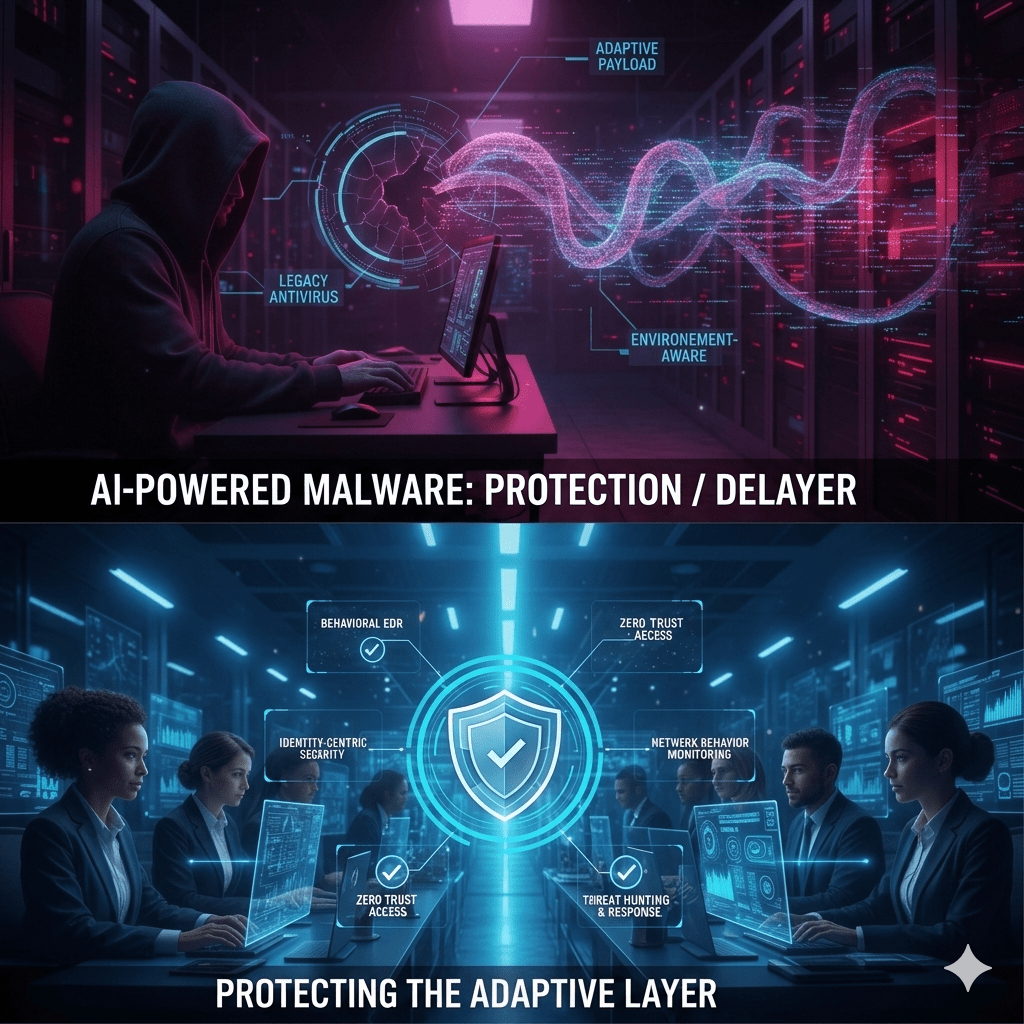
AI-powered malware is not science fiction. It is already being used to evade detection, adapt to defenses, and persist inside business environments longer than traditional malware ever could. The shift is subtle but critical. Malware is no longer static code. It is becoming adaptive software.
At Mindcore Technologies, we are seeing early-stage AI-assisted malware techniques show up in real investigations. These threats do not rely on zero-day exploits alone. They rely on learning how your environment behaves and adjusting accordingly.
This article explains what AI-powered malware actually is, why legacy defenses struggle, and how organizations must adapt their security strategy.
What Makes Malware “AI-Powered”
AI-powered malware uses machine learning or adaptive logic to change behavior based on its environment.
Instead of following a fixed script, it can:
- Modify execution paths
- Change timing and activity patterns
- Avoid known detection triggers
- Adjust persistence techniques
- Mimic normal user or system behavior
This makes it harder to identify using signatures or static rules.
The Hard Truth About AI-Generated Threats
Most security tools assume malware behaves predictably.
AI-powered malware does not.
It observes:
- Which processes are monitored
- When scans occur
- How endpoints respond
- What network activity is allowed
Then it adapts to stay below detection thresholds.
Real-World AI-Assisted Malware Techniques
1. Evasion Through Behavioral Learning
Malware delays execution, staggers activity, or runs only during specific user behavior patterns to avoid detection.
2. Dynamic Payload Modification
Instead of delivering a single payload, malware adjusts components to bypass signature-based defenses.
3. Environment Awareness
Malware checks for:
- Virtual machines
- Sandboxes
- Debugging tools
- Security agents
If detected, it alters behavior or remains dormant.
4. AI-Assisted Command and Control
Communication patterns are randomized or disguised as legitimate traffic, making network detection difficult.
5. Adaptive Lateral Movement
Once inside, malware tests access boundaries and changes techniques until it finds paths that work.
Why Traditional Defenses Struggle
Signature-Based Detection
AI-powered malware rarely reuses the same code twice. Signatures quickly become irrelevant.
Static Heuristics
Fixed rules are easy for adaptive malware to learn and bypass.
Perimeter-Focused Security
Modern malware enters through phishing, credentials, or trusted channels, not brute-force intrusion.
The Real Risk Is Dwell Time
The most dangerous aspect of AI-powered malware is not initial infection. It is how long it stays undetected.
Longer dwell time means:
- More data exposure
- Credential theft
- Lateral movement
- Higher likelihood of ransomware or extortion
Detection speed now matters more than prevention alone.
What Actually Defends Against AI-Powered Malware
Defending against adaptive threats requires shifting from static controls to behavioral, layered defense.
1. Behavioral Endpoint Detection
Endpoint security must detect:
- Abnormal process behavior
- Unusual parent-child relationships
- Suspicious persistence techniques
Behavior-based EDR is essential. Static antivirus is insufficient.
2. Identity-Centric Security
Most AI-powered malware seeks credentials.
Defenses must include:
- Phishing-resistant MFA
- Least-privilege access
- Continuous authentication checks
If stolen credentials cannot be abused, malware loses leverage.
3. Network Behavior Monitoring
AI-powered malware blends into normal traffic.
Effective defenses monitor:
- Anomalous connection patterns
- Unusual data transfers
- Suspicious internal movement
Detection focuses on behavior, not known bad destinations.
4. Zero Trust Access Controls
Trust assumptions are what adaptive malware exploits.
Zero Trust principles:
- Verify every access attempt
- Limit lateral movement
- Segment critical systems
Containment reduces blast radius.
5. Rapid Patch and Configuration Management
Adaptive malware exploits inconsistencies.
Strong hygiene includes:
- Timely OS and application patching
- Configuration drift monitoring
- Removal of legacy software
Predictable environments are harder to exploit.
6. Post-Compromise Detection and Response
No defense is perfect.
Organizations must be ready to:
- Detect compromise early
- Isolate affected systems
- Remove persistence mechanisms
- Rotate credentials immediately
Response speed limits damage.
7. Human Oversight and Threat Hunting
AI-powered malware often hides in gray areas.
Proactive threat hunting looks for:
- Subtle anomalies
- Long-term persistence indicators
- Low-and-slow activity
Automation helps, but human expertise still matters.
The Biggest Mistake Organizations Make
The most common failure is assuming existing tools will “evolve automatically.”
Security tools do not adapt unless:
- They are configured correctly
- They are monitored
- They are actively managed
AI-powered threats exploit complacency, not just technical gaps.
How Mindcore Technologies Defends Against AI-Generated Threats
Mindcore helps organizations defend against AI-powered malware through:
- Behavioral endpoint detection and response
- Identity and access hardening
- Zero Trust architecture design
- Network behavior monitoring
- Threat hunting and investigation
- Incident response and remediation
- Ongoing security posture management
We focus on reducing dwell time and limiting impact, not chasing perfect prevention.
A Simple Reality Check for Leaders
You are exposed to AI-powered malware if:
- Security relies heavily on signatures
- Credential misuse is not tightly controlled
- Lateral movement is unrestricted
- Detection focuses on known threats only
Adaptive threats demand adaptive defense.
Final Takeaway
AI-powered malware represents a shift from static attacks to adaptive adversaries. The question is no longer whether malware can get in. The question is how quickly you can detect and contain it.
Organizations that invest in behavioral detection, identity protection, and rapid response will stay ahead. Those that rely on legacy assumptions will face longer dwell times and higher impact incidents.