Passwords alone are no longer enough to protect your users, systems, or sensitive data. Cybercriminals routinely steal, guess, or reuse passwords to break into accounts and escalate access inside networks. Multi-Factor Authentication (MFA) changes this dynamic by requiring users to present two or more distinct forms of verification before access is granted — dramatically reducing the likelihood of unauthorized access.
At Mindcore Technologies, we implement MFA not as an optional add-on but as a foundational control that protects identities, supports compliance, and enhances trust across systems and users.
What Multi-Factor Authentication Is
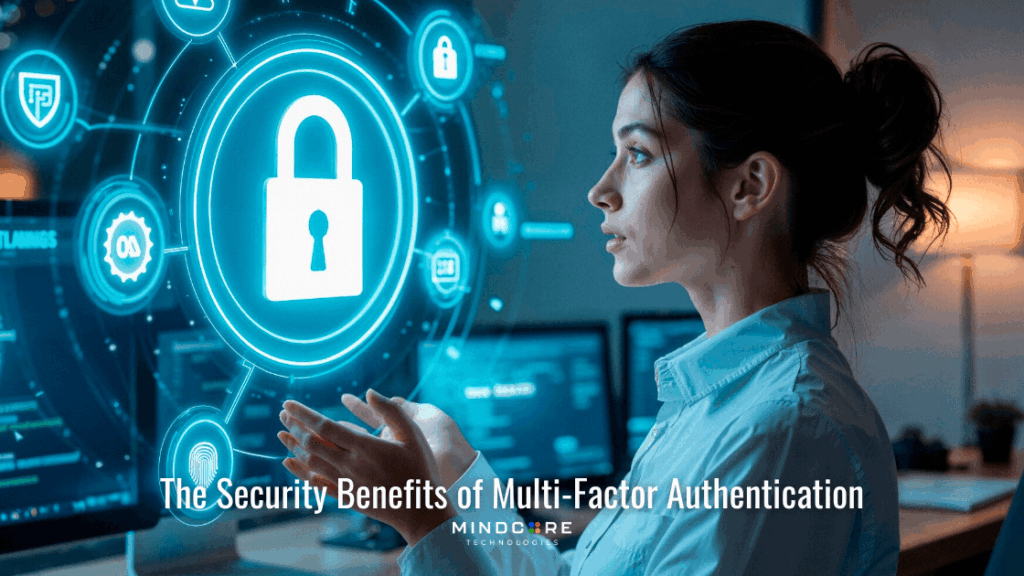
MFA is an authentication method that requires users to confirm their identity using more than one factor, such as:
- Something you know (password or PIN)
- Something you have (security token, phone app code)
- Something you are (biometric like fingerprint or face recognition)
By combining different factor types, MFA ensures that knowing a password alone is not sufficient to access an account or system.
Core Security Benefits of MFA
1. Significantly Reduces Unauthorized Access
Passwords are vulnerable to phishing, brute-force attacks, and reuse across sites. With MFA in place, attackers need more than just a stolen password — they must also compromise additional authentication factors. This layered defense sharply reduces the likelihood of account takeovers.
Government cybersecurity guidance states that enabling MFA makes accounts far less likely to be compromised, even if passwords are leaked or guessed.
2. Strong Defense Against Phishing and Credential Theft
Phishing attacks remain one of the most common paths to breach a system. MFA stops many of these attacks because even if users inadvertently provide a correct password to a fake site, attackers cannot complete the second or third factor required for access.
3. Reduces Fraud and Identity Theft
By requiring multiple verification obstacles, MFA significantly lowers the risk that unauthorized users can impersonate legitimate users. This reduces fraud tied to online transactions, unauthorized system access, and credential misuse.
4. Improves Regulatory Compliance
Industry standards and regulations such as HIPAA, PCI-DSS, and GDPR often require strong authentication as part of technical safeguards. Implementing MFA helps organizations align with these requirements, reducing regulatory risk and enhancing audit readiness.
5. Builds User Trust and Confidence
Customers and internal users are increasingly aware of data security risks. Deploying MFA signals that you take protection seriously, which enhances trust and can differentiate your organization in markets where security reputation matters.
6. Enables Secure Remote and Hybrid Work
With distributed workforces and cloud applications, risk expands beyond traditional network perimeters. MFA ensures that only verified users — regardless of where they connect from — can access systems and data, strengthening secure access for remote employees.
How Mindcore Technologies Implements MFA Securely
At Mindcore Technologies, MFA is integrated as part of a broader identity and access governance framework, not deployed as an isolated checkbox. This includes:
- Adaptive MFA Policies — triggering additional authentication based on risk context and user behavior
- Secure Factor Choices — leveraging authenticator apps, hardware tokens, or biometrics rather than insecure SMS where appropriate
- User Education and Enrollment Support — ensuring users understand MFA flows and reduce friction
- Continuous Monitoring and Enforcement — linking MFA signals into security monitoring and incident response pipelines
- Compliance Mapping — aligning MFA controls to specific regulatory frameworks
This strategic implementation approach makes MFA a defensible cornerstone of identity security, not just an added hurdle for users.
What You Should Do Next
To maximize the security benefits of MFA:
- Enable MFA on all critical systems and applications, especially email, cloud services, VPNs, and administrative portals.
- Use phishing-resistant factors (authenticator apps or hardware keys) wherever possible.
- Implement adaptive policies that escalate authentication requirements based on user risk signals.
- Integrate MFA logs with your security monitoring tools for visibility and anomaly detection.
- Educate users on how MFA works and why it matters to improve adoption.
Final Thought
Passwords alone are an invitation to compromise. Multi-Factor Authentication elevates your security posture by forcing attackers to overcome multiple barriers — not just a single string of characters.
When engineered into your identity and access controls with context, policy, and monitoring, MFA becomes a powerful, measurable defense that protects your data, infrastructure, and trust.
If you’d like, I can also provide a business leadership summary, implementation checklist, or comparison of MFA factor types to assist with planning. Just tell me what you need next.