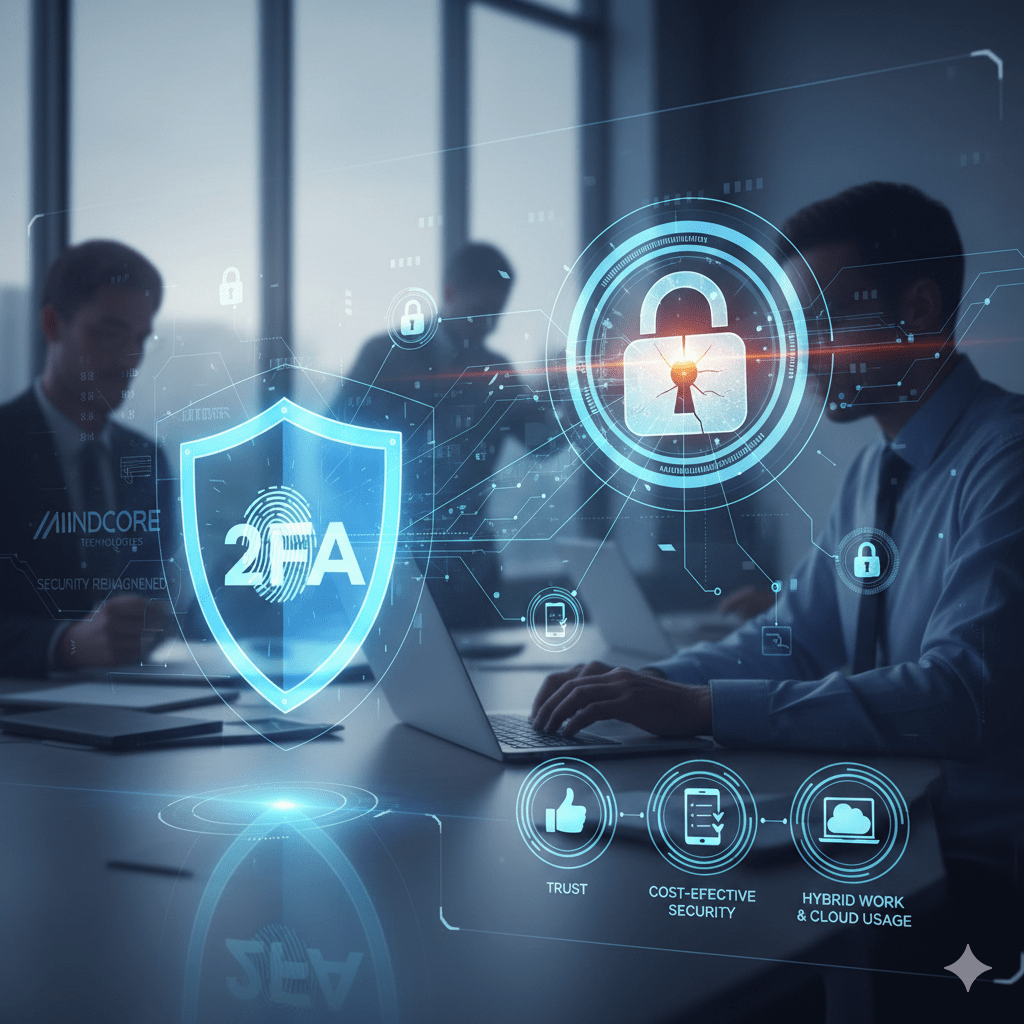
Passwords are no longer enough to protect business systems, sensitive data, and user accounts from modern cyber threats. Credential theft, phishing, and brute-force attacks can give attackers access even if passwords are strong. That’s why two-factor authentication (2FA) — requiring a second verification step beyond a password — is rapidly becoming standard practice, not just a recommended security control.
At Mindcore Technologies, we see 2FA adoption as a core defensive layer that reduces exposure, strengthens access control, and supports broader identity-centric security strategies.
What Two-Factor Authentication (2FA) Is
Two-factor authentication adds a second form of verification to the login process. Instead of relying on one credential (a password), 2FA requires a second factor drawn from a different category:
- Something you know – A PIN or secret answer
- Something you have – A device like a smartphone or security token
- Something you are – Biometric data (fingerprint, face recognition)
Most business implementations use something you have (e.g., a code sent to a device or generated by an authenticator app) after the password is entered.
Because it separates authentication across multiple factors, 2FA makes account compromise far more difficult even if passwords are stolen.
Why 2FA Is Becoming a Business Standard
1. Password-Only Security Is Too Weak
Cybercriminals increasingly exploit weak, reused, or stolen passwords to gain access to accounts. By requiring a second factor — especially tied to a device or biometrics — 2FA dramatically reduces this attack surface.
2. Phishing and Credential Theft Remain Rampant
Even basic phishing can capture passwords, but attackers without access to the second factor often fail to complete logins. This makes 2FA one of the most effective defenses against credential reuse and phishing attacks.
3. Customers and Users Expect It
Customers today expect stronger protections on their accounts, especially with sensitive data or financial services. Offering 2FA signals that your business values security and is acting responsibly to protect user information.
4. Compliance and Regulatory Pressures
Many industry standards and regulations (e.g., HIPAA, PCI-DSS, GDPR) either require or strongly encourage multi-factor authentication. Adopting 2FA helps organizations meet compliance requirements and avoid penalties.
5. Cost-Effective Security Investment
Implementing 2FA costs far less than the financial and reputational damage that can result from a breach. By making unauthorized access significantly harder, 2FA protects against costly security incidents.
6. Adoption Is Accelerating With Hybrid Work and Cloud Usage
Remote and hybrid work environments have increased reliance on cloud apps and remote access portals. 2FA is a foundational guardrail for secure remote authentication where perimeter boundaries no longer exist.
How 2FA Fits Into Modern Security Strategies
2FA isn’t a replacement for strong passwords — it’s a complementary control that closes gaps typical of password-only security. Successful security programs now combine 2FA with:
- Single sign-on (SSO) and centralized identity management
- Adaptive or risk-based authentication
- Identity governance and least-privilege access
- Continuous monitoring and anomaly detection
This layered approach ensures that access decisions are defensible and aligned with business risk profiles.
How Mindcore Technologies Helps You Deploy 2FA
At Mindcore Technologies, we integrate two-factor authentication into broader identity and access governance frameworks, not as an isolated feature. Our services include:
- Policy design and factor selection that matches risk and usability goals
- Integration with cloud and on-prem systems
- Adaptive and conditional access configuration
- User onboarding and training to improve adoption
- Monitoring and incident response alignment so anomalous access attempts are immediately visible
This ensures that 2FA becomes a strategic security capability, not just a checkbox.
Final Thought
Two-factor authentication is rapidly becoming the standard because single-factor access is no longer defensible. Organizations that adopt 2FA:
- Harden user accounts against common attack methods
- Improve customer trust and compliance
- Reduce financial and operational risk
Today’s threat landscape demands that businesses go beyond passwords — and 2FA is one of the most effective, practical ways to do it.