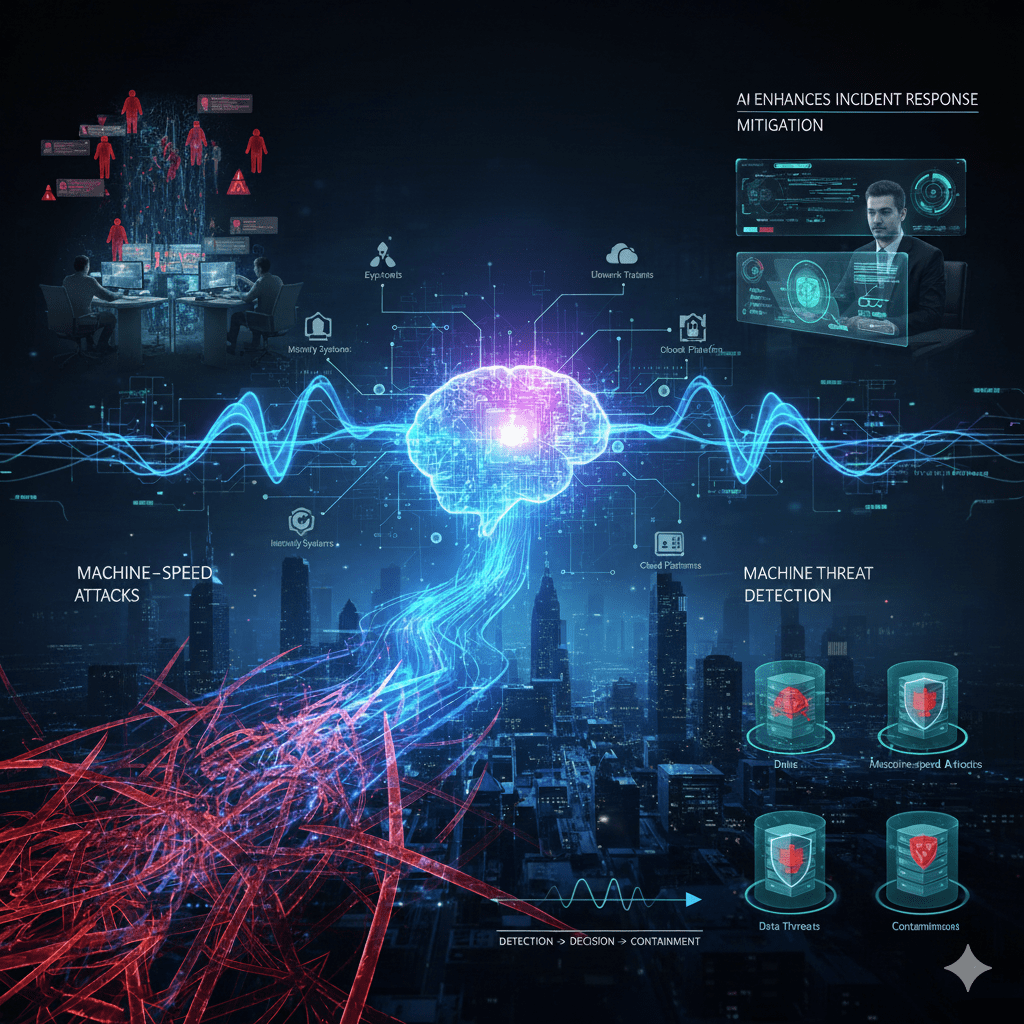
Incident response fails for one simple reason. Humans are too slow for machine-speed attacks. By the time an analyst confirms an alert, attackers have already moved laterally, escalated privileges, or exfiltrated data.
At Mindcore Technologies, we see incident response as a time compression problem, not a tooling problem. AI matters because it collapses the time between detection, decision, and containment. Used correctly, it changes outcomes. Used blindly, it creates false confidence and automation risk.
This article explains how AI actually enhances incident response, where automation delivers real value, and how organizations should deploy it safely.
Why Traditional Incident Response Breaks Down
Most incident response programs still rely on:
- Manual alert triage
- Human correlation of events
- Reactive investigation
- Delayed containment approvals
These workflows were built for slower threats. Modern attacks move faster than human decision cycles.
Common failures include:
- Alerts piling up faster than teams can review
- Attacks progressing during investigation
- Containment actions delayed by uncertainty
- Response happening after damage is done
Speed, not sophistication, is the primary gap.
What AI Actually Changes in Incident Response
AI does not replace incident responders. It removes friction from the parts humans are bad at.
AI excels at:
- Pattern recognition across massive data sets
- Correlating weak signals into meaningful incidents
- Making consistent decisions under time pressure
- Executing pre-approved actions instantly
This shifts responders from reactive analysis to strategic oversight.
How AI Enhances Incident Response in Practice
1. Faster Threat Detection Through Correlation
AI correlates signals across:
- Endpoints
- Identity systems
- Network traffic
- Cloud platforms
What looks like isolated noise to humans becomes a coherent attack story to AI.
2. Reducing Alert Fatigue
Incident response fails when everything looks urgent.
AI helps by:
- Suppressing low-confidence alerts
- Grouping related events into single incidents
- Prioritizing activity with real risk indicators
Fewer alerts lead to faster, better decisions.
3. Early Identification of Attack Progression
AI recognizes attack stages such as:
- Initial access
- Privilege escalation
- Lateral movement
- Data staging
Catching attacks mid-chain prevents full compromise.
4. Automated Containment of Known Risk
For high-confidence threats, AI can:
- Isolate compromised endpoints
- Disable suspicious accounts
- Block malicious connections
- Restrict session activity
Automation stops damage while humans assess impact.
5. Continuous Monitoring During the Incident
Incidents do not pause during response.
AI monitors:
- Attacker adaptation
- New compromise attempts
- Post-containment behavior
This prevents attackers from re-entering through alternate paths.
Why Automation Matters More Than Perfect Detection
Perfect detection is unrealistic. Fast containment is achievable.
AI-driven response focuses on:
- Limiting blast radius
- Preserving evidence
- Preventing escalation
Stopping damage early matters more than understanding everything immediately.
Where AI-Driven Incident Response Goes Wrong
AI introduces risk when deployed without discipline.
1. Blind Automation
Automated actions without oversight can:
- Disrupt business operations
- Lock out legitimate users
- Break critical systems
High-impact actions must be pre-approved and well-scoped.
2. Poor Playbook Design
AI executes what it is given.
Weak playbooks lead to:
- Inconsistent response
- Missed containment steps
- Unintended consequences
Automation amplifies both good and bad design.
3. Lack of Explainability
If teams cannot explain:
- Why an action was taken
- What triggered automation
- How decisions were made
Response credibility collapses during audits or post-incident review.
What AI Does Not Replace in Incident Response
AI does not replace:
- Human judgment
- Legal and regulatory decision-making
- Executive communication
- Strategic risk assessment
AI accelerates execution. Humans remain accountable.
How to Deploy AI in Incident Response Safely
1. Pre-Approve Containment Actions
Define what AI is allowed to do automatically.
Examples:
- Endpoint isolation
- Account suspension under defined conditions
- Blocking known malicious indicators
Clear guardrails prevent chaos.
2. Anchor AI Decisions to Identity and Context
Context matters.
AI response should consider:
- User role
- Device trust
- Data sensitivity
- Business impact
Not all alerts deserve the same response.
3. Maintain Human-in-the-Loop Oversight
High-risk actions require confirmation.
AI should:
- Recommend
- Prepare
- Execute approved actions
Humans decide exceptions.
4. Ensure Full Logging and Auditability
Every AI-driven action must be:
- Logged
- Traceable
- Reviewable
Incident response must stand up to scrutiny.
5. Test Continuously
AI response workflows must be tested like fire drills.
This includes:
- Simulated attacks
- Playbook validation
- Response timing analysis
Unpracticed automation fails under pressure.
The Biggest Incident Response Mistake We See
Organizations invest heavily in detection but underinvest in response speed.
Detection without fast containment is visibility, not protection.
How Mindcore Technologies Uses AI in Incident Response
Mindcore helps organizations modernize incident response through:
- AI-assisted threat correlation
- Identity and endpoint containment automation
- Pre-approved response playbooks
- Human-supervised response workflows
- Compliance-ready logging and reporting
- Continuous tuning and optimization
We focus on reducing dwell time, not generating alerts.
A Simple Readiness Check
You are not ready for AI-enhanced incident response if:
- Response relies entirely on manual steps
- Containment requires executive approval every time
- Alerts overwhelm analysts
- Actions are not logged consistently
Attackers exploit delay, not ignorance.
Final Takeaway
AI enhances incident response by doing what humans cannot at scale: correlating signals, acting instantly, and enforcing consistency under pressure. The advantage is not automation alone. It is time regained during an attack.
Organizations that deploy AI with clear guardrails, identity context, and human oversight will contain incidents faster and with less damage. Those that rely on manual response will continue to fight machine-speed threats with human-speed processes.