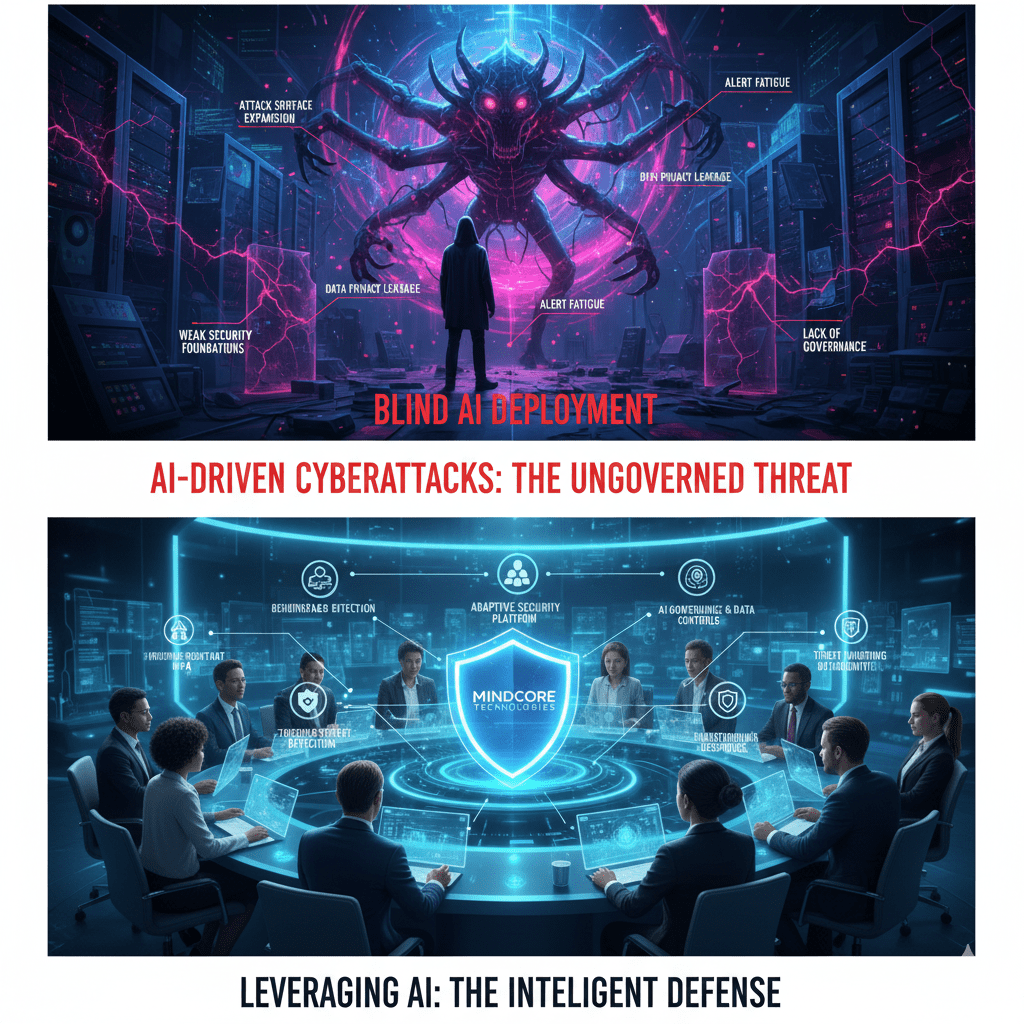
AI is not automatically making organizations more secure. It is making good security teams more effective and weak security programs more dangerous. The difference comes down to how AI is deployed, governed, and integrated into real defensive workflows.
At Mindcore Technologies, we see a growing divide. Some organizations are using AI to reduce detection time, cut noise, and surface real risk faster than ever. Others are deploying AI tools blindly, increasing attack surface, privacy risk, and false confidence.
This article explains how AI is actually transforming cybersecurity, where it provides real defensive advantage, and how businesses should leverage it without creating new vulnerabilities.
The Reality Check: AI Is Not a Security Strategy
AI does not replace fundamentals.
AI amplifies:
- Good visibility
- Clean data
- Strong identity controls
- Mature response processes
If those foundations are weak, AI magnifies the weaknesses.
Organizations that expect AI to “fix security” without fixing architecture are setting themselves up for failure.
Where AI Actually Strengthens Cybersecurity
When applied correctly, AI excels in areas where humans struggle at scale.
1. Faster Threat Detection Through Behavioral Analysis
Traditional security tools rely heavily on:
- Signatures
- Static rules
- Known indicators
AI excels at detecting abnormal behavior, even when there is no known signature.
Effective AI-driven detection identifies:
- Unusual login patterns
- Abnormal data access
- Suspicious process behavior
- Deviations from baseline activity
This shortens the gap between compromise and detection.
2. Reducing Alert Noise and Analyst Fatigue
Security teams are overwhelmed by alerts.
AI helps by:
- Correlating related events
- Suppressing low-risk noise
- Prioritizing high-confidence threats
When implemented properly, AI allows analysts to focus on incidents that actually matter.
3. Improving Phishing and Social Engineering Detection
AI-driven attacks require AI-driven defense.
Modern AI-based email security:
- Detects impersonation patterns
- Analyzes intent, not just content
- Flags abnormal communication behavior
This is critical as phishing becomes more realistic and targeted.
4. Accelerating Incident Response
AI improves response by:
- Automatically gathering context
- Recommending containment actions
- Speeding up investigation timelines
This does not remove humans from the loop. It gives them better information faster.
5. Enhancing Threat Hunting Capabilities
Threat hunting is difficult to scale manually.
AI assists by:
- Identifying subtle anomalies
- Surfacing long-term trends
- Highlighting low-and-slow attacker behavior
This is where AI provides long-term defensive advantage.
Where AI Creates New Security Risk
AI also introduces risk when deployed without controls.
1. AI Expands the Attack Surface
AI systems require:
- Data access
- Integrations
- APIs
- Automation
Each of these becomes a potential attack path if not secured properly.
2. Blind Trust in AI Output
AI output is not always correct or safe.
Common failures include:
- Hallucinated conclusions
- Incomplete analysis
- Overconfidence in recommendations
Security decisions must still be validated by humans.
3. Data Privacy and Leakage Risk
AI systems:
- Ingest sensitive data
- Cache prompts and responses
- Generate derived information
Without strict governance, AI becomes a data exposure vector.
4. Adversarial Use of AI Against Defenders
Attackers also use AI.
They exploit:
- Detection thresholds
- Alert fatigue
- Predictable AI-driven responses
Defensive AI must assume intelligent adversaries.
How to Leverage AI Safely in Cybersecurity
Using AI effectively requires discipline and structure.
1. Anchor AI to Identity and Access Controls
AI insights are only useful if access is controlled.
Strong identity foundations include:
- Phishing-resistant MFA
- Conditional access policies
- Least-privilege enforcement
AI can surface risk, but identity controls stop damage.
2. Treat AI Output as Advisory, Not Authority
AI should inform decisions, not make them unilaterally.
Best practice:
- Human review for high-risk actions
- Clear escalation paths
- No autonomous execution without approval
AI supports analysts. It does not replace accountability.
3. Govern Data Access Rigorously
AI should only see what it needs.
Effective controls include:
- Data classification
- Explicit allowlists
- Separation between sensitive systems and AI tools
If AI cannot access sensitive data, it cannot leak it.
4. Monitor AI Behavior Like Any Other System
AI systems must be monitored.
This includes:
- Usage patterns
- Access behavior
- Output anomalies
- Abuse attempts
AI without monitoring becomes a blind spot.
5. Integrate AI Into Existing Security Operations
AI works best when embedded into:
- SOC workflows
- Incident response processes
- Threat hunting programs
Standalone AI tools without operational integration rarely deliver value.
The Biggest AI Security Mistake Organizations Make
The most common failure we see is AI optimism without governance.
Organizations rush to adopt AI because:
- It promises efficiency
- It looks impressive
- Competitors are using it
Without clear rules, ownership, and oversight, AI becomes technical debt.
How Mindcore Technologies Uses AI to Strengthen Defenses
Mindcore leverages AI as part of a disciplined security strategy, not a shortcut.
Our approach includes:
- AI-assisted behavioral detection
- Identity-centric security design
- AI governance and data controls
- Threat hunting augmentation
- Analyst-driven response workflows
- Continuous monitoring and tuning
We use AI to enhance human judgment, not replace it.
A Simple Decision Framework for Leaders
AI strengthens cybersecurity when:
- Foundations are solid
- Data access is controlled
- Outputs are validated
- Humans remain accountable
AI weakens cybersecurity when:
- It is deployed blindly
- It operates autonomously
- It lacks governance
- It increases exposure
Final Takeaway
AI is transforming cybersecurity, but not by making defenses automatic. It makes them faster, more informed, and more scalable when used correctly.
Organizations that treat AI as a force multiplier for strong fundamentals will gain real advantage. Those that treat AI as a replacement for fundamentals will create new risks they do not fully understand.
The question is not whether to use AI in cybersecurity. The question is whether you are using it deliberately, safely, and with clear accountability.