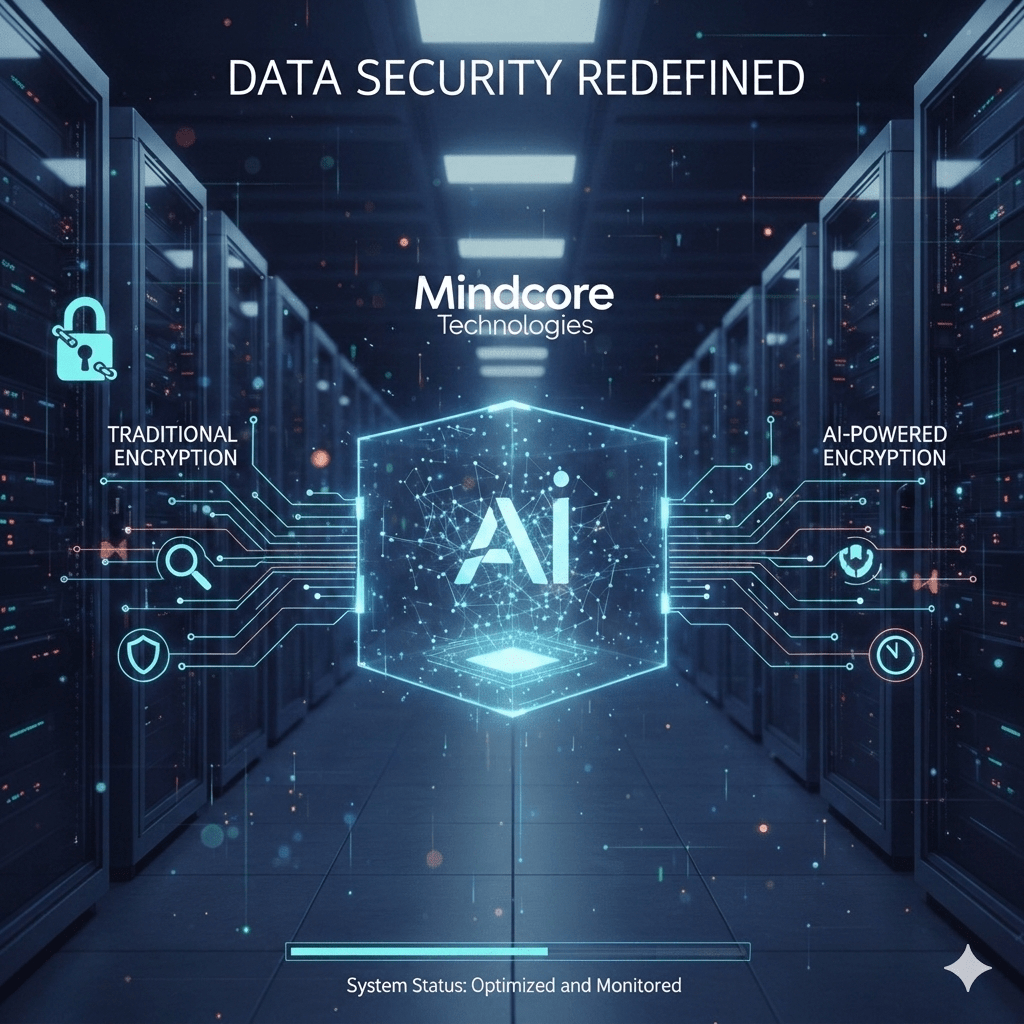
Encryption has always been about math and key management. AI changes that equation by introducing adaptability, context, and automation into how data is protected. Used correctly, AI-powered encryption strengthens security posture and reduces human error. Used poorly, it creates opaque systems that are hard to audit, govern, or trust.
At Mindcore Technologies, we see AI-powered encryption not as a replacement for proven cryptography, but as an intelligence layer that improves how encryption is applied, monitored, and managed in real-world environments.
This article explains what AI-powered encryption actually is, how it differs from traditional approaches, and how organizations should deploy it without increasing risk.
What AI-Powered Encryption Really Means
AI does not invent new cryptographic algorithms. That is a common misconception.
AI-powered encryption refers to using machine learning and automation to:
- Optimize key management
- Adapt encryption policies dynamically
- Detect misuse or weak configurations
- Automate response to risk conditions
The cryptography itself remains standards-based. AI enhances how and when it is used.
Why Traditional Encryption Struggles at Scale
Encryption failures rarely occur because algorithms are broken. They occur because:
- Keys are mismanaged
- Access policies are inconsistent
- Encryption is applied unevenly
- Exceptions accumulate over time
- Visibility into usage is poor
As environments grow more distributed and cloud-driven, manual encryption management does not scale.
How AI Changes the Encryption Model
AI introduces context-awareness into data protection.
1. Adaptive Encryption Based on Risk
Traditional encryption is static.
AI-powered encryption can:
- Increase protection for high-risk access
- Apply stricter controls to sensitive data
- Adjust policies based on location, device, or behavior
This ensures encryption strength aligns with real-time risk.
2. Smarter Key Management
Key management is one of the weakest points in encryption.
AI helps by:
- Monitoring key usage patterns
- Detecting abnormal access attempts
- Rotating keys automatically based on risk
- Flagging misconfigured or overused keys
This reduces exposure caused by human error.
3. Automated Policy Enforcement
AI can enforce encryption policies consistently across:
- Cloud platforms
- Endpoints
- Applications
- Data stores
This eliminates gaps caused by manual configuration drift.
4. Detecting Encryption Misuse
Encryption can be abused.
AI helps identify:
- Unauthorized decryption attempts
- Excessive key usage
- Encryption being bypassed or disabled
- Anomalous access to protected data
Visibility is as important as protection.
5. Supporting Zero Trust Architectures
AI-powered encryption aligns naturally with Zero Trust.
It enables:
- Data-level protection regardless of location
- Conditional access tied to identity and behavior
- Encryption that travels with the data
This is essential for modern, distributed environments.
Where AI-Powered Encryption Can Create Risk
AI improves encryption management, but it also introduces new concerns.
1. Reduced Transparency
AI-driven decisions can be difficult to explain.
If organizations cannot answer:
- Why encryption was applied or relaxed
- Why keys were rotated
- Why access was granted
They face audit and compliance risk.
2. Over-Automation Without Oversight
Encryption decisions should not be fully autonomous.
High-risk actions require:
- Human approval
- Clear escalation paths
- Audit trails
Blind automation creates accountability gaps.
3. Data Privacy Implications
AI systems often analyze:
- Access patterns
- Usage behavior
- Contextual metadata
This data must be governed carefully to avoid privacy overreach.
4. Vendor Lock-In and Black Box Solutions
Some AI-powered encryption platforms:
- Hide key logic
- Limit portability
- Obscure control mechanisms
This creates long-term operational and compliance risk.
What AI-Powered Encryption Does Not Replace
AI does not replace:
- Proven cryptographic standards
- Strong identity and access controls
- Sound data classification
- Governance and policy discipline
AI strengthens encryption operations. It does not compensate for weak fundamentals.
How Organizations Should Deploy AI-Powered Encryption Safely
1. Anchor AI Encryption to Identity
Encryption decisions should be tied to:
- Verified identity
- Device trust
- Access context
Identity remains the control plane.
2. Maintain Explainability
Organizations must be able to explain:
- How encryption policies work
- Why actions were taken
- How keys are managed
Explainability is now a compliance requirement.
3. Enforce Human Oversight for Critical Actions
AI should recommend, not decide, when:
- Access to highly sensitive data changes
- Keys are revoked
- Encryption policies are modified
Oversight preserves accountability.
4. Limit Data Exposure to the AI Layer
AI should not ingest:
- Raw sensitive content unnecessarily
- Decryption material without justification
Data minimization applies to AI systems as well.
5. Monitor and Audit Continuously
AI-powered encryption systems must be monitored like any other security control.
This includes:
- Usage logging
- Anomaly detection
- Policy review
- Regular audits
Security without visibility is illusion.
Why AI-Powered Encryption Matters Now
As data moves across:
- Cloud services
- Remote work environments
- Third-party platforms
- AI systems themselves
Perimeter-based security fails.
Encryption must be:
- Dynamic
- Context-aware
- Automated
- Governed
AI provides the intelligence layer needed to meet this reality.
How Mindcore Technologies Helps Organizations Use AI-Powered Encryption
Mindcore helps organizations modernize data protection without sacrificing control through:
- Encryption architecture design
- AI-assisted key management strategy
- Identity-aligned encryption controls
- Policy governance and audit readiness
- Vendor and platform evaluation
- Ongoing monitoring and optimization
We focus on practical security, not buzzwords.
A Simple Readiness Check
You are not ready for AI-powered encryption if:
- Key management is manual and inconsistent
- Encryption policies are static
- Usage is not monitored
- Decisions cannot be explained
- Governance is undefined
AI amplifies whatever discipline already exists.
Final Takeaway
AI-powered encryption is redefining data security by adding intelligence to how encryption is applied, managed, and monitored. The value is not stronger math. The value is better decisions at scale.
Organizations that deploy AI-powered encryption with identity alignment, transparency, and oversight will strengthen security significantly. Those that treat it as a black box will create new risks that are harder to detect than the problems encryption was meant to solve.