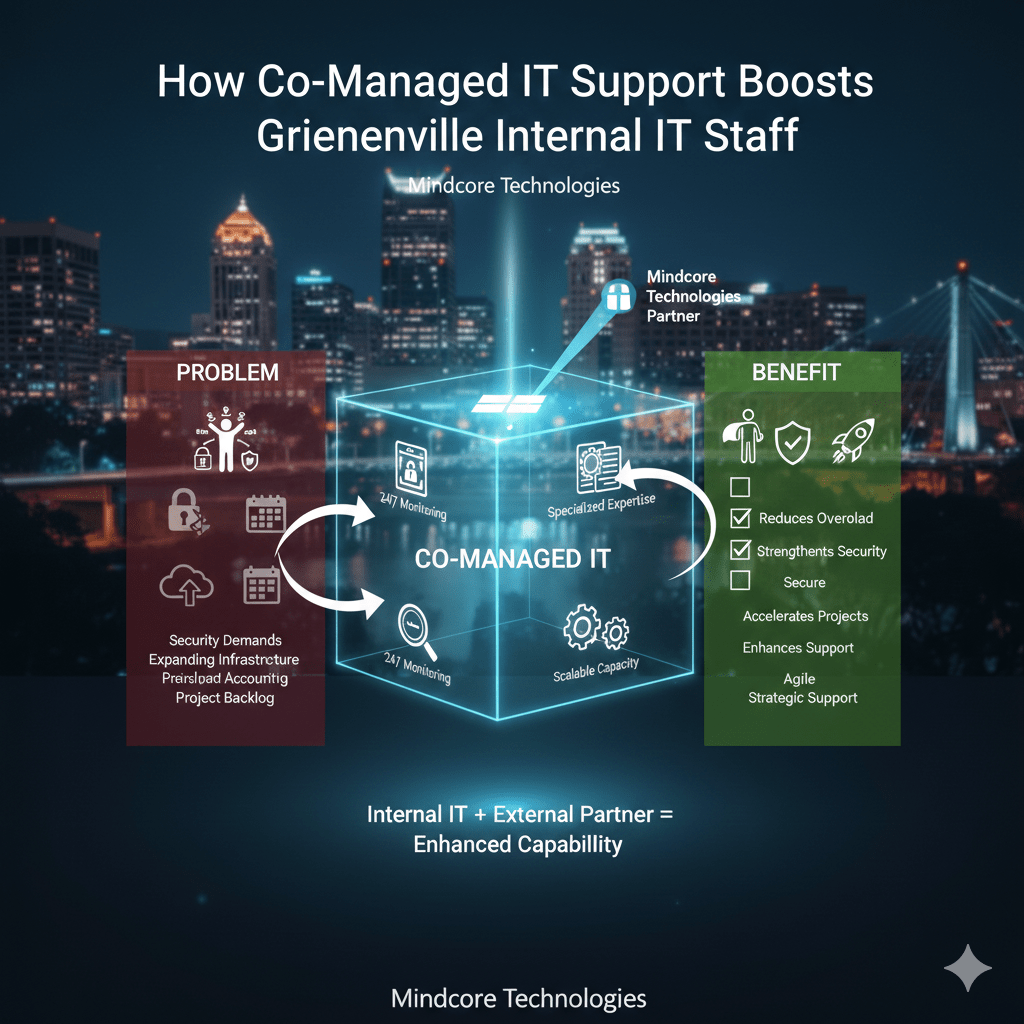
Most Greenville businesses do not lack IT talent. They lack capacity.
Internal IT teams are often skilled and dedicated, but as companies grow, complexity increases faster than headcount. The result is reactive firefighting, delayed projects, and rising security risk.
Co-managed IT support is not outsourcing IT. It is strategic reinforcement.
At Mindcore Technologies, we work alongside internal IT departments, not around them. The goal is to extend capability, improve resilience, and reduce operational strain without replacing in-house expertise.
What Is Co-Managed IT Support?
Co-managed IT is a partnership model where a managed service provider works alongside an internal IT team.
It supplements internal staff with:
- Specialized expertise
Provides access to advanced security, networking, and cloud knowledge that may not exist internally. - 24/7 monitoring and support resources
Extends coverage beyond standard office hours without expanding payroll. - Scalable operational capacity
Adjusts support levels as business demands increase.
The internal IT team remains in control. The external partner strengthens execution.
Why Greenville Internal IT Teams Become Overloaded
Growth creates pressure points that small teams struggle to absorb.
Increasing Security Demands
- Rising cybersecurity threats
Monitoring, patching, and response require constant attention. - Compliance obligations
Logging, audit readiness, and vendor risk management add complexity. - Identity and cloud governance challenges
SaaS sprawl increases administrative burden.
Security workload scales with the business.
Expanding Infrastructure
- New locations and hybrid work models
Require redesigned network architecture and secure remote access. - Cloud adoption growth
Demands structured governance and cost monitoring. - Device proliferation
More endpoints mean more vulnerability management.
Infrastructure complexity grows faster than staff size.
Project Backlog And Strategic Delay
- Reactive ticket queues
Daily support requests consume available time. - Delayed modernization initiatives
Infrastructure upgrades are postponed. - No long-term roadmap development
IT becomes operational, not strategic.
Internal teams become trapped in maintenance mode.
How Co-Managed IT Boosts Internal IT Performance
Co-managed IT strengthens internal teams instead of replacing them.
1. Reduces Operational Overload
- Offloads routine monitoring tasks
24/7 system monitoring reduces manual oversight demands. - Handles after-hours alerts
Internal teams are not required to respond to overnight incidents. - Supports ticket overflow
Prevents backlog accumulation during peak periods.
Reduced overload improves focus and morale.
2. Strengthens Cybersecurity Posture
- Continuous threat monitoring
Detects anomalies before they escalate. - Advanced security tooling implementation
Adds capabilities internal teams may not have bandwidth to deploy. - Regular vulnerability scanning and patch management
Maintains consistent protection cycles.
Security maturity improves without expanding headcount.
3. Accelerates Strategic Projects
- Provides additional engineering support
Enables faster rollout of infrastructure upgrades. - Assists with cloud migration planning
Reduces project risk and complexity. - Supports network modernization initiatives
Improves scalability and resilience.
Projects move forward instead of remaining in backlog.
4. Enhances Business Continuity Planning
- Develops structured disaster recovery strategies
Ensures recovery processes are documented and tested. - Implements redundancy planning
Reduces single points of failure. - Tests failover procedures regularly
Validates continuity readiness.
Resilience becomes proactive instead of reactive.
5. Provides Strategic Advisory Support
- IT roadmap development
Aligns infrastructure investments with business growth goals. - Budget forecasting assistance
Improves capital planning and lifecycle management. - Executive-level reporting
Provides leadership with visibility into risk and performance.
Internal IT teams gain strategic leverage.
When Greenville Businesses Should Consider Co-Managed IT
Co-managed IT is appropriate when:
- The internal IT team is consistently overloaded.
- Security incidents are increasing.
- Strategic projects are repeatedly delayed.
- Compliance demands are growing.
- Leadership lacks clear visibility into IT performance metrics.
Growth without reinforcement creates risk.
Common Misconceptions About Co-Managed IT
“It Replaces Our IT Team”
- Co-managed support complements internal staff.
- Internal teams retain authority and decision-making control.
- The partnership strengthens execution, not hierarchy.
“It Is Only For Large Enterprises”
- Mid-sized businesses often benefit most.
- Growing companies need scalable expertise without adding payroll.
- Flexible service models align with business size.
“It Is Just Help Desk Support”
- True co-managed models include security, infrastructure design, and strategic planning.
- Monitoring, compliance, and risk management are core components.
- It is an operational partnership, not just ticket handling.
How Mindcore Technologies Supports Greenville Internal IT Teams
Mindcore strengthens Greenville IT departments by:
- Providing 24/7 monitoring and proactive threat detection.
- Assisting with cloud governance and identity security implementation.
- Supporting infrastructure modernization and network segmentation.
- Reducing ticket overload during peak demand periods.
- Developing long-term IT strategy aligned with leadership goals.
Co-managed IT is about capability expansion, not control transfer.
Final Takeaway
Greenville businesses that rely solely on small internal IT teams often experience overload, delayed projects, and rising security exposure as they grow.
Co-managed IT support reinforces internal staff with additional expertise, continuous monitoring, and strategic advisory capabilities. It improves resilience, accelerates modernization, and reduces operational strain.
For long-term growth, IT must evolve from reactive support to structured, scalable oversight.