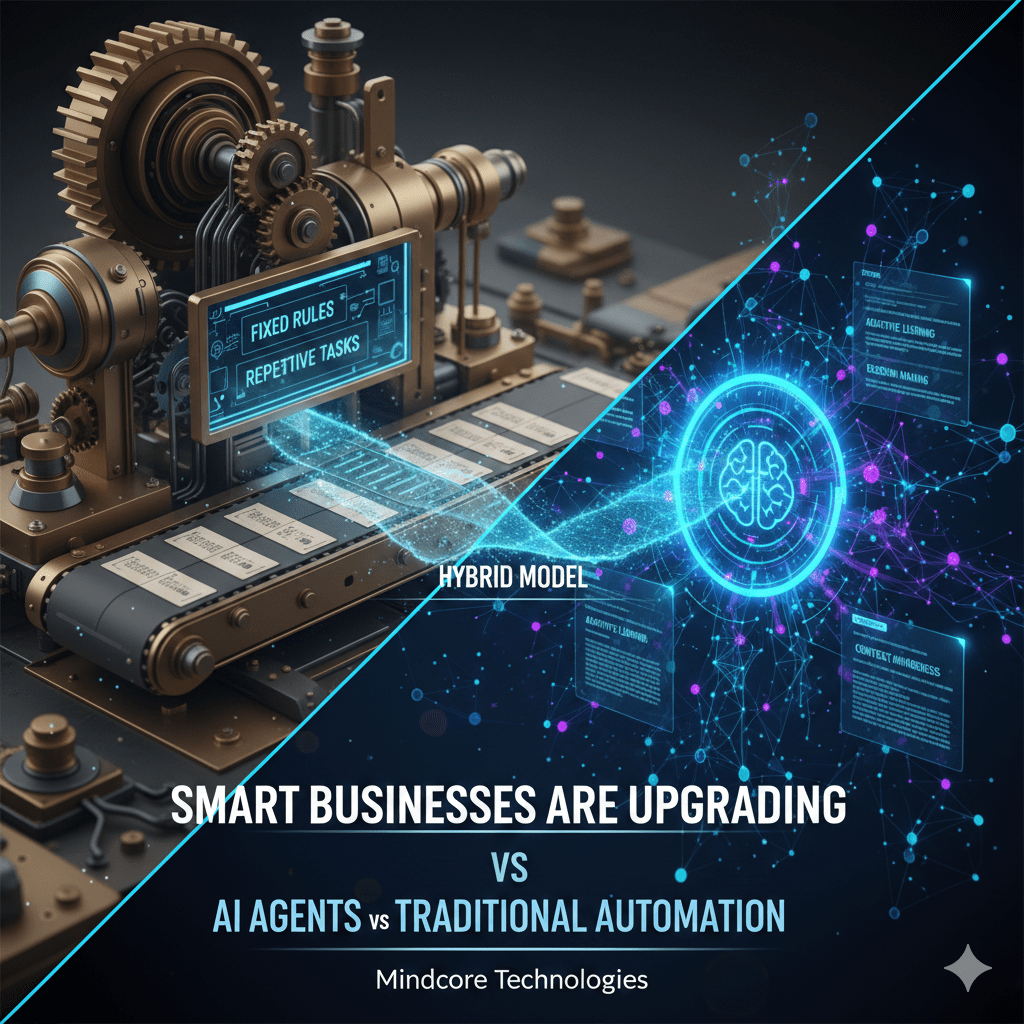
The Core Difference: Static Rules vs Intelligent Behavior
Traditional automation — including Robotic Process Automation (RPA) — executes predefined steps exactly as programmed. It is excellent for predictable, structured workflows like batch processing, scheduled tasks, or repetitive data transfers. However, it doesn’t adapt when conditions change or new context arises.
AI agents, on the other hand, are designed to understand context, interpret unstructured inputs (like text or conversations), and make decisions based on goals and data. They use machine learning and reasoning to handle complexity that simple rules can’t address.
Why Forward-Thinking Organizations Are Making the Shift
1. Adaptability and Learning
Traditional automation repeats the same workflow until someone rewrites the rules. AI agents learn from data patterns, handle exceptions without manual rule updates, and improve behavior over time — reducing maintenance overhead and extending capabilities.
2. Decision-Making and Context Awareness
Legacy automation falters when inputs vary or when judgment is needed. AI agents can interpret context — such as customer tone, priority signals, or business conditions — and act appropriately without human intervention.
3. Handling Unstructured Data
Tasks involving unstructured information — emails, document text, images — are outside the scope of classic automation. AI agents can ingest, understand, and act on this content, enabling automation in areas that were previously manual or semi-automated.
4. End-to-End Process Intelligence
Where traditional automation is a tool for execution, AI agents can become dynamic workflow partners that optimize decisions, escalate exceptions, and trigger additional actions based on goals and observations.
Business Outcomes Businesses See When Upgrading
Increased Efficiency — Agents eliminate manual oversight for adaptive processes, reducing bottlenecks and enabling employees to focus on high-value work.
Smarter Decisions — By integrating real-time data evaluation, agents support better operational choices and reduce error rates compared with rigid scripts.
Scalability — Workflows that once required frequent rule updates now scale with business complexity because the agent learns and adapts without constant engineering intervention.
Competitive Advantage — Organizations that embrace AI agents can transition from “doing work faster” to “doing work smarter,” enabling new service levels and innovation.
When Traditional Automation Still Makes Sense
- Stable, highly predictable tasks where outcomes never vary
- Compliance-driven processes requiring strict, auditable rule sets
- High-volume, high-speed but simple operations such as nightly batch runs
In these contexts, traditional automation remains cost-effective, fast, and reliable — especially when paired with AI agents for the complex adaptive layers.
The Hybrid Model: Best of Both Worlds
Winning organizations rarely choose only one approach. Instead, they build hybrid automation stacks:
- Traditional scripts to handle foundation tasks
- AI agents to manage decision points, exception workflows, and adaptive behaviors
This layered strategy preserves the speed and determinism of automation while leveraging the intelligence and autonomy of AI agents.
Mindcore Technologies’ Perspective
At Mindcore Technologies, we help businesses:
- Assess the right tasks for automation vs agents
- Design hybrid workflows that reduce manual work and increase agility
- Integrate AI agents securely into existing systems and governance
- Monitor performance and continuous improvement of agent behavior
Instead of viewing AI agents as “nice-to-have,” we treat them as strategic accelerators that elevate routine operations into intelligent, adaptable processes that scale with business needs.
Final Thought
Upgrading from traditional automation to AI agents isn’t a fad — it’s a strategic transition that:
- Enhances adaptability and future-proofs operations
- Reduces maintenance and reliance on manual rule editing
- Enables intelligent decision-making at scale
- Shortens time from insight to action
Smart businesses don’t just automate — they evolve their automation with intelligence, turning static workflows into dynamic capabilities that support growth, resilience, and innovation.
If you want, I can also provide an implementation roadmap for hybrid automation powered by AI agents — just let me know.