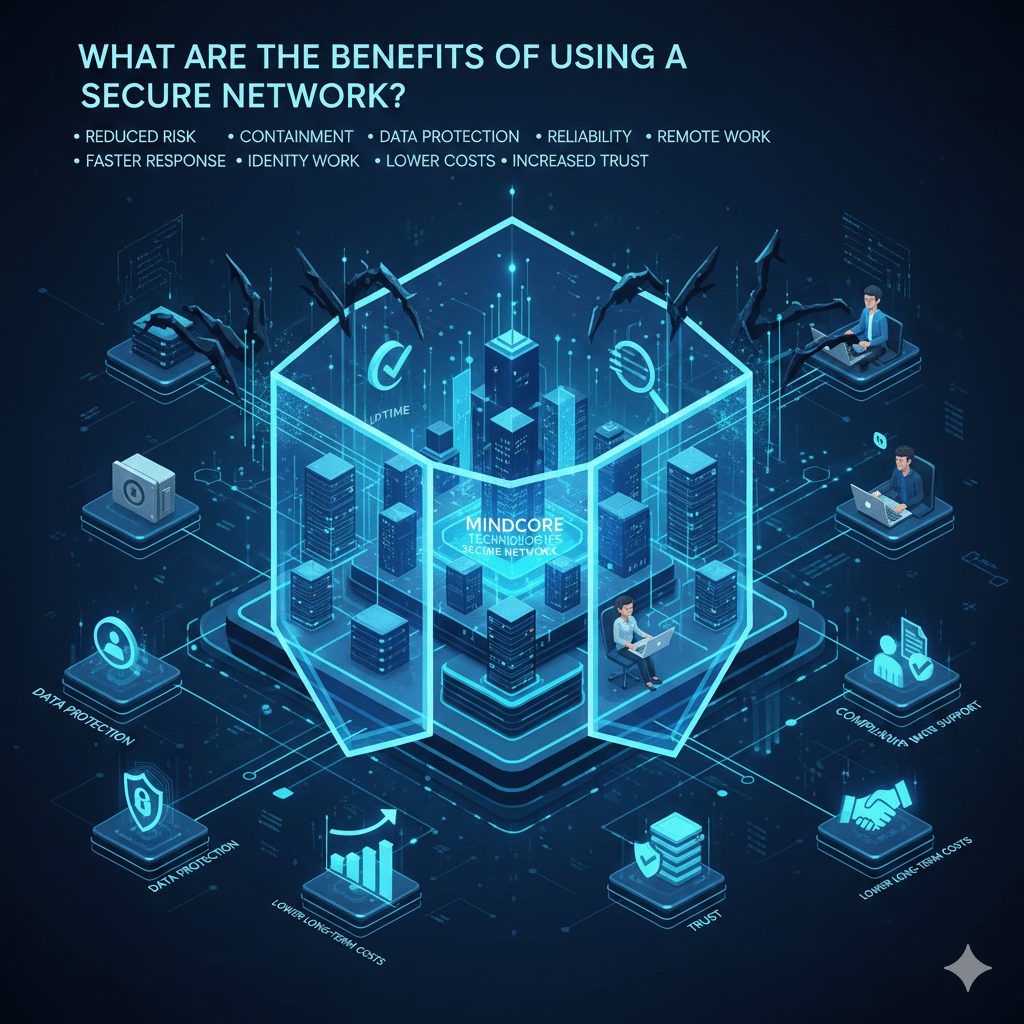
A secure network does more than stop attackers. It stabilizes operations, protects revenue, and reduces decision pressure when something goes wrong. Organizations that treat network security as a background IT task usually discover its value only after a breach, outage, or compliance failure.
At Mindcore Technologies, we see a clear divide between organizations that invest in secure network design and those that rely on inherited, flat, overly trusted environments. The difference shows up in downtime, incident impact, and recovery speed.
This article breaks down the real, measurable benefits of using a secure network and why those benefits extend far beyond “cybersecurity.”
1. Reduced Risk of Breaches and Ransomware
The most obvious benefit is also the most misunderstood.
A secure network:
- Limits exposure to the internet
- Restricts unauthorized access paths
- Prevents uncontrolled lateral movement
Most ransomware incidents do not start with advanced exploits. They succeed because once attackers gain access, the network allows them to move freely. Secure networks remove that freedom.
2. Containment When Something Goes Wrong
Breaches happen. What matters is how far they spread.
Secure networks use:
- Segmentation between systems
- Controlled east-west traffic
- Restricted access to sensitive resources
This turns a compromise into a contained incident instead of a full network failure. Containment is often the difference between minor disruption and days of downtime.
3. Protection of Sensitive Data
Data moves constantly across networks.
A secure network:
- Restricts who can reach sensitive data
- Monitors abnormal data movement
- Limits outbound connections
This makes silent data theft and extortion significantly harder. When data cannot move freely, attackers lose leverage.
4. Improved Business Uptime and Reliability
Security and reliability are tightly linked.
Secure networks:
- Reduce attack-related outages
- Prevent misconfigurations from cascading
- Isolate failures to specific segments
Organizations with strong network security experience fewer disruptions, even outside of security incidents.
5. Faster Detection and Response
Visibility is a core benefit.
Secure networks provide:
- Traffic monitoring and logging
- Alerting on abnormal behavior
- Context for faster investigation
When something unusual happens, teams can respond quickly instead of guessing where the problem started.
6. Support for Remote and Hybrid Work
Modern work depends on secure connectivity.
A secure network:
- Protects remote access paths
- Validates users and devices
- Enforces consistent policy regardless of location
This allows businesses to support flexible work models without expanding risk.
7. Stronger Identity Protection
Identity is now the primary attack surface.
Secure networks:
- Integrate with identity systems
- Enforce access based on user and role
- Prevent over-privileged connectivity
This limits damage even when credentials are stolen.
8. Easier Compliance and Audits
Many regulations require:
- Controlled access
- Network segmentation
- Logging and monitoring
- Data protection
Secure networks:
- Reduce audit findings
- Simplify evidence collection
- Demonstrate security maturity
Compliance becomes manageable instead of disruptive.
9. Lower Long-Term Costs
Insecure networks are expensive.
Costs often include:
- Incident response
- Downtime
- Ransom payments
- Recovery and remediation
- Reputational damage
Secure networks reduce the frequency and severity of incidents, lowering total cost over time.
10. Increased Trust From Customers and Partners
Trust is operational currency.
Secure networks:
- Protect customer data
- Reduce service disruptions
- Demonstrate responsible stewardship
Clients and partners notice reliability and professionalism long before they notice security tools.
What a Secure Network Actually Includes
A secure network is not one device.
It typically includes:
- Firewalls with identity-aware policies
- Network segmentation
- Secure remote access
- Encrypted traffic inspection
- Continuous monitoring
- Regular configuration review
Security comes from architecture, not products alone.
Common Misconceptions About Secure Networks
We often hear:
- “We already have a firewall”
- “Internal traffic is trusted”
- “Security slows things down”
In reality:
- Firewalls alone are insufficient
- Internal trust is what attackers exploit
- Well-designed security improves performance and reliability
How Secure Networks Improve Day-to-Day Operations
Beyond security, organizations see:
- Fewer support tickets
- More predictable performance
- Faster troubleshooting
- Clearer ownership of systems
Secure networks create operational clarity.
How Mindcore Technologies Builds Secure Networks
Mindcore Technologies designs secure networks by focusing on how businesses actually operate, not theoretical models. Our approach includes:
- Identity-centric network design
- Zero Trust segmentation
- Secure Wi-Fi and remote access
- Encrypted traffic visibility
- Continuous monitoring and optimization
- Alignment with compliance requirements
We treat network security as business infrastructure, not just a security control.
A Simple Reality Check
You are not fully benefiting from network security if:
- Internal systems can talk to everything
- Access is trusted after login
- Monitoring is minimal
- Segmentation is limited
- Incidents would spread quickly
Secure networks limit blast radius by design.
Final Takeaway
The benefits of using a secure network extend far beyond preventing cyberattacks. Secure networks protect data, stabilize operations, support modern work, simplify compliance, and reduce long-term cost and disruption.
Organizations that invest in secure network architecture gain resilience, visibility, and trust. Those that rely on flat, permissive networks continue to absorb avoidable risk.