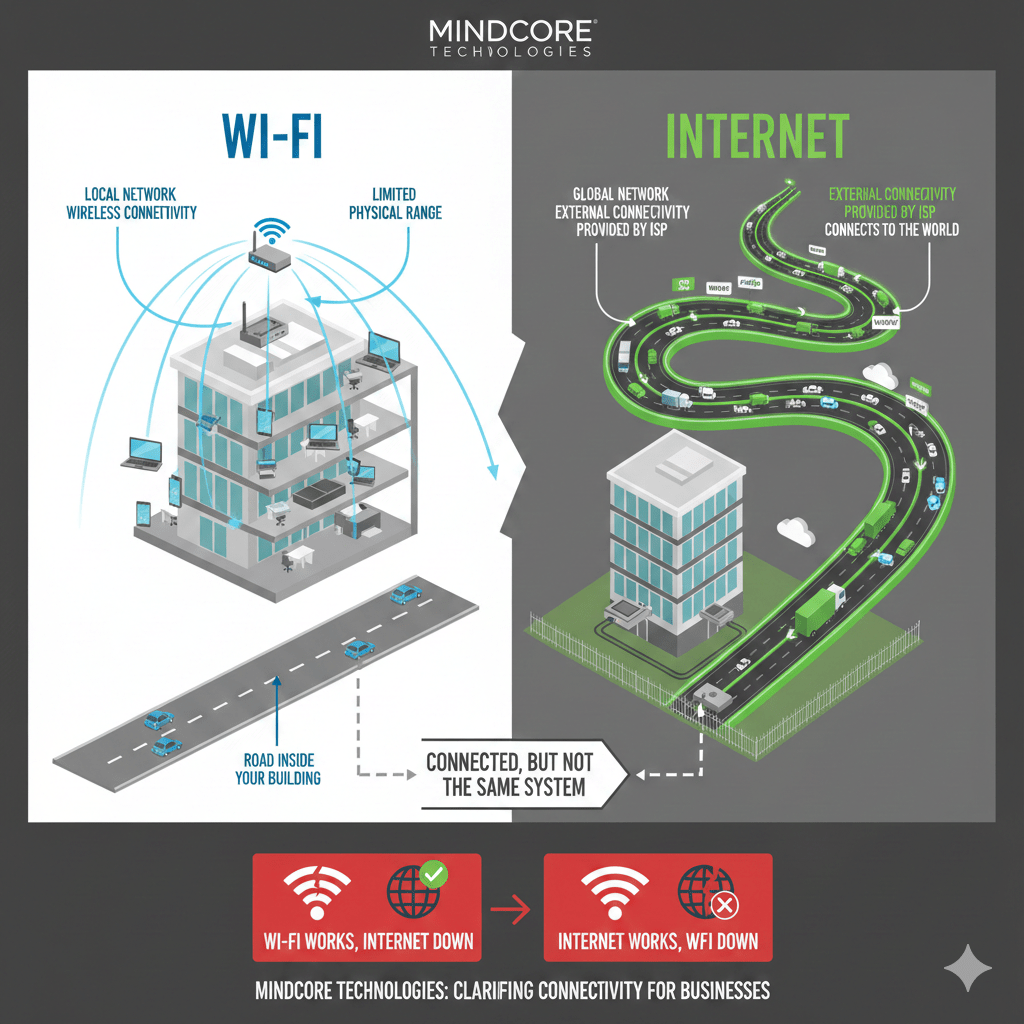
Most people use the terms Wi-Fi and internet interchangeably. Technically, they are not the same thing at all. That misunderstanding causes real problems, especially when businesses troubleshoot outages, performance issues, or security incidents.
At Mindcore Technologies, one of the first clarifications we make during incidents is simple: your Wi-Fi can be working perfectly while your internet is down, and your internet can be working while your Wi-Fi is failing. Knowing the difference matters.
This article breaks down the distinction clearly, explains why it matters for businesses and remote workers, and shows where security and reliability issues usually originate.
The Short Answer
- Wi-Fi is how your devices connect locally to a network.
- The internet is the global network your local network connects out to.
Wi-Fi is the road inside your building.
The internet is the highway outside.
They are connected, but they are not the same system.
What Wi-Fi Actually Is
Wi-Fi is a wireless networking technology. It allows devices like laptops, phones, printers, and tablets to connect to a local network without cables.
Wi-Fi:
- Exists only within a limited physical range
- Is provided by routers or access points
- Connects devices to a local network, not directly to the internet
- Can work even if the internet is down
If devices can talk to each other locally, Wi-Fi is working.
What the Internet Actually Is
The internet is a global network of networks operated by internet service providers (ISPs).
The internet:
- Lives outside your building
- Is provided by an ISP
- Connects your local network to websites, cloud apps, and services
- Can be available even if Wi-Fi is broken
If your modem or ISP connection fails, the internet is down, even if Wi-Fi still shows “connected.”
Why People Get Confused
Most users experience Wi-Fi and internet together, so failures feel identical.
Common complaints like:
- “The Wi-Fi is down”
- “The internet is slow”
Often mean one is failing while the other is fine.
This confusion delays fixes and hides root causes.
Key Differences That Matter
Wi-Fi Problems Look Like
- Devices disconnecting from the network
- Weak signal or dead zones
- Some rooms working, others not
- Printers or local servers unreachable
Wi-Fi issues are usually local infrastructure problems.
Internet Problems Look Like
- No access to websites or cloud apps
- All devices affected at once
- Wi-Fi still shows “connected”
- Local systems still accessible
Internet issues are usually ISP or modem-related.
Why This Difference Matters for Businesses
Understanding the difference helps businesses:
- Troubleshoot outages faster
- Avoid blaming the wrong system
- Apply the correct security controls
- Design more reliable networks
Misdiagnosis leads to wasted time and recurring issues.
Security Implications Most People Miss
Wi-Fi and internet security are different layers.
Wi-Fi Security Protects
- Who can join your local network
- What devices can communicate internally
- Whether attackers can gain a foothold
Weak Wi-Fi allows attackers inside before they touch the internet.
Internet Security Protects
- Traffic going out and coming in
- External threats and malicious destinations
- Exposure to the public internet
Strong firewalls do not help if attackers already joined your Wi-Fi.
How Attacks Commonly Happen
Many breaches follow this pattern:
- Weak or shared Wi-Fi access
- Attacker joins the local network
- Internal systems are trusted by default
- Internet-facing controls are bypassed
This is why Wi-Fi security is just as important as internet security.
Home vs Business: Where the Difference Matters Most
At Home
- Wi-Fi issues usually cause frustration
- Internet issues cause outages
- Security risks still affect work accounts
Home Wi-Fi often becomes a backdoor to business systems.
At Work
- Wi-Fi issues disrupt productivity internally
- Internet issues stop external operations
- Both affect uptime, security, and trust
Businesses must manage both intentionally.
How Businesses Should Manage Wi-Fi and Internet Separately
Strong environments treat them as distinct layers:
- Business-grade Wi-Fi with modern encryption
- Segmented wireless networks
- Identity-based access controls
- Dedicated business internet connections
- Monitoring at both local and ISP levels
Each layer needs its own controls.
Common Mistakes We See
- Assuming “connected” means “secure”
- Troubleshooting Wi-Fi when the ISP is down
- Upgrading internet speed but ignoring Wi-Fi design
- Investing in firewalls while using weak wireless security
These gaps compound over time.
How Mindcore Technologies Helps Clarify and Fix Both
Mindcore Technologies helps organizations design and manage both Wi-Fi and internet connectivity by focusing on:
- Secure, segmented Wi-Fi architecture
- Identity-aware wireless access
- Business-grade internet reliability
- Firewall and outbound traffic controls
- Continuous monitoring and visibility
We treat connectivity as infrastructure, not guesswork.
A Simple Reality Check
If you cannot confidently answer:
- Is this a Wi-Fi problem or an internet problem?
- Which layer failed last time?
- Which layer is secured properly?
Your network will feel unreliable even when it is not.
Final Takeaway
Wi-Fi and the internet are connected, but they are not the same thing. Wi-Fi connects devices locally. The internet connects your network to the world. Confusing the two leads to slower troubleshooting, weaker security, and avoidable downtime.
Businesses and remote workers who understand the difference can diagnose issues faster, secure networks more effectively, and avoid common attack paths that start with misplaced trust.