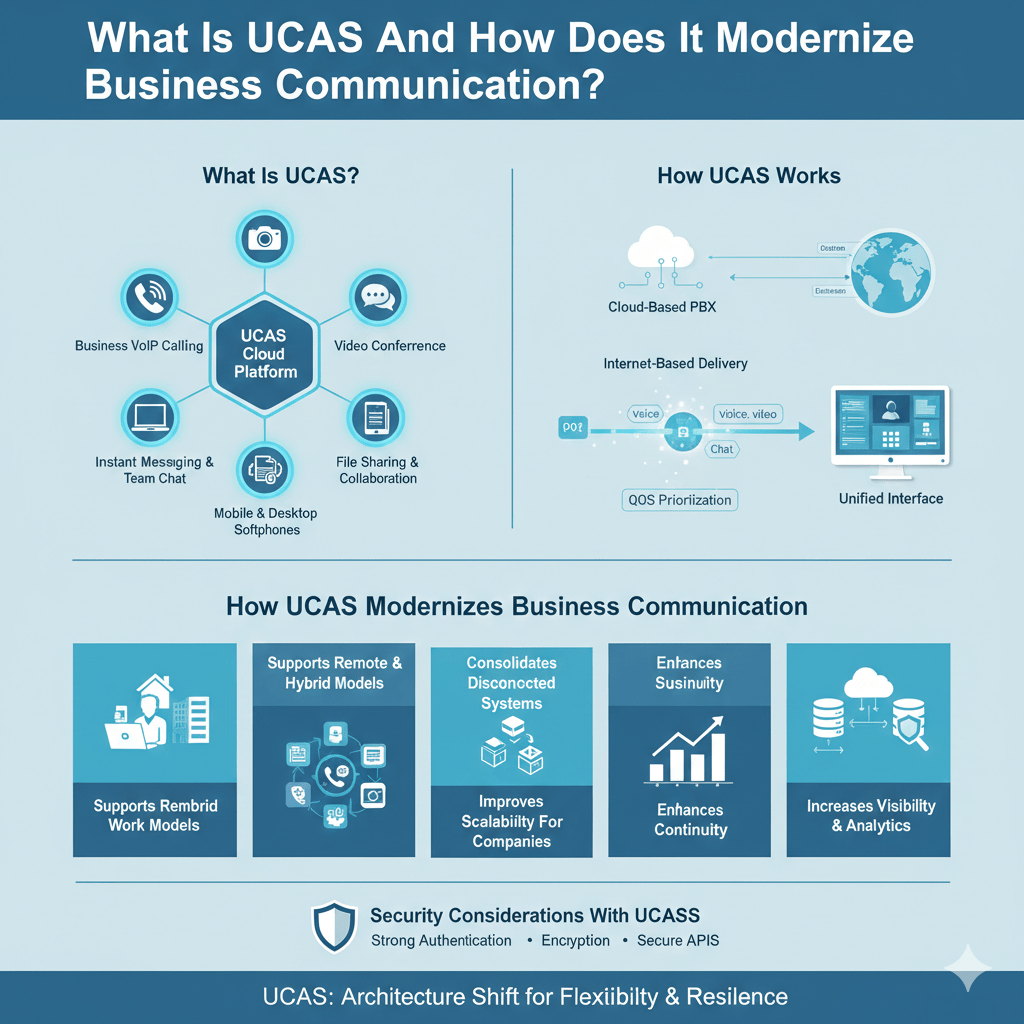
UCaaS is not just cloud phone service. It is a unified communications architecture delivered as a cloud platform that consolidates voice, video, messaging, collaboration, and mobility into a single managed environment.
For modern businesses, communication is no longer limited to desk phones. Teams operate across remote offices, mobile devices, shared workspaces, and multiple time zones. Traditional PBX systems were never designed for that.
At Mindcore Technologies, we evaluate UCaaS as a communications infrastructure decision, not a feature upgrade. When implemented correctly, it improves scalability, visibility, resilience, and security.
What Is UCaaS?
UCaaS stands for Unified Communications as a Service.
It is a cloud-based delivery model that combines multiple communication tools into one integrated platform.
A typical UCaaS platform includes:
- Business VoIP calling, replacing traditional phone systems.
- Video conferencing for internal and external meetings.
- Instant messaging and team chat for real-time collaboration.
- Presence indicators showing user availability.
- File sharing and collaboration integrations.
- Mobile and desktop softphone applications.
Instead of managing separate systems for voice, chat, and meetings, UCaaS centralizes them.
How UCaaS Works
UCaaS operates through a cloud-hosted infrastructure managed by a provider.
The core components include:
Cloud-Based PBX
- Manages call routing, extensions, auto-attendants, and voicemail.
- Eliminates the need for on-premise PBX hardware.
- Scales dynamically as users are added or removed.
Internet-Based Delivery
- Voice and video traffic travel over your internet connection.
- Requires stable bandwidth and proper Quality of Service configuration.
- Depends on network design for performance consistency.
Unified Interface
- Users access voice, chat, video, and collaboration tools from one application.
- Identity-based login allows consistent access across devices.
- Centralized dashboards provide administrative visibility.
UCaaS replaces hardware-heavy telecom environments with cloud-managed systems.
How UCaaS Modernizes Business Communication
Modernization is not about convenience. It is about operational flexibility and resilience.
1. Supports Remote And Hybrid Work Models
Traditional systems anchor communication to a building.
UCaaS allows:
- Employees to make and receive calls from laptops and mobile devices.
- Business numbers to remain consistent regardless of location.
- Seamless collaboration across distributed teams.
- Immediate onboarding of remote staff without physical phone deployment.
Communication becomes location-independent.
2. Consolidates Disconnected Systems
Many businesses operate with fragmented communication tools.
UCaaS unifies:
- VoIP systems
- Video conferencing platforms
- Team messaging tools
- File sharing and collaboration applications
Consolidation reduces complexity and administrative overhead.
3. Improves Scalability For Growing Companies
Traditional phone systems scale slowly and require hardware upgrades.
UCaaS allows:
- Rapid provisioning of new users.
- Easy integration of new office locations.
- Flexible licensing aligned with business growth.
- Centralized management across multiple sites.
Scaling becomes administrative, not physical.
4. Enhances Business Continuity
UCaaS platforms are typically hosted in redundant cloud environments.
This enables:
- Call rerouting during local office outages.
- Geographic failover options.
- Automatic updates and system maintenance.
- Reduced dependency on a single physical site.
Resilience improves when infrastructure is distributed.
5. Increases Visibility And Analytics
Modern communication systems provide measurable insights.
UCaaS platforms offer:
- Call reporting and performance metrics.
- Meeting analytics and participation tracking.
- Usage monitoring across departments.
- Centralized logging for troubleshooting and compliance.
Data improves operational decision-making.
Security Considerations With UCaaS
Cloud delivery does not eliminate security responsibility.
Key security areas include:
- Strong authentication controls for user accounts.
- Multi-factor authentication for administrative access.
- Encryption of voice, video, and messaging traffic.
- Secure API integrations with CRM or collaboration tools.
- Proper firewall configuration and network segmentation.
Security depends on identity management and network hygiene.
Common Mistakes Businesses Make With UCaaS
Modernization fails when businesses:
- Ignore network readiness and bandwidth capacity.
- Skip Quality of Service configuration.
- Allow administrative accounts without multi-factor authentication.
- Fail to plan redundancy for internet connectivity.
- Deploy softphones on unmanaged devices without endpoint protection.
UCaaS performance and security are tied directly to infrastructure maturity.
UCaaS vs Traditional On-Premise Systems
Traditional systems:
- Require physical hardware maintenance.
- Scale slowly.
- Offer limited remote flexibility.
- Depend heavily on local infrastructure.
UCaaS systems:
- Operate through cloud-hosted platforms.
- Scale rapidly without hardware upgrades.
- Support distributed teams naturally.
- Provide built-in redundancy in many deployments.
The difference is architectural.
How Mindcore Technologies Helps Businesses Deploy UCaaS Properly
Mindcore supports secure and reliable UCaaS deployment by:
- Conducting network readiness assessments before migration.
- Designing segmented network architecture to protect voice and collaboration traffic.
- Configuring QoS policies to ensure call and video stability.
- Hardening authentication and administrative access.
- Implementing redundancy planning for business continuity.
UCaaS must align with your infrastructure strategy, not replace it blindly.
Final Takeaway
UCaaS modernizes business communication by unifying voice, video, messaging, and collaboration into a scalable cloud-based platform. It supports hybrid work, simplifies management, and improves resilience.
However, modernization only succeeds when network readiness, identity controls, and security configuration are handled properly. Without those foundations, performance suffers and risk increases.
UCaaS is not just a telecom upgrade. It is a communication architecture shift.