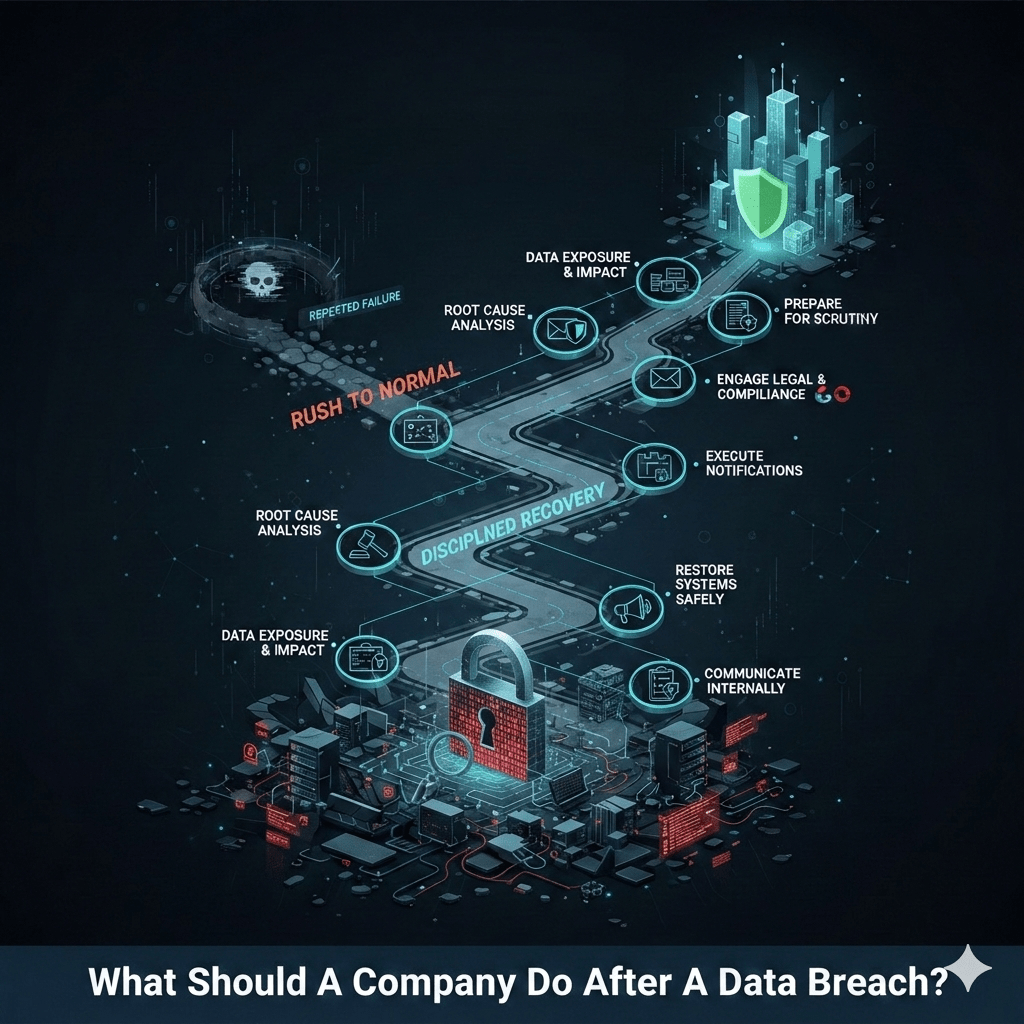
Once a data breach is contained, the real work begins. This is where organizations either stabilize, learn, and harden, or repeat the same failure under pressure months later.
At Mindcore Technologies, post-breach reviews show a clear divide: companies that follow a disciplined, phased plan reduce long-term impact; those that rush to “get back to normal” miss root causes and reopen risk.
This guide lays out what to do after the initial containment, in the order that actually works.
Phase 1: Validate Containment and Eliminate Persistence
Before moving forward, confirm the breach is truly contained.
Do this immediately after initial response:
- Verify all compromised accounts are disabled or reset
- Revoke all sessions, tokens, API keys, and OAuth grants
- Remove unauthorized admin roles and access
- Scan for persistence mechanisms (scheduled tasks, inbox rules, startup items)
- Confirm no new suspicious activity appears in logs
Do not assume containment is complete until persistence is ruled out.
Phase 2: Conduct a Structured Root Cause Analysis
This is not a blame exercise. It is a control-failure analysis.
Answer these questions with evidence:
- How was initial access obtained (credentials, session, misconfiguration)?
- Why was that access possible?
- Which controls failed or were missing?
- How long did unauthorized access exist?
- What signals were missed or ignored?
Document facts, timelines, and evidence. This analysis will inform legal, insurance, and remediation decisions.
Phase 3: Determine Data Exposure and Impact
Be precise. Avoid speculation.
Assess and document:
- What data could have been accessed
- Whether access was read-only, modified, or exported
- Which systems and users were involved
- Whether regulated data is in scope (PII, PHI, PCI)
If you cannot prove data was not accessed, assume potential exposure.
Phase 4: Engage Legal, Compliance, and Insurance Early
Breach response is a legal and business event.
Coordinate with:
- Legal counsel to guide disclosure obligations
- Compliance teams to interpret regulatory impact
- Cyber insurance carriers per policy requirements
Timing, scope, and wording of notifications matter. Incorrect handling increases liability.
Phase 5: Execute Required Notifications (When and Where Appropriate)
Once facts are established and legal guidance is in place:
You may need to notify:
- Regulators
- Affected individuals
- Customers or partners
- Payment processors or platforms
Notifications should be:
- Accurate
- Timely
- Consistent
- Documented
Over- or under-disclosure both create risk.
Phase 6: Restore Systems Safely (Not Quickly)
Restoration without remediation invites reinfection.
Before restoring:
- Patch exploited vulnerabilities
- Remove excessive permissions
- Update configurations and policies
- Validate backup integrity
During restoration:
- Monitor closely for abnormal behavior
- Restore in phases, not all at once
Security comes before speed.
Phase 7: Strengthen Controls That Failed
Most breaches are not tool failures. They are architecture and trust failures.
Common post-breach improvements include:
- Enforcing phishing-resistant MFA
- Reducing credential and session lifetimes
- Implementing least-privilege access
- Segmenting networks and data
- Tightening cloud sharing and access governance
- Improving logging and alerting
Fix the conditions that made the breach possible.
Phase 8: Review Incident Response Performance
Treat the breach as a learning event.
Evaluate:
- How quickly the breach was detected
- Whether escalation paths were clear
- If roles and responsibilities were understood
- Where communication broke down
Update playbooks, contacts, and procedures based on reality, not theory.
Phase 9: Communicate Internally With Clarity
Employees need facts, not fear.
Internal communication should:
- Explain what happened at a high level
- Clarify what has changed
- Reinforce security expectations
- Avoid speculation or blame
Confusion internally leads to mistakes externally.
Phase 10: Prepare for Follow-Up Scrutiny
Expect:
- Regulator questions
- Insurance audits
- Customer due diligence
- Executive or board review
Your documentation, timelines, and remediation actions will be examined.
What Companies Often Get Wrong After a Breach
Avoid these mistakes:
- Declaring victory too early
- Fixing symptoms instead of root causes
- Letting urgency override discipline
- Treating the breach as “bad luck”
- Returning to the same access model
Breaches repeat when lessons aren’t applied.
How Mindcore Technologies Supports Post-Breach Recovery
Mindcore helps organizations move from incident to resilience by providing:
- Post-breach forensic analysis and validation
- Identity and access redesign
- Endpoint and network hardening
- Cloud and data access governance
- Long-term monitoring and detection improvements
We focus on preventing recurrence, not just restoring operations.
A Simple Post-Breach Reality Check
Your organization remains at risk if:
- Access remains overly broad
- Monitoring is still minimal
- Root cause is unclear
- Controls were patched but not redesigned
- Lessons were not documented
A breach without change is a warning ignored.
Final Takeaway
What a company does after a data breach determines whether it becomes a one-time incident or a recurring failure. Effective post-breach action is deliberate, evidence-driven, and focused on reducing trust and improving visibility.
Organizations that slow down, document thoroughly, and redesign weak controls emerge stronger. Those that rush back to normal often meet the same attacker again.