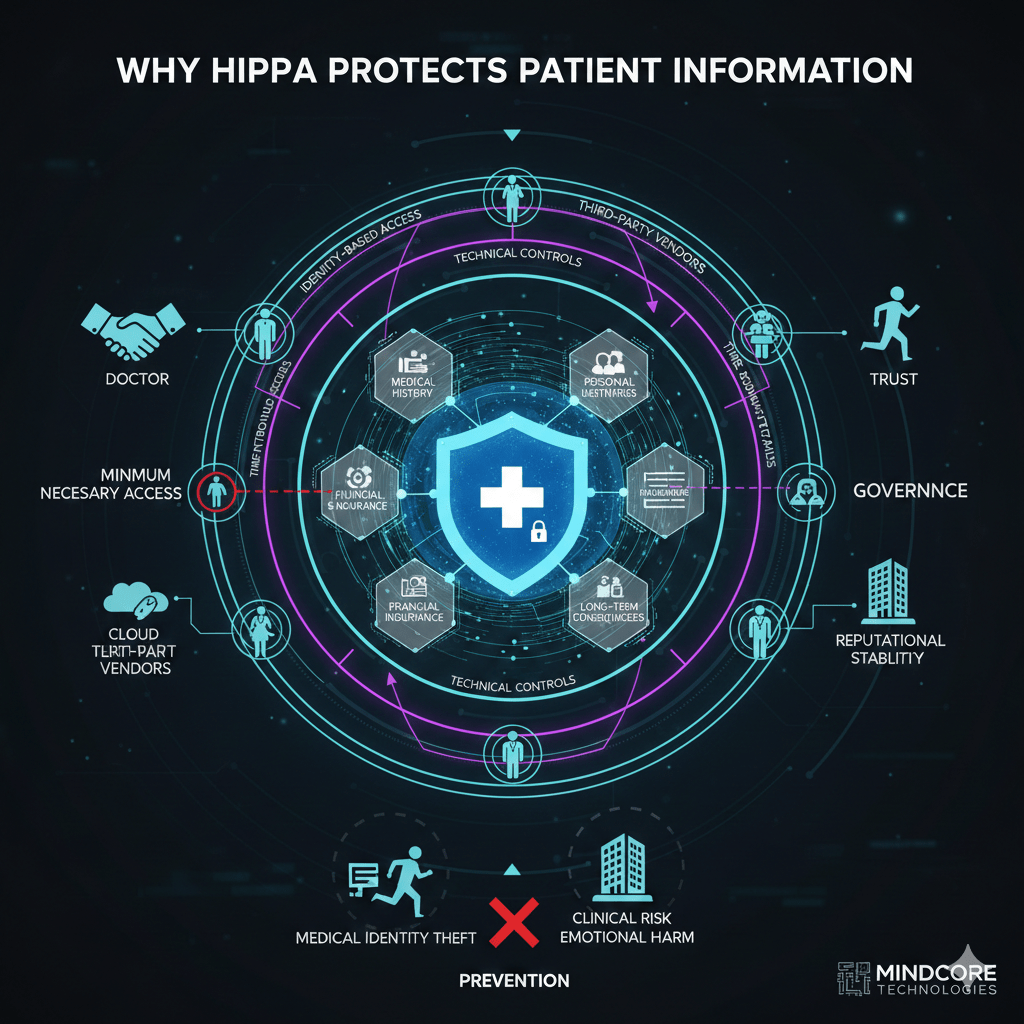
Protecting patient information under HIPAA is not about avoiding fines. It is about preventing harm that occurs when sensitive health data is exposed, misused, or accessed without clear justification.
Most patient data incidents do not begin with advanced cyberattacks. They begin with routine access that was never properly limited, reviewed, or governed.
At Mindcore Technologies, HIPAA-related investigations consistently show the same pattern. Patient information is compromised during normal operations because systems were designed for convenience, not control. HIPAA exists to force that control.
Patient Information Is Uniquely Sensitive
HIPAA protects patient information because healthcare data carries risks that other data types do not.
Patient information can expose:
- Medical history and diagnoses
Details that can affect employment, insurance, and personal relationships. - Financial and insurance data
Information that enables identity theft and fraud. - Personal identifiers
Names, dates of birth, addresses, and Social Security numbers that cannot be changed. - Long-term consequences
Medical data is permanent. A credit card can be replaced. A diagnosis cannot.
HIPAA recognizes that misuse of patient data creates lasting harm.
Why HIPAA Treats Privacy as a Legal Obligation
Patient privacy cannot be optional in healthcare.
HIPAA enforces privacy because:
- Patients cannot opt out of care-related data collection
Trust is mandatory for treatment. - Healthcare requires frequent and urgent access
Speed must be balanced with control. - Data is shared across many systems and vendors
Exposure increases without governance. - Misuse often occurs internally, not externally
Most violations involve authorized users accessing data improperly.
HIPAA exists to make privacy enforceable, not assumed.
Protecting Patient Information Preserves Trust
Healthcare depends on patient honesty.
Patients are less likely to:
- Share complete medical histories
- Disclose sensitive conditions
- Engage fully in care
if they believe their information is not protected.
Protecting patient information under HIPAA:
- Reinforces confidence in care providers
- Supports better clinical outcomes
- Prevents reputational damage to organizations
Loss of trust directly impacts care quality.
Why Patient Data Protection Reduces Real-World Harm
When patient information is exposed, the impact extends beyond compliance.
Real-world consequences include:
- Medical identity theft
Fraudulent claims, altered records, and billing disputes. - Clinical risk
Tampered or incomplete records affect treatment decisions. - Emotional and reputational harm
Disclosure of sensitive conditions causes distress and stigma. - Operational disruption
Breach response diverts staff and resources from patient care.
HIPAA prioritizes prevention because recovery is costly and incomplete.
HIPAA Focuses on Controlling Access, Not Blocking Care
HIPAA does not prohibit access to patient information. It requires appropriate access.
This means:
- Minimum necessary access
Users see only what their role requires. - Purpose-based use
Data access must align with treatment, payment, or operations. - Auditability
Organizations must be able to show who accessed data and why. - Accountability
Improper access has consequences.
Protecting patient information is about discipline, not restriction.
Why Technical Controls Matter Under HIPAA
Policies alone do not protect patient information.
HIPAA expects safeguards that:
- Limit access technically, not administratively
Systems enforce boundaries automatically. - Reduce reliance on endpoint trust
Devices cannot be assumed safe. - Prevent unnecessary data movement
Patient data should not freely reach local systems. - Provide clear audit trails
Activity must be visible and reviewable.
When controls are weak, HIPAA violations occur quietly.
The Risk of Overexposed Patient Information
Patient information is most often exposed when:
- Access permissions are too broad
- Sessions persist indefinitely
- VPNs extend internal networks unnecessarily
- Vendors retain standing access
- Audit reviews are infrequent
These conditions violate HIPAA’s intent even if no breach has occurred.
Why HIPAA Protection Matters in Modern Healthcare
Healthcare delivery has changed.
HIPAA protection matters more now because:
- Cloud platforms expanded data access
- Telehealth introduced unmanaged access points
- Third-party vendors multiplied PHI exposure
- Credential theft became the dominant attack method
HIPAA forces organizations to manage this complexity responsibly.
How Architecture Determines Whether Patient Information Is Protected
Organizations protect patient information effectively when:
- Access is identity-based, not network-based
- Permissions align strictly with job roles
- Sessions are time-bound and monitored
- Patient data stays inside controlled environments
- Vendor access is scoped and auditable
They fail when trust is assumed instead of enforced.
How Mindcore Technologies Helps Protect Patient Information
Mindcore helps healthcare organizations protect patient information by:
- Identifying real-world PHI access paths
Including internal users, vendors, and remote staff. - Reducing excessive access through identity-driven controls
Enforcing least privilege consistently. - Containing patient data within secure workspace architectures
Preventing unnecessary endpoint exposure. - Improving audit readiness and visibility
Making HIPAA compliance provable.
The focus is preventing harm before it occurs.
A Simple HIPAA Protection Reality Check
Patient information is not adequately protected if:
- Users can access data beyond their role
- PHI reaches unmanaged devices
- Access is long-lived and rarely reviewed
- Vendor access is broad or permanent
- Audit evidence is manually reconstructed
These are structural risks, not training gaps.
Final Takeaway
Protecting patient information under HIPAA is essential because healthcare cannot function without trust, and trust cannot exist without control.
HIPAA exists to ensure patient data is accessed deliberately, protected consistently, and exposed only when necessary. Organizations that understand this design protection into their systems. Those that do not rely on luck, until luck runs out.