

Updated in 2026
Cybersecurity leaders often face an uphill battle when justifying security budgets, regardless of economic conditions. Security is still too often viewed as a secondary IT function rather than a core business safeguard. During a recession, budget pressure intensifies. Spending cuts frequently target IT through reduced funding, hiring freezes, layoffs, and the de-prioritization of cybersecurity initiatives.
At the same time, cybercriminal activity increases during economic downturns. Attackers understand that organizations are stretched thin, operating with fewer resources and weaker defenses. During the height of the COVID-19 pandemic, reported cybercrime increased by nearly 70 percent year over year. In challenging economic conditions, the risk landscape becomes more hostile, not less.
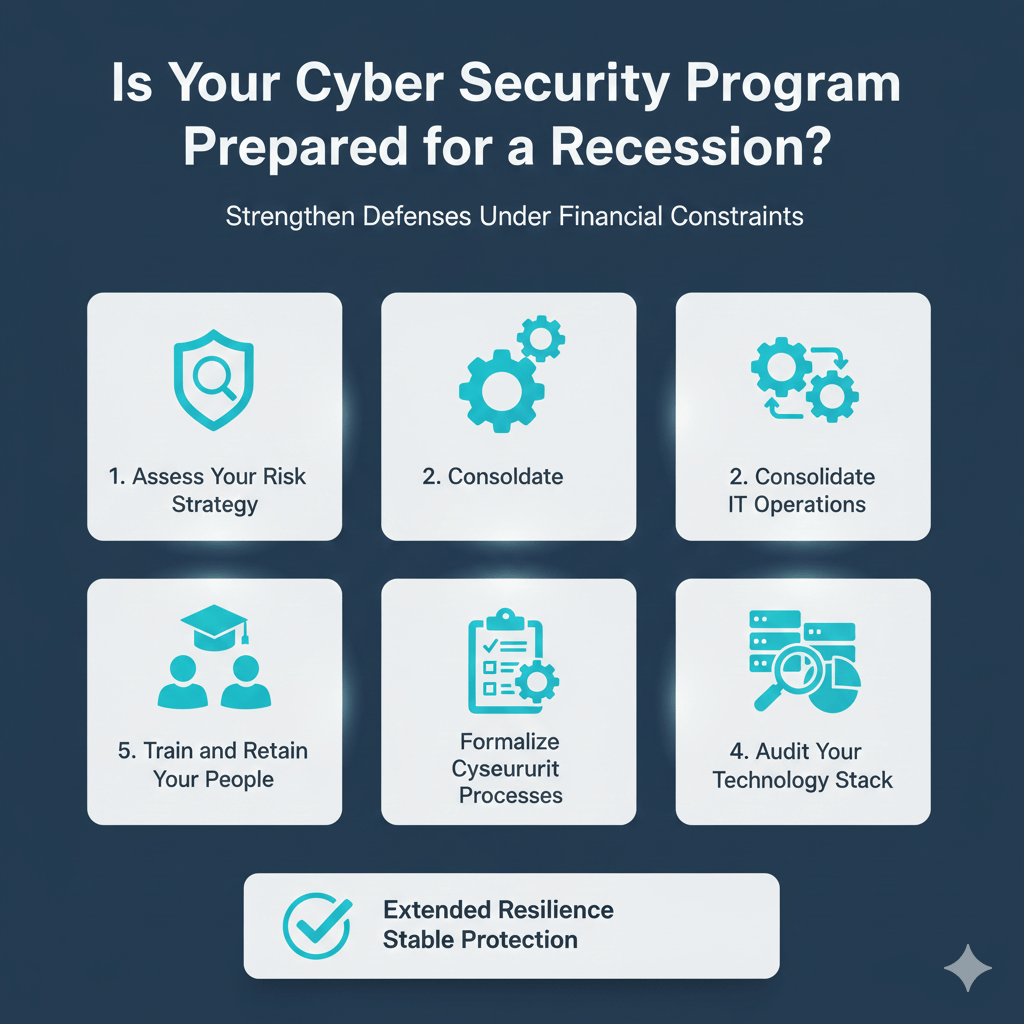
Preparing your cybersecurity program for a recession is not optional. It is a business necessity. The steps below outline how organizations can strengthen defenses while operating under tighter financial constraints.
1. Assess Your Risk Strategy
A cybersecurity risk assessment is foundational to any effective security program. It identifies internal and external threats, evaluates potential impact, and estimates the cost of a successful attack.
During a financial downturn, it becomes unrealistic to protect everything equally. High-performing teams focus resources on systems, applications, and data that carry the greatest business risk. Reviewing and refining your risk strategy allows you to prioritize protection where it matters most, often improving outcomes while reducing overall spend.
2. Consolidate IT Operations
Recessions frequently bring staffing reductions and hiring freezes, and most IT teams are not structured to absorb major personnel losses without disruption.
One way to offset this pressure is by consolidating responsibilities within the existing team. For example, system administrators may take on patch management, software updates, or vulnerability remediation. If internal consolidation is not sufficient, short-term outsourcing can help fill skill gaps without committing to permanent headcount increases.
3. Formalize Cybersecurity Processes
When budgets tighten and workloads increase, informal processes and outdated documentation often become the norm. This creates inconsistency, slows response times, and increases risk.
Formalizing cybersecurity processes improves efficiency, accountability, and resilience. Clear procedures for incident response, patching, access control, and escalation reduce reliance on individual knowledge and ensure continuity even when staffing changes occur. Regular reviews keep these processes aligned with evolving threats and business needs.
4. Audit Your Technology Stack
A cybersecurity audit serves as a practical checkpoint to confirm that people, processes, and technology are working together effectively. It highlights gaps, redundancies, and misaligned controls that increase risk.
During a recession, annual software licenses and subscriptions can quietly drain IT budgets. Technology audits often reveal opportunities to consolidate tools, eliminate unused services, and replace overlapping solutions. In many cases, reducing complexity delivers greater security value than investing in new technology.
5. Train and Retain Your People
People remain the most targeted attack surface in cybersecurity. Phishing, social engineering, and credential theft continue to outperform technical exploits.
Your existing security talent becomes even more critical during economic uncertainty. Retaining key staff and investing in continuous training pays dividends. Regular security awareness training for all employees reduces risk and helps prevent costly mistakes that are harder to absorb during financial stress.
Expert Cyber Security Services in New Jersey and Florida
Economic uncertainty makes the choice of IT and cybersecurity partners more important than ever. Organizations need providers who understand their industry, regulatory obligations, and risk tolerance.
Mindcore delivers comprehensive cybersecurity services for businesses across New Jersey and Florida. Our team helps organizations strengthen defenses, optimize security spend, and build resilience that holds up under economic pressure. To learn how we can help recession-proof your cybersecurity program, contact us to schedule a consultation with our team.

