

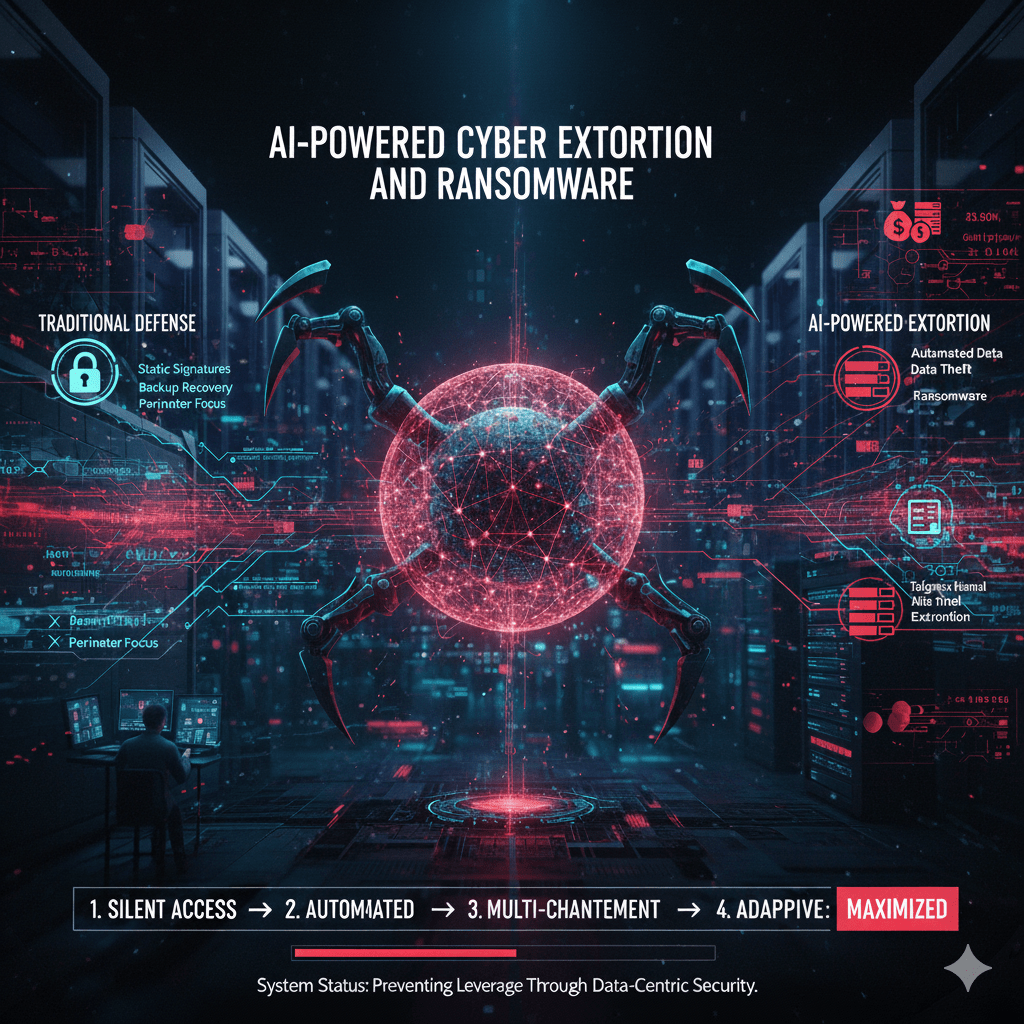
Ransomware is no longer just about encrypting files and demanding payment. AI has transformed cyber extortion into a precision-driven, data-first operation. Attackers now steal sensitive data quietly, analyze it automatically, and apply pressure strategically long before a ransom note appears.
At Mindcore Technologies, we see ransomware incidents today as extortion campaigns, not malware outbreaks. Encryption is often the final step, not the first.
This guide explains how AI-powered cyber extortion actually works, why legacy defenses fail, and the exact controls businesses need to stay ahead.
Why Ransomware Has Become More Dangerous
AI gives attackers three major advantages:
- Speed
- Targeting accuracy
- Psychological leverage
Modern ransomware groups use AI to:
- Identify high-value systems automatically
- Classify stolen data for maximum pressure
- Tailor extortion demands based on business impact
This is no longer opportunistic crime. It is calculated coercion.
What AI-Powered Cyber Extortion Looks Like in the Wild
1. Silent Access and Reconnaissance
Attackers gain access through:
- Phishing-resistant bypass techniques
- Compromised credentials
- Infostealers and session hijacking
AI accelerates reconnaissance by mapping networks, permissions, and data repositories automatically.
2. Automated Data Theft Before Encryption
Data is exfiltrated first.
AI helps attackers:
- Identify sensitive files
- Prioritize legal, financial, and regulated data
- Compress and stage exfiltration efficiently
Many organizations do not realize data theft occurred until extortion begins.
3. Multi-Channel Extortion Pressure
AI enables:
- Automated ransom negotiations
- Targeted threats against executives
- Public leak site preparation
- Regulatory pressure tactics
Encryption is optional. Reputation damage is guaranteed.
4. Adaptive Ransomware Deployment
If defenders respond, AI-driven tooling:
- Changes encryption tactics
- Delays execution
- Targets backups
- Shifts payload behavior
Static defenses cannot keep up.
Why Traditional Ransomware Defenses Fail
Most defenses focus on:
- Malware signatures
- Backup recovery
- Perimeter protection
AI-powered extortion bypasses all three.
Failures occur because:
- Credentials are valid
- Data theft happens quietly
- Backups do not protect stolen data
- Detection occurs too late
Once data is exfiltrated, leverage is permanent.
The Real Objective Is Data, Not Downtime
Encryption causes disruption. Data theft creates leverage.
Attackers use stolen data to:
- Threaten regulatory exposure
- Damage customer trust
- Pressure executives directly
- Force rapid payment decisions
Preventing encryption alone is not enough.
How to Safeguard Your Business Effectively
Defense must assume attackers will get in. The goal is to limit damage, visibility, and leverage.
1. Lock Down Identity First
AI-powered ransomware thrives on identity abuse.
Critical controls:
- Phishing-resistant MFA
- Conditional access enforcement
- Short session lifetimes
- Least-privilege access
If identity is protected, ransomware stalls.
2. Detect Data Exfiltration Early
Data theft is the most important signal.
You must monitor:
- Unusual outbound data volume
- New transfer destinations
- Abnormal access to sensitive repositories
- Off-hours data movement
Stopping exfiltration removes extortion leverage.
3. Harden Endpoints Against Infostealers
Infostealers are the front door.
Controls must include:
- Advanced endpoint detection and response
- Browser and session protection
- Credential dumping prevention
A compromised endpoint enables everything else.
4. Segment Sensitive Systems Aggressively
Flat networks amplify ransomware damage.
Best practices:
- Separate backups from production
- Restrict access to sensitive data stores
- Isolate administrative systems
Segmentation limits blast radius.
5. Secure and Test Backups Correctly
Backups still matter, but only if done right.
Requirements:
- Offline or immutable backups
- Separate credentials
- Regular restore testing
Backups reduce downtime, not extortion pressure.
6. Monitor for Lateral Movement
AI-driven attacks move quietly.
Watch for:
- Privilege escalation
- Unusual admin activity
- Access pattern changes
Lateral movement detection buys response time.
7. Prepare an Extortion Response Plan
Preparation reduces panic.
Plans must include:
- Legal and regulatory response
- Executive communication strategy
- Law enforcement coordination
- Technical containment steps
Decisions made under pressure are expensive.
The Biggest Mistake We See
Organizations focus on recovery, not prevention of leverage.
If data is stolen:
- Backups do not help
- Encryption becomes optional
- Attackers retain control
Stopping extortion means stopping data theft.
How Mindcore Technologies Helps Defend Against AI-Powered Extortion
Mindcore helps organizations reduce ransomware and extortion risk through:
- Identity-centric security architecture
- Endpoint and session protection
- Data access and exfiltration monitoring
- Network segmentation and Zero Trust design
- Incident response and extortion readiness
- Compliance-aligned security controls
We focus on preventing leverage, not just restoring systems.
A Simple Readiness Check for Leadership
You are exposed if:
- Identity abuse is not tightly controlled
- Data access is not monitored continuously
- Endpoints are not protected against infostealers
- Response plans exist only on paper
AI-powered extortion exploits delay and confusion.
Final Takeaway
AI has transformed ransomware into a data-driven extortion business. Defending against it requires moving beyond malware detection and backups toward identity protection, behavior monitoring, and data-centric security.
Organizations that prepare now will reduce damage and maintain control under pressure. Those that rely on legacy defenses will discover too late that recovery is not the same as protection.

