

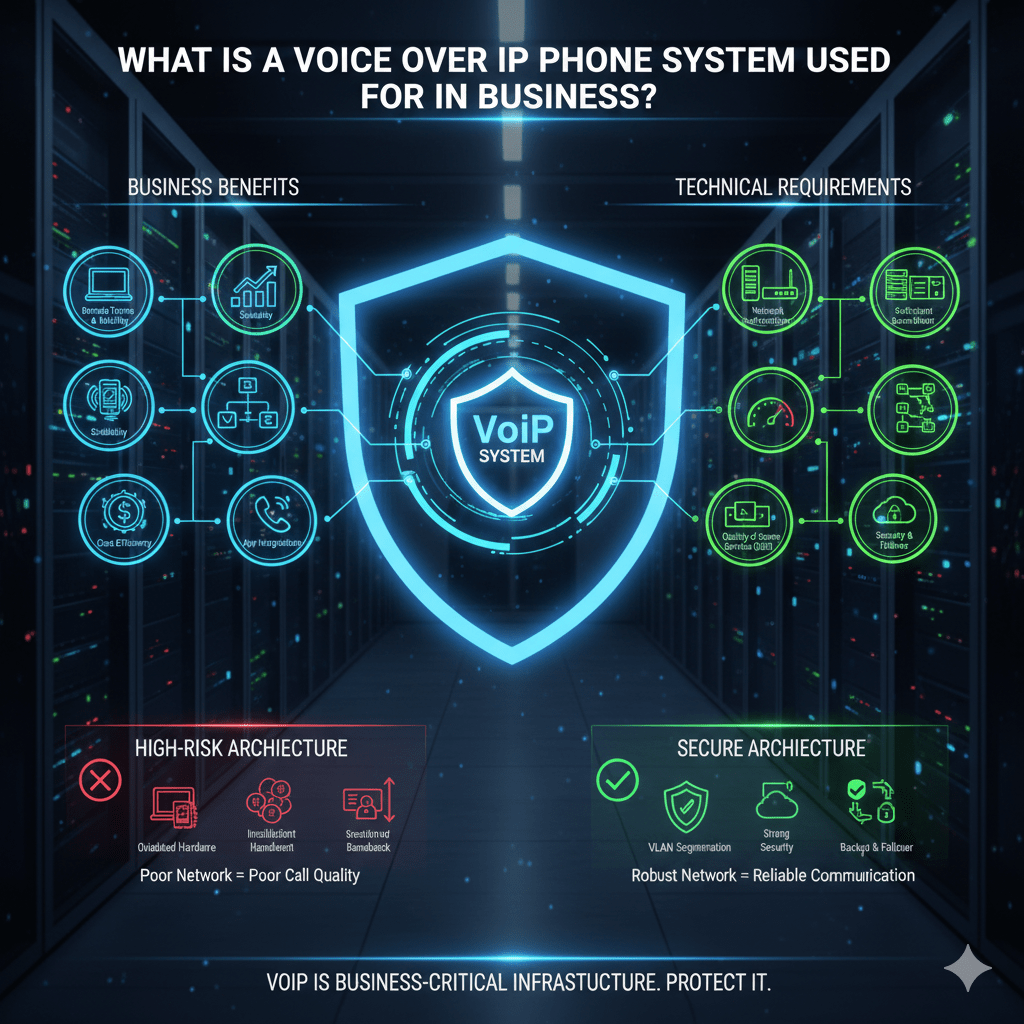
What Is A Voice Over IP Phone System in business? It is not just a cheaper phone service; it functions as a centralized communications platform supporting operations, customer engagement, and internal collaboration. In business, it functions as a centralized communications platform that supports operations, customer engagement, remote teams, and internal collaboration.
When implemented correctly, VoIP improves flexibility and scalability. When deployed without network planning, it creates performance and reliability issues.
At Mindcore Technologies, we evaluate VoIP as business-critical infrastructure, not a utility. It affects uptime, client experience, security exposure, and operational continuity.
1. Handling Inbound and Outbound Business Calls
The primary use of What Is A Voice Over IP Phone System in business is replacing traditional phone lines while enabling centralized management of inbound and outbound calls.
It enables:
- Direct inbound call routing
Calls route to departments, extensions, or auto-attendants automatically. - Outbound client communication
Sales, support, billing, and operations teams manage high call volumes efficiently. - Extension dialing across locations
Multiple offices operate as a unified phone system. - Call forwarding to mobile or remote users
Employees stay reachable without revealing personal numbers.
VoIP centralizes communication across distributed teams.
2. Supporting Remote and Hybrid Workforces
Modern businesses rarely operate from a single location.
What Is A Voice Over IP Phone System used for? It supports distributed operations by:
- Allowing employees to use softphones on laptops and mobile devices
Maintaining business numbers anywhere. - Keeping extension identity consistent
Clients dial the same number regardless of employee location. - Enabling secure remote call routing
Without traditional phone infrastructure. - Reducing dependency on physical office lines
Increasing operational flexibility.
For hybrid environments, VoIP becomes foundational.
3. Automating Call Management and Routing
VoIP systems include advanced call-handling features that traditional systems lack.
These include:
- Auto-attendants and interactive voice response (IVR)
Directing callers to appropriate departments without manual routing. - Call queues for customer support teams
Managing high call volumes systematically. - Hunt groups for sales teams
Ensuring calls are answered quickly. - Time-based routing rules
Adjusting call handling outside business hours.
Automation improves responsiveness and customer experience.
4. Integrating with Business Applications
What Is A Voice Over IP Phone System in modern business? It integrates with CRM, helpdesk, collaboration tools, and analytics dashboards to centralize communication and operational data.
Common integrations include:
- Customer Relationship Management (CRM) systems
Automatically logging calls and pulling client records. - Helpdesk platforms
Linking calls to support tickets. - Collaboration tools
Enabling unified messaging and calling. - Analytics dashboards
Measuring call performance and team productivity.
Integration transforms the phone system into a data tool.
5. Scaling Communication Without Infrastructure Overhaul
Traditional phone systems require physical wiring and hardware changes to scale.
VoIP allows businesses to:
- Add or remove users quickly
Without installing new phone lines. - Open new locations with minimal hardware investment
Connecting them to the same cloud PBX. - Adjust capacity during growth periods
Scaling call handling as needed. - Consolidate multiple systems into one platform
Reducing operational complexity.
Scalability is one of VoIP’s strongest advantages.
6. Reducing Communication Costs
VoIP reduces certain operational expenses by:
- Eliminating traditional carrier line charges
Replacing analog circuits with internet-based routing. - Lowering long-distance call costs
Especially for multi-location or international businesses. - Consolidating voice and data infrastructure
Using one network instead of parallel systems. - Reducing hardware maintenance expenses
Especially in cloud-based deployments.
Cost savings depend on proper network readiness.
7. Enabling Business Continuity
VoIP can strengthen resilience when properly configured.
Business continuity benefits include:
- Call rerouting during outages
Redirecting calls to mobile devices if the office is inaccessible. - Cloud-hosted failover systems
Maintaining availability during local disruptions. - Geographic flexibility
Employees can relocate temporarily without losing communication. - Redundancy through multiple internet connections
Preventing single points of failure.
Communication uptime directly affects revenue and reputation.
8. Improving Customer Experience
VoIP systems improve client interactions through:
- Call analytics and reporting
Measuring response times and call duration. - Recorded call options for quality assurance
Improving training and consistency. - Voicemail-to-email functionality
Accelerating response times. - Integrated video and collaboration tools
Enhancing communication beyond voice.
Better call handling improves brand perception.
Security Considerations for Business VoIP
VoIP systems are internet-connected and must be secured properly.
Businesses must address:
- Toll fraud risks
Restricting international dialing permissions. - SIP port exposure
Limiting unnecessary internet-facing access. - Administrative account security
Enforcing strong authentication and multi-factor protection. - Voice traffic encryption
Protecting sensitive conversations. - Network segmentation
Separating voice traffic from general data.
VoIP must be treated as critical IT infrastructure.
When VoIP Is Not Implemented Properly
VoIP creates problems when:
- Network equipment is outdated
- Quality of Service (QoS) is not configured
- Bandwidth is insufficient
- Firewall rules are misconfigured
- No internet redundancy exists
Performance issues directly impact professionalism and trust.
How Mindcore Technologies Helps Businesses Deploy VoIP Properly
Mindcore supports business VoIP deployment by:
- Conducting network readiness assessments
Identifying bandwidth and hardware gaps. - Designing segmented voice architectures
Protecting performance and security. - Configuring QoS and firewall policies correctly
Ensuring call stability. - Securing VoIP administrative access and SIP exposure
Reducing attack surface. - Implementing redundancy and failover strategies
Protecting uptime.
The objective is reliable, secure communication infrastructure.
Final Takeaway
Understanding What Is A Voice Over IP Phone System shows it is used for far more than making calls—it centralizes communication, improves remote collaboration, integrates with business applications, enhances customer experience, and supports scalability. It centralizes communication, supports remote teams, integrates with business applications, improves customer experience, and enhances scalability.
However, its success depends entirely on network readiness, bandwidth stability, and security configuration. Businesses that treat VoIP as infrastructure, not a convenience upgrade, gain flexibility and resilience. Those that migrate without preparation risk downtime, poor call quality, and security exposure.
Frequently Asked Questions
What is a Voice over IP phone system used for in business?
A VoIP phone system is used to manage business communications over the internet instead of traditional phone lines. It supports calling, remote collaboration, call routing, customer support, and unified communication across teams and locations.
How does VoIP help remote and hybrid workforces?
VoIP allows employees to make and receive business calls from laptops, mobile devices, or desk phones regardless of location. Businesses using cloud-based communication infrastructure can maintain consistent collaboration without depending on physical office phone systems.
Can VoIP systems integrate with other business applications?
Yes. VoIP systems commonly integrate with CRM platforms, helpdesk systems, collaboration tools, analytics dashboards, and customer support software to improve workflow efficiency and visibility. These integrations help centralize communication and operational data.
What are the security risks of business VoIP systems?
Common VoIP security risks include toll fraud, exposed SIP ports, weak administrative credentials, unencrypted voice traffic, and poor network segmentation. Organizations implementing strong cybersecurity controls can reduce these communication security risks significantly.
Why is network readiness important for VoIP performance?
VoIP depends heavily on stable internet connectivity, sufficient bandwidth, Quality of Service (QoS) configuration, and properly configured network hardware. Businesses with resilient managed IT infrastructure experience fewer dropped calls, less downtime, and improved communication reliability.
Matt Rosenthal’s Expertise in Business VoIP and Communication Infrastructure
Matt Rosenthal, CEO of Mindcore Technologies, has extensive experience helping organizations design secure, scalable, and reliable communication infrastructures. His expertise in managed IT services, network architecture, cloud services, and cybersecurity helps businesses deploy VoIP systems that support remote work, improve operational flexibility, and maintain communication continuity. Matt focuses on building resilient environments with proper bandwidth planning, network segmentation, security controls, and redundancy strategies so businesses can improve call reliability, customer experience, and long-term operational efficiency.

