

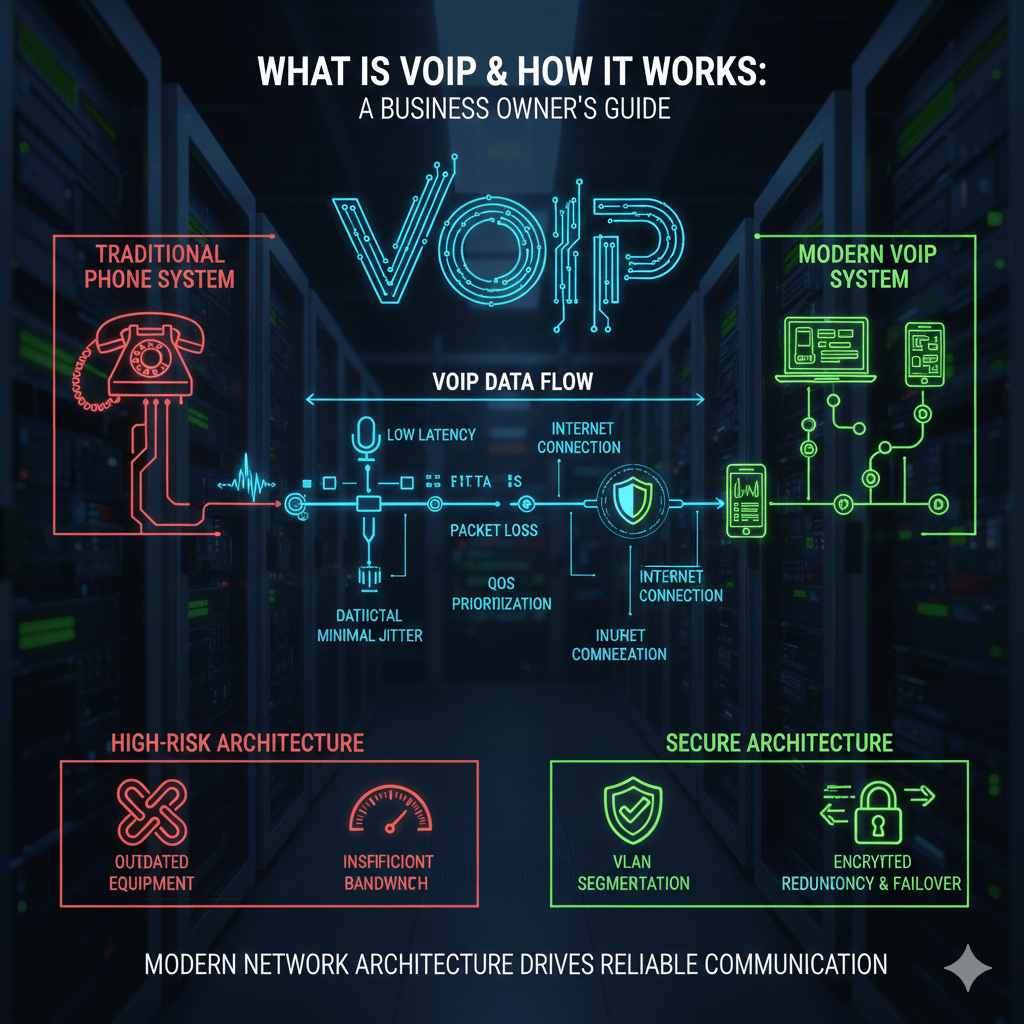
VoIP is not just “phone service over the internet.” It is a network-dependent communication system that can either improve business agility or expose your operations to downtime and security risk, depending on how it’s implemented.
Many business owners switch to VoIP to reduce costs. The smarter ones evaluate reliability, bandwidth, network design, and security first.
At Mindcore Technologies, we regularly see businesses adopt VoIP without upgrading infrastructure. The result is dropped calls, jitter, poor audio quality, and exposed systems.
If you’re considering VoIP, you need to understand how it actually works.
What Is VoIP?
VoIP stands for Voice over Internet Protocol. It converts voice into digital packets and transmits them over an IP network instead of traditional analog phone lines.
Instead of copper phone circuits, VoIP relies on:
- Your internet connection
Voice traffic travels over the same network as email and cloud apps. - IP phones or softphones
Hardware desk phones or computer/mobile apps. - A VoIP service provider or cloud PBX
The system that routes calls and manages features. - Network infrastructure
Routers, switches, firewalls, and bandwidth capacity.
VoIP replaces physical phone lines with data transmission.
How VoIP Actually Works
VoIP works through packetization and routing.
Here’s the technical process simplified:
- Voice is captured through a microphone
Analog sound waves are converted into digital data. - Audio is compressed using codecs
Reducing bandwidth usage while preserving clarity. - Data is split into packets
Each packet contains a small portion of the conversation. - Packets are transmitted over your network
Routed through switches and firewalls. - Packets are reassembled at the destination
The recipient hears reconstructed audio in real time.
This process happens in milliseconds.
Call quality depends entirely on network stability.
Why Network Design Determines VoIP Performance
VoIP does not tolerate unstable networks.
Business VoIP performance depends on:
- Low latency
High latency causes delays and awkward conversation overlap. - Minimal jitter
Packet timing inconsistencies cause choppy audio. - Low packet loss
Missing packets result in clipped speech. - Sufficient bandwidth
Voice traffic must compete with other network activity. - Proper Quality of Service (QoS) configuration
Prioritizing voice traffic over non-critical data.
If your network struggles with video calls today, VoIP will amplify that weakness.
Key Business Benefits of VoIP
When implemented correctly, VoIP provides:
- Scalability
Add or remove users without rewiring physical lines. - Mobility
Employees can take calls from anywhere using secure apps. - Advanced features
Auto-attendants, call routing, voicemail-to-email, analytics. - Lower infrastructure costs
Reduced reliance on traditional phone carriers. - Centralized management
Simplified administration across multiple locations.
Flexibility is the primary advantage.
Common VoIP Mistakes Business Owners Make
VoIP failures usually result from poor preparation.
Common mistakes include:
- Keeping outdated networking equipment
Old routers and switches cannot handle modern traffic loads. - Skipping QoS configuration
Voice traffic competes equally with file downloads and streaming. - Underestimating bandwidth needs
VoIP requires consistent upload and download performance. - Ignoring firewall configuration
Misconfigured firewalls cause dropped or blocked calls. - Neglecting redundancy planning
Internet outage equals phone outage.
VoIP success starts with infrastructure readiness.
Security Risks of VoIP Systems
VoIP systems are internet-connected. That introduces risk.
Security concerns include:
- SIP registration hijacking
Attackers intercept or spoof call sessions. - Toll fraud
Compromised systems generate unauthorized international calls. - Eavesdropping attacks
Unencrypted voice traffic can be intercepted. - Denial-of-service attacks (DoS)
Overwhelming VoIP servers to disrupt operations. - Credential compromise for admin portals
Weak passwords expose the entire phone system.
VoIP must be treated as critical IT infrastructure.
How To Secure a Business VoIP Deployment
Business-grade VoIP security requires:
1. Harden Network Infrastructure
You must:
- Upgrade routers and switches to business-grade equipment
Consumer devices are not sufficient. - Implement VLAN segmentation for voice traffic
Separating voice from general data reduces congestion and exposure. - Configure QoS policies properly
Prioritizing voice packets. - Ensure adequate bandwidth capacity
Especially during peak usage.
Infrastructure stability directly affects uptime.
2. Secure the VoIP System Itself
Protect the system by:
- Enforcing strong authentication for admin portals
Including multi-factor authentication. - Changing default SIP ports where appropriate
Reducing automated attack exposure. - Restricting international dialing permissions
Minimizing toll fraud risk. - Using encrypted signaling and media protocols
Protecting call confidentiality.
VoIP systems should never operate on default settings.
3. Plan for Redundancy
VoIP is only as reliable as your internet connection.
Redundancy should include:
- Secondary internet connections
Automatic failover prevents full outage. - Cloud-based call routing backups
Calls redirect to mobile devices if primary systems fail. - Power backup systems
Routers and switches require UPS support. - Disaster recovery testing
Confirming failover actually works.
Downtime affects revenue and customer trust.
VoIP vs Traditional Phone Systems
Traditional systems:
- Operate independently of internet bandwidth
- Require physical infrastructure
- Offer limited flexibility
VoIP systems:
- Depend on internet stability
- Offer advanced integrations and mobility
- Require strong network design
VoIP is superior when infrastructure is modernized first.
Is VoIP Right for Your Business?
VoIP makes sense if:
- You rely heavily on remote or hybrid teams
- You want scalable, cloud-based communication
- You are modernizing your IT infrastructure
- You are upgrading networking equipment
VoIP will frustrate you if:
- Your internet connection is unstable
- Your firewall is outdated
- Your internal network is congested
- You lack IT oversight
Communication reliability must be engineered.
How Mindcore Technologies Supports Business VoIP Deployments
Mindcore helps businesses deploy secure, reliable VoIP systems by:
- Assessing network readiness before migration
Identifying bandwidth and hardware gaps. - Designing segmented voice networks
Protecting performance and security. - Implementing firewall and QoS optimization
Ensuring consistent call quality. - Securing VoIP administrative interfaces
Preventing credential abuse and toll fraud. - Designing redundancy and failover architecture
Protecting uptime.
VoIP should enhance operations, not create instability.
A Practical VoIP Readiness Check
You are not ready for VoIP if:
- Internet outages are common
- Network equipment is over five years old
- You lack QoS configuration
- Firewall rules are loosely managed
- No backup internet plan exists
These weaknesses will directly affect call quality and reliability.
Final Takeaway
VoIP is a powerful business communication solution, but it is entirely dependent on network design, bandwidth stability, and security configuration.
Business owners who prepare their infrastructure properly gain flexibility, mobility, and cost efficiency. Those who migrate without planning experience dropped calls, poor performance, and security exposure.
VoIP success is not about switching phone providers. It is about modernizing your network architecture to support real-time communication securely and reliably.

