

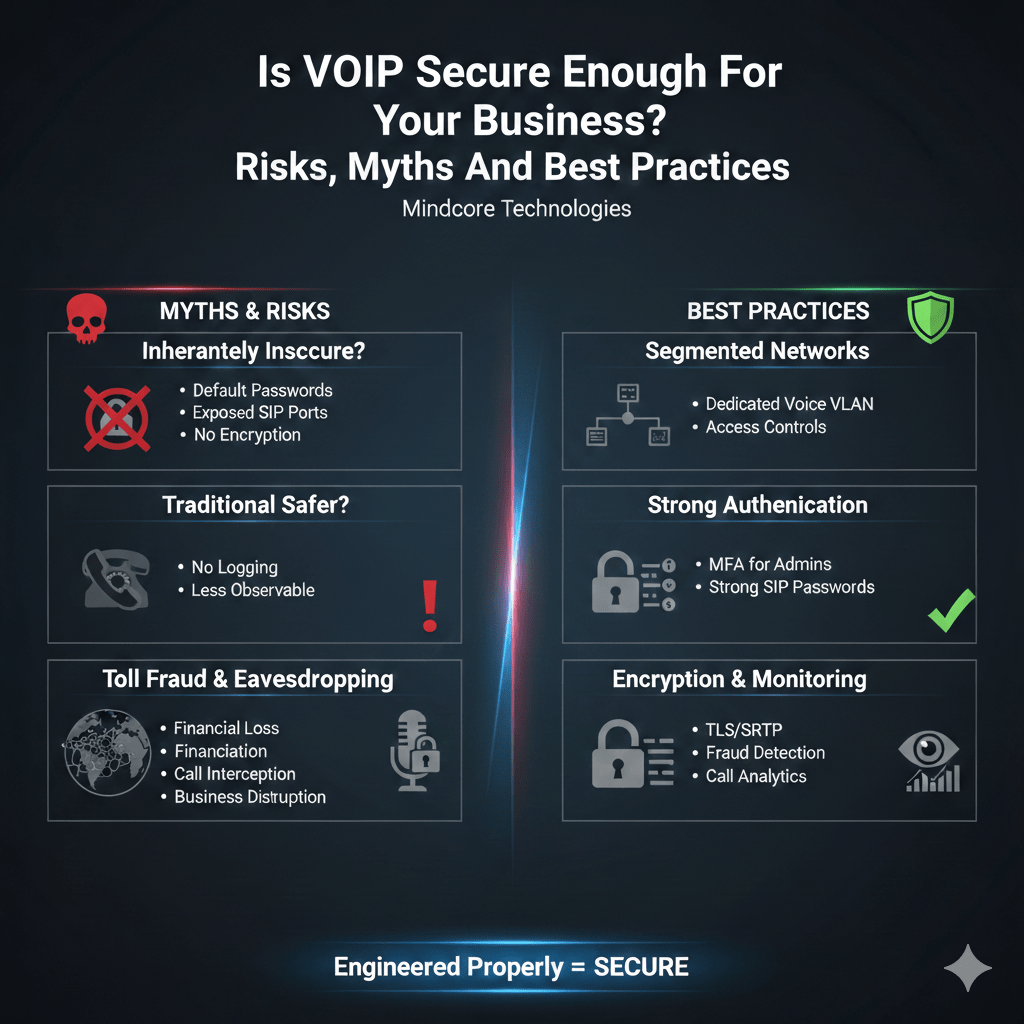
VoIP is secure enough for business, but only if it is engineered properly. The problem is not the technology. The problem is how it is deployed.
Too many organizations treat VoIP like a plug-and-play phone upgrade. It is not. It is a network-connected communication system that introduces internet-facing exposure.
At Mindcore Technologies, we routinely see VoIP environments that are either highly resilient or dangerously misconfigured. The difference is architecture discipline.
Let’s separate myth from reality.
Common Myths About VoIP Security
Myth 1: VoIP Is Inherently Insecure
VoIP is not insecure by default. It becomes insecure when:
- Default passwords are never changed
- SIP ports are left exposed to the internet
- No encryption is configured
- Firewall rules are loosely managed
With proper configuration, VoIP can be as secure as any cloud-based system.
Myth 2: Traditional Phone Lines Are Safer
Traditional phone systems are less exposed digitally, but that does not mean they are safer.
They lack:
- Centralized logging
- Advanced authentication
- Encrypted signaling options
- Fraud monitoring
They are less internet-facing, but also less flexible and less observable.
Myth 3: Small Businesses Are Not Targets
VoIP fraud targets small and mid-sized businesses frequently.
Attackers look for:
- Poorly secured SIP endpoints
- Weak administrative credentials
- Unrestricted international dialing
- Unmonitored call patterns
SMBs are often targeted because security oversight is limited.
Real VoIP Security Risks
Understanding real risks helps businesses mitigate them properly.
1. Toll Fraud
Attackers compromise VoIP credentials and place unauthorized international calls.
Impact includes:
- Unexpected financial loss
- Reputational damage
- Service disruption
Toll fraud often happens overnight when monitoring is absent.
2. SIP Registration Hijacking
If SIP credentials are weak, attackers can register unauthorized devices to your system.
Consequences include:
- Call interception
- Call redirection
- Eavesdropping
Poor authentication hygiene enables this.
3. Denial-of-Service (DoS) Attacks
VoIP systems can be overwhelmed with traffic.
This results in:
- Dropped calls
- Inability to place outbound calls
- Business disruption
Availability is part of security.
4. Eavesdropping
Unencrypted voice traffic can be intercepted.
Sensitive business discussions may be exposed if:
- TLS is not enabled for signaling
- SRTP is not enabled for media
- Internal networks are flat and unsecured
Encryption prevents interception.
5. Lateral Network Exposure
If VoIP devices are placed on the same network as workstations and servers:
- Compromised phones can become pivot points
- Attackers may move laterally
- Internal systems may become exposed
VoIP devices should never exist on flat networks.
Best Practices For Securing VoIP
VoIP security is achievable with structured controls.
1. Segment Voice Traffic
You should:
- Place VoIP phones on a dedicated voice VLAN
- Restrict communication between VLANs
- Limit phone outbound traffic to approved servers only
- Monitor traffic patterns for anomalies
Segmentation reduces blast radius.
2. Harden Authentication
Protect the system by:
- Changing all default credentials
- Enforcing strong SIP passwords
- Enabling multi-factor authentication for administrators
- Restricting device registration to trusted IP ranges
Authentication is the first barrier against compromise.
3. Encrypt All Voice Traffic
Security requires:
- TLS for SIP signaling
- SRTP for voice media streams
- Blocking insecure fallback protocols
- Ensuring certificates are properly configured
Encryption protects confidentiality.
4. Restrict Dialing Permissions
Minimize fraud exposure by:
- Disabling unnecessary international dialing
- Applying call spending limits
- Monitoring unusual call patterns
- Setting alerts for high-volume anomalies
Fraud prevention must be proactive.
5. Secure the Management Platform
Your VoIP management console should:
- Require multi-factor authentication
- Be accessible only through restricted IP ranges
- Log all administrative activity
- Receive regular firmware and security updates
Management access is a high-value target.
6. Implement Redundancy and Failover
Security includes availability.
Businesses should:
- Maintain secondary internet connections
- Configure automatic call rerouting
- Use UPS battery backup for networking equipment
- Test failover scenarios regularly
Downtime impacts revenue and reputation.
When VoIP Is Not Secure Enough
VoIP is not secure enough if:
- Network infrastructure is outdated
- No VLAN segmentation exists
- Default passwords remain in use
- No monitoring is in place
- SIP ports are broadly exposed
- No redundancy plan exists
In those cases, risk is self-inflicted.
How Mindcore Technologies Secures Business VoIP Systems
Mindcore helps businesses deploy secure VoIP environments by:
- Conducting network readiness and security assessments
- Designing segmented voice network architecture
- Hardening firewall and SIP configurations
- Implementing encrypted signaling and media streams
- Setting up fraud monitoring and anomaly detection
- Designing redundancy and failover strategies
VoIP security is not complex. It requires structured design.
Final Takeaway
VoIP is secure enough for business when treated as critical IT infrastructure. It is insecure when deployed casually without segmentation, encryption, authentication hardening, and monitoring.
The risks are manageable. The myths are misleading. The best practices are straightforward.
If your network is modernized and security controls are enforced, VoIP provides scalable, flexible, and secure communication. If not, it becomes an unnecessary risk.

