

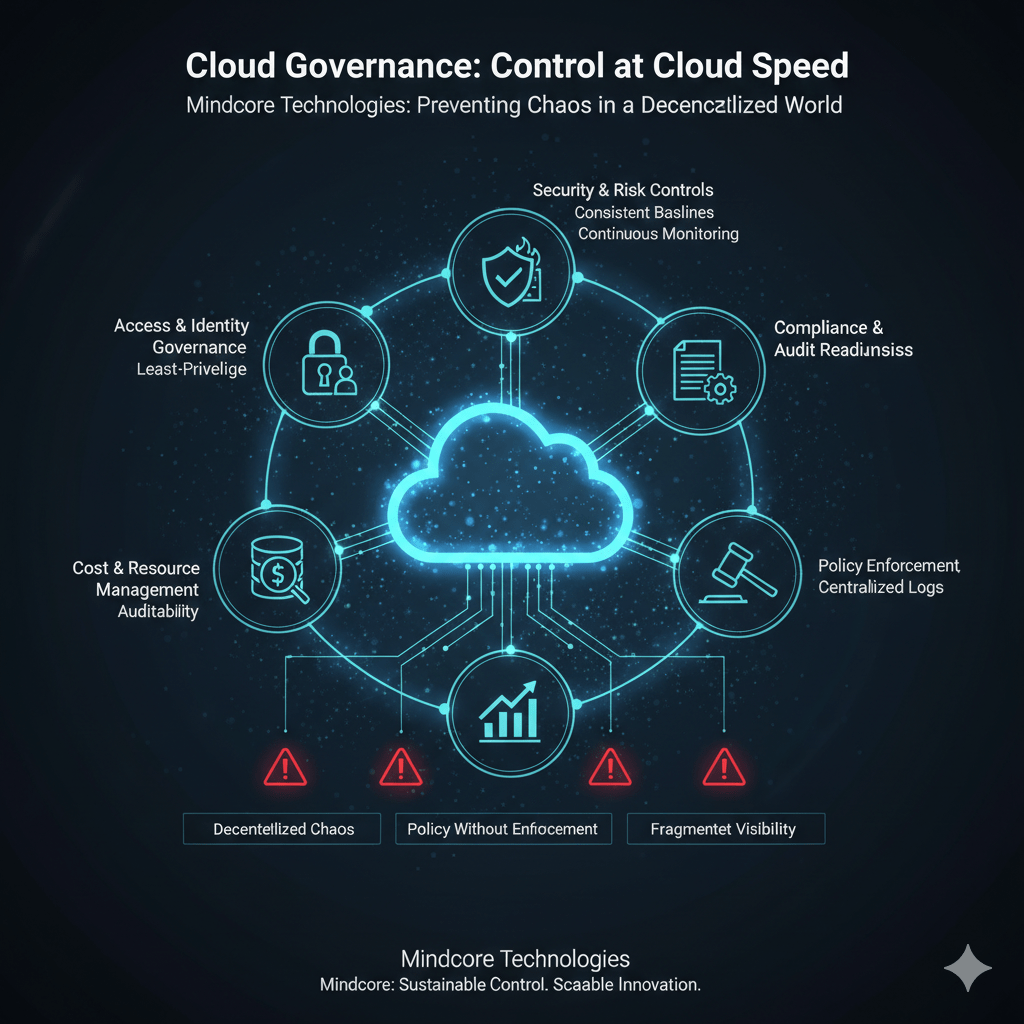
Cloud governance is the discipline of controlling how cloud services are used, accessed, and managed once speed and decentralization are introduced, and understanding What Is Cloud Governance helps businesses implement these controls effectively.
Most organizations believe cloud governance is about policies. In practice, it is about preventing chaos when teams can deploy infrastructure, access data, and integrate services faster than oversight can keep up.
At Mindcore Technologies, cloud assessments repeatedly reveal the same problem: cloud adoption succeeded, but control did not scale with it. Cloud governance exists to restore that control without slowing the business.
What Cloud Governance Actually Covers
What Is Cloud governance is not a single framework or tool. It is a set of enforceable controls that define how cloud environments operate.
It typically includes:
- Access and identity governance
Who can access cloud services, what they can do, and how that access is reviewed and revoked. - Security and risk controls
How configurations, exposure, and attack surfaces are managed consistently across platforms. - Data governance and protection
How sensitive data is classified, accessed, shared, and audited in cloud services. - Cost and resource management
How cloud spend is monitored, optimized, and aligned to business value. - Compliance and audit readiness
How regulatory requirements are enforced and evidenced across environments.
Cloud governance exists to ensure cloud speed does not create uncontrolled risk.
Why Cloud Governance Became Necessary
Traditional governance models assumed centralized infrastructure and slow change.
Cloud breaks those assumptions because:
- Teams can deploy resources instantly
Infrastructure creation no longer requires centralized approval by default. - Access is identity-based, not network-based
Users authenticate directly to cloud platforms from anywhere. - Data spreads across SaaS, IaaS, and integrations
Ownership and control blur quickly. - Shadow IT becomes inevitable
Teams adopt tools and services faster than governance processes adapt.
Without governance, cloud environments grow faster than organizations can understand them.
The Biggest Cloud Governance Failure
The most common failure is treating cloud governance as documentation instead of enforcement.
This shows up as:
- Policies that are not technically enforced
Rules exist, but nothing prevents violations. - Inconsistent controls across cloud platforms
AWS, Azure, and SaaS tools follow different standards. - Manual reviews that do not scale
Access reviews and audits become reactive exercises. - Governance that depends on user behavior
Instead of architecture enforcing boundaries.
Cloud governance fails when it relies on reminders instead of design.
Core Pillars of Effective Cloud Governance
Understanding What Is Cloud Governance rests on several foundational pillars.
Identity and Access Governance
Cloud environments are identity-driven.
Effective governance requires:
- Role-based access aligned to job functions
Permissions reflect real responsibilities. - Least-privilege access by default
Access is granted narrowly and expanded only when justified. - Regular access reviews tied to risk
Sensitive systems require more frequent validation. - Automated provisioning and deprovisioning
Access changes happen immediately when roles change.
Identity governance limits damage when credentials are compromised.
Security Configuration and Exposure Control
Misconfigurations are a leading cloud risk.
Governance must ensure:
- Consistent security baselines
Cloud resources follow approved configuration standards. - Restricted public exposure
Services are not internet-facing unless explicitly required. - Continuous monitoring for drift
Deviations from baseline are detected quickly. - Clear ownership of remediation
Findings lead to action, not reports.
Configuration discipline prevents accidental exposure.
Data Governance in the Cloud
Data is often the most valuable cloud asset.
Governance must address:
- Data classification by sensitivity
Not all data requires the same controls. - Access aligned to minimum necessary use
Users see only what their role requires. - Control over data movement and sharing
Exports, downloads, and integrations are visible and restricted. - Auditability of data access
Who accessed what data, and when, must be provable.
Data governance prevents silent exposure.
Cost and Resource Governance
Uncontrolled cloud usage becomes a financial risk.
Governance includes:
- Visibility into cloud spend by team or service
Costs are traceable and accountable. - Controls on resource creation
Preventing unnecessary or oversized deployments. - Lifecycle management of unused resources
Idle services are identified and removed. - Alignment between cost and business value
Spend supports outcomes, not experimentation without oversight.
Cost governance prevents cloud waste from becoming permanent.
Compliance and Audit Alignment
Compliance expectations did not disappear with the cloud.
Governance supports compliance by:
- Mapping controls to regulatory requirements
HIPAA, SOC 2, ISO, and others require demonstrable enforcement. - Centralizing logs and evidence
Audit data is consistent and accessible. - Reducing reliance on manual evidence gathering
Controls generate proof automatically. - Ensuring consistent enforcement across platforms
Compliance does not vary by tool.
Compliance becomes manageable when governance is built in.
How Secure Workspaces Strengthen Cloud Governance
Secure workspace architectures improve governance by design.
They help by:
- Containing access at the application level
Users interact with services without exposing infrastructure. - Reducing endpoint trust assumptions
Devices become access terminals, not control points. - Enforcing session-based access
Long-lived trust is replaced with verified sessions. - Providing centralized visibility
Access and activity are consistently logged.
Governance becomes enforceable, not aspirational.
How Mindcore Technologies Implements Cloud Governance
Mindcore helps organizations operationalize cloud governance by:
- Assessing how cloud services are actually used
Governance reflects reality, not assumptions. - Defining identity, access, and data governance models
Controls align with business roles and risk. - Reducing exposure through architectural changes
Not just additional tools. - Centralizing visibility and audit readiness
Security, IT, and compliance share a single view. - Prioritizing governance actions by impact
Not all gaps carry equal risk.
The objective is sustainable control without slowing cloud innovation.
A Simple Cloud Governance Reality Check
Your cloud governance is weak if:
- Teams deploy services without oversight
- Access reviews are manual or infrequent
- Sensitive data is widely accessible
- Logs exist but are fragmented
- Governance depends on policy reminders
These are structural gaps, not training failures.
Final Takeaway
Cloud governance is not about limiting cloud usage. It is about making cloud usage safe, predictable, and accountable at scale.
Organizations that succeed design governance into their cloud architecture. Those that do not eventually lose visibility, control, and trust in their own environments, often right before an incident forces change.
Frequently Asked Questions
What is cloud governance?
Cloud governance is the framework of policies, controls, processes, and standards used to manage cloud environments securely, efficiently, and consistently across an organization.
Why is cloud governance important for businesses?
Cloud governance helps businesses maintain operational control, strengthen security, manage costs, support compliance requirements, and ensure cloud resources align with organizational objectives. Organizations leveraging cloud infrastructure services improve visibility and operational consistency across distributed environments.
How does cloud governance improve cybersecurity?
Cloud governance improves cybersecurity through identity governance, access controls, secure configuration standards, monitoring policies, compliance enforcement, and centralized visibility across cloud environments. Businesses implementing strong cybersecurity governance reduce exposure to cloud misconfigurations and unauthorized access risks.
What are common challenges in cloud governance?
Common challenges include cloud sprawl, inconsistent security policies, unmanaged permissions, cost overruns, compliance complexity, limited visibility, and fragmented multi-cloud environments. Organizations without centralized governance often struggle to maintain operational control and security consistency.
Why is visibility important in cloud governance?
Operational visibility helps organizations monitor cloud usage, identify security risks, manage resources efficiently, enforce compliance policies, and detect unauthorized or risky activity across cloud systems. Organizations implementing Zero Trust security frameworks strengthen visibility and identity governance across distributed environments.
Cloud Governance and Infrastructure Strategy Expertise from Matt Rosenthal
Matt Rosenthal, CEO of Mindcore Technologies, has extensive experience helping organizations strengthen cloud governance, cybersecurity resilience, and operational continuity across modern digital environments. His expertise in cloud architecture, identity governance, infrastructure scalability, compliance readiness, threat monitoring, operational risk management, and secure access controls helps businesses improve visibility into cloud operations while reducing cybersecurity exposure and operational inefficiencies. Matt’s leadership focuses on building proactive cloud governance frameworks that strengthen infrastructure resilience, improve operational efficiency, reduce enterprise risk, and support long-term digital transformation initiatives.

