

Most Greenville businesses assume their network is “fine” because nothing has crashed recently.
That assumption is expensive.
Modern network failures rarely begin with dramatic outages. They begin with slow performance, unnoticed security alerts, failed backups, and minor configuration issues that escalate quietly.
At Mindcore Technologies, we often get called after the warning signs were already there. The difference between a minor incident and a major disruption is usually monitoring.
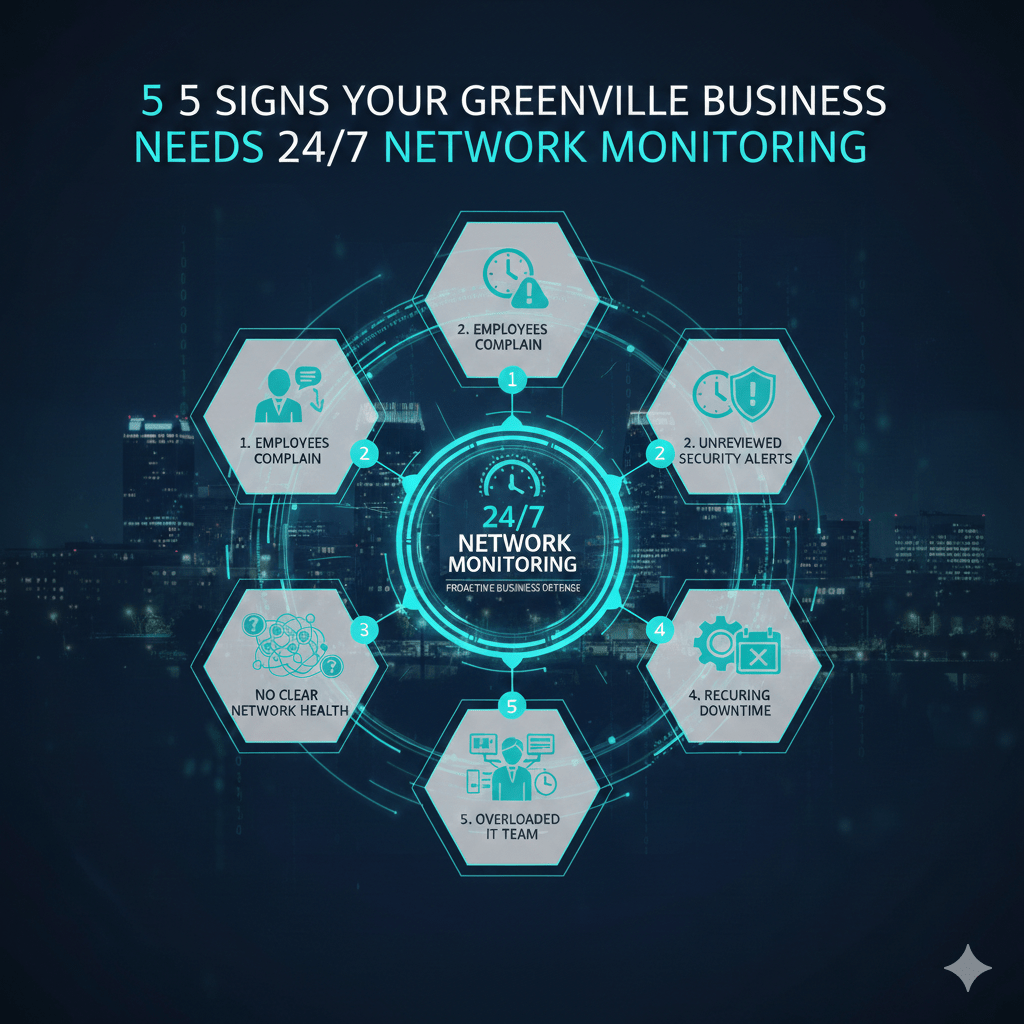
If your business shows any of the signs below, 24/7 network monitoring is no longer optional.
1. You Only Discover Problems When Employees Complain
What This Looks Like
- Slow internet during peak hours
Staff report lag, but no one knows why performance degraded. - Random application timeouts
Cloud apps disconnect without clear root cause. - Wi-Fi dead zones in certain office areas
Problems persist because no monitoring data exists.
When users are your monitoring system, issues are already impacting productivity.
Why This Is Risky
- Performance degradation often signals underlying hardware stress.
- Small network errors compound over time.
- Root causes become harder to trace after the fact.
What 24/7 Monitoring Fixes
- Real-time visibility into bandwidth usage and device health.
- Automated alerts for performance anomalies.
- Historical trend analysis to identify bottlenecks early.
Proactive detection prevents recurring disruptions.
2. Security Alerts Are Not Reviewed Continuously
What This Looks Like
- Firewall alerts sitting unread overnight
Suspicious activity may go unnoticed. - No after-hours monitoring
Attacks occurring at 2 AM are discovered the next morning. - No centralized alert dashboard
Logs exist but are not actively reviewed.
Attackers operate outside business hours.
Why This Is Risky
- Ransomware dwell time increases without detection.
- Lateral movement occurs silently.
- Minor anomalies escalate into major breaches.
What 24/7 Monitoring Fixes
- Continuous log review and anomaly detection.
- Immediate alert escalation for suspicious behavior.
- Faster containment before damage spreads.
Response speed directly impacts financial impact.
3. You Have No Clear View Of Network Health
What This Looks Like
- Uncertainty about switch, router, or firewall capacity
No one knows if devices are nearing performance limits. - No documentation of network topology
Troubleshooting becomes guesswork. - Firmware updates applied inconsistently
Some devices may be vulnerable.
Without monitoring, infrastructure health becomes reactive.
Why This Is Risky
- Hardware failures happen without warning.
- Unpatched devices become attack entry points.
- Capacity planning becomes impossible.
What 24/7 Monitoring Fixes
- Device health tracking, including CPU and memory usage.
- Automated firmware and patch alerts.
- Capacity forecasting to plan upgrades proactively.
Infrastructure maturity requires visibility.
4. Downtime Has Happened More Than Once This Year
What This Looks Like
- Recurring internet outages
Often blamed on the ISP without deeper analysis. - Server crashes during high-demand periods
Capacity issues remain unresolved. - VoIP instability affecting customer calls
Communication reliability degrades gradually.
Recurring outages indicate systemic weaknesses.
Why This Is Risky
- Downtime erodes customer trust.
- Productivity loss compounds financially.
- Leadership loses confidence in IT reliability.
What 24/7 Monitoring Fixes
- Immediate detection of connectivity failures.
- Root cause analysis through detailed logs.
- Alert-based response to prevent repeat incidents.
Consistency builds operational confidence.
5. Your IT Team Is Overloaded
What This Looks Like
- Internal IT reacting to tickets all day
No time for proactive monitoring. - After-hours issues go unchecked
Limited coverage outside standard hours. - No time for performance optimization
Preventive maintenance gets postponed.
Even strong IT teams cannot watch systems 24 hours a day.
Why This Is Risky
- Alert fatigue increases oversight gaps.
- Strategic projects are delayed.
- Burnout reduces effectiveness.
Capacity limits create blind spots.
What 24/7 Monitoring Fixes
- Extends monitoring coverage without increasing payroll.
- Reduces manual oversight burden.
- Provides structured reporting to leadership.
Monitoring strengthens internal teams instead of replacing them.
What 24/7 Network Monitoring Actually Includes
Effective monitoring should provide:
- Real-time device health tracking
Continuous insight into performance and uptime. - Security log analysis
Detection of suspicious access attempts. - Bandwidth and traffic visibility
Identifies congestion and misuse. - Alert escalation procedures
Ensures rapid response to critical events. - Reporting and trend analysis
Helps leadership understand risk exposure.
Monitoring must be active, not passive.
How Mindcore Technologies Supports Greenville Businesses
Mindcore delivers structured 24/7 network monitoring by:
- Implementing continuous device and traffic monitoring systems.
- Configuring automated alert escalation workflows.
- Reviewing firewall and security logs in real time.
- Providing detailed reporting to executive leadership.
- Identifying capacity and security risks before disruption occurs.
Monitoring is the foundation of operational resilience.
Final Takeaway
If your Greenville business relies on employee complaints, reactive troubleshooting, or limited after-hours visibility, you already have a monitoring gap.
24/7 network monitoring is not about watching blinking lights. It is about protecting uptime, detecting threats early, and preventing minor issues from becoming operational crises.
Businesses that invest in continuous visibility reduce downtime, strengthen security, and support long-term growth.

