

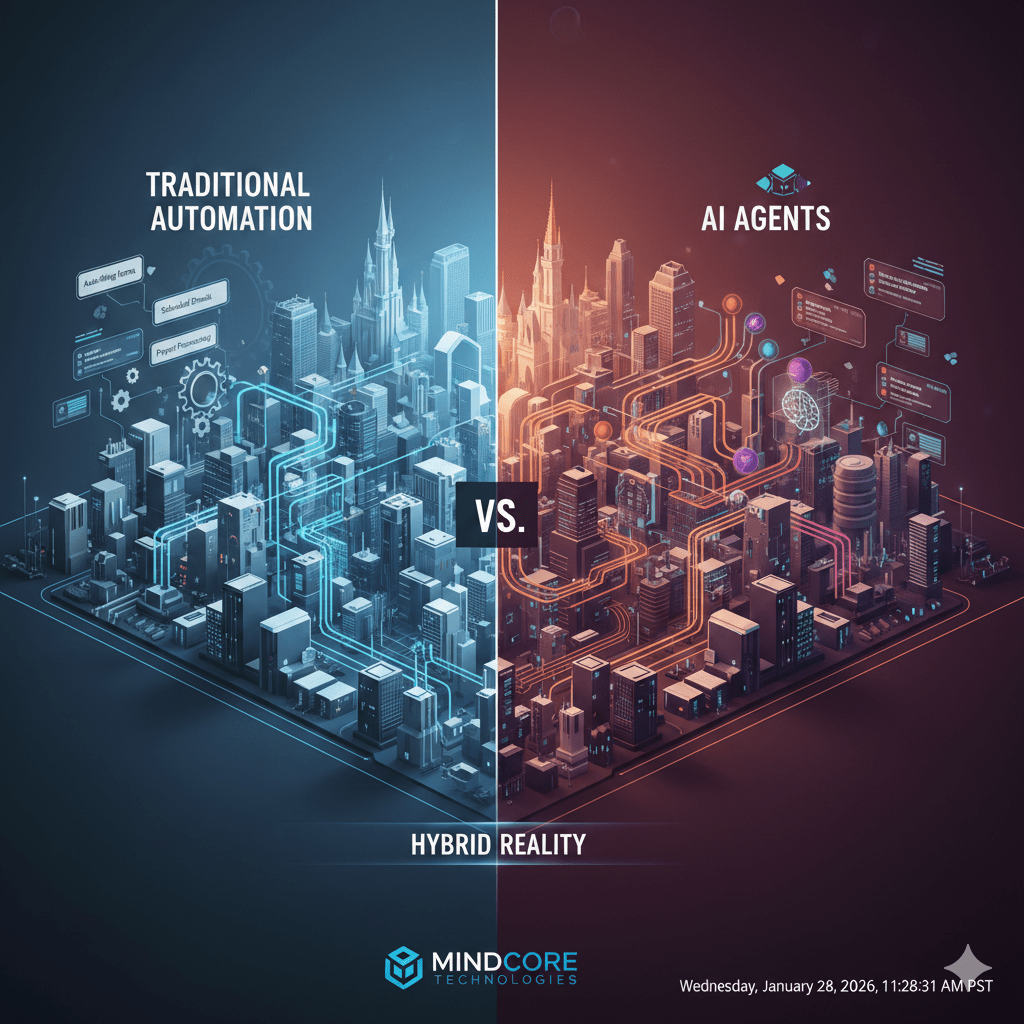
Your organization may already use automation — but that doesn’t mean it’s ready for complex decision-making, dynamic workflows, or changing business conditions. Traditional automation handles fixed tasks well, but it stops when variations, context, or human-like judgment are required. AI agents go further by operating with autonomy, learning from data, and adapting to change — making them valuable for workflows that go beyond static rule execution. Understanding the differences helps Orlando teams choose the right tool for each business need.
What Traditional Automation Really Is
Traditional automation uses predefined rules and scripts to complete tasks exactly the way they were programmed. It’s reliable and efficient for repetitive and predictable processes:
- Auto-filling forms
- Sending scheduled emails
- Processing structured records
- Migrating data between systems
These systems are straightforward to deploy, low-maintenance, and deliver predictable results — as long as nothing changes. But they cannot adapt when unexpected variables occur or when workflows require interpretation or context.
What AI Agents Actually Do
AI agents are built to be goal-oriented, adaptive, and context-aware. Unlike traditional automation, they don’t just follow rigid instructions — they:
- Interpret structured and unstructured data
- Make decisions based on context
- Adjust behavior when conditions change
- Learn from interactions over time
In real world terms, an AI agent for a tourism company might analyze incoming inquiries, detect urgency, and adjust its responses automatically — even changing tone or escalation according to customer sentiment. A logistics agent could reroute deliveries in real time based on weather or traffic conditions.
Head-to-Head: What Really Matters
Here’s how traditional automation and AI agents differ in ways that impact your operations:
- Rule Flexibility: Traditional automation acts only on fixed conditions; AI agents adapt when new patterns emerge.
- Task Complexity: Rules-based bots excel at predictable work; AI agents handle dynamic, unpredictable scenarios.
- Input Types: Traditional tools usually work with structured data; AI agents can process structured and unstructured inputs (e.g., text, voice).
- Autonomy: AI agents can act independently and adjust action plans; traditional automation awaits explicit instructions.
This flexibility makes AI agents especially suitable for customer interactions, complex workflows, and decision-based routing, while traditional automation remains strong for predictable, stable tasks.
Choosing the Right Approach for Orlando Businesses
The decision isn’t binary — it’s about matching each tool to the job:
When Traditional Automation Is Best
- Tasks are routine and unchanging
- Inputs are structured and predictable
- Speed and repeatability matter most
- Implementation needs to be quick and simple
Examples: Payroll processing, scheduled reporting, basic form handling.
When AI Agents Provide More Value
- Workflows change based on behavior or context
- Decisions need interpretation or judgment
- You want systems that learn and improve over time
- Unstructured data (text, voice, images) is part of the workflow
Examples: Intelligent customer support, dynamic scheduling, adaptive routing.
Cost, Maintenance, and Long-Term Value
Traditional automation:
- Lower upfront cost
- Easier and faster setup
- Minimal ongoing training or tuning
AI agents:
- Higher initial effort (data, setup, training)
- Requires ongoing refinement
- Offers better scalability and long-term value as workflows evolve
Choosing based on total value over time — not just immediate implementation cost — prevents expensive rework or reliance on brittle workflows.
Hybrid Reality: Best of Both Worlds
In many real business environments — including Orlando’s diverse sectors like hospitality, healthcare, and logistics — you don’t choose one or the other exclusively. The most effective systems use:
- Traditional automation for predictable infrastructure tasks
- AI agents for complex, adaptive, intelligence-driven workflows
This layered approach delivers reliability without sacrificing flexibility.
How Mindcore Technologies Helps Orlando Teams
At Mindcore Technologies, we help businesses implement both traditional automation and AI agent solutions strategically:
- Align automation to business processes and risk profiles
- Integrate AI agents with secure identity and cloud systems
- Tune agent models with high-quality data
- Balance cost, performance, and operational outcomes
- Build hybrid environments that scale with demand
Our goal is to ensure your workflows are not just automated, but optimized, adaptive, and resilient — so technology becomes a competitive advantage, not an operational burden.
Final Thought
There is no universal “right” choice between AI agents and traditional automation. The right path depends on:
- Complexity of tasks
- Variability in input data
- Need for adaptability or learning
- Long-term strategic goals
Traditional automation keeps operations running efficiently. AI agents enable responsiveness, contextual decisions, and evolving capabilities. In practice, a thoughtful combination of both constitutes the most effective strategy for modern enterprises.

