

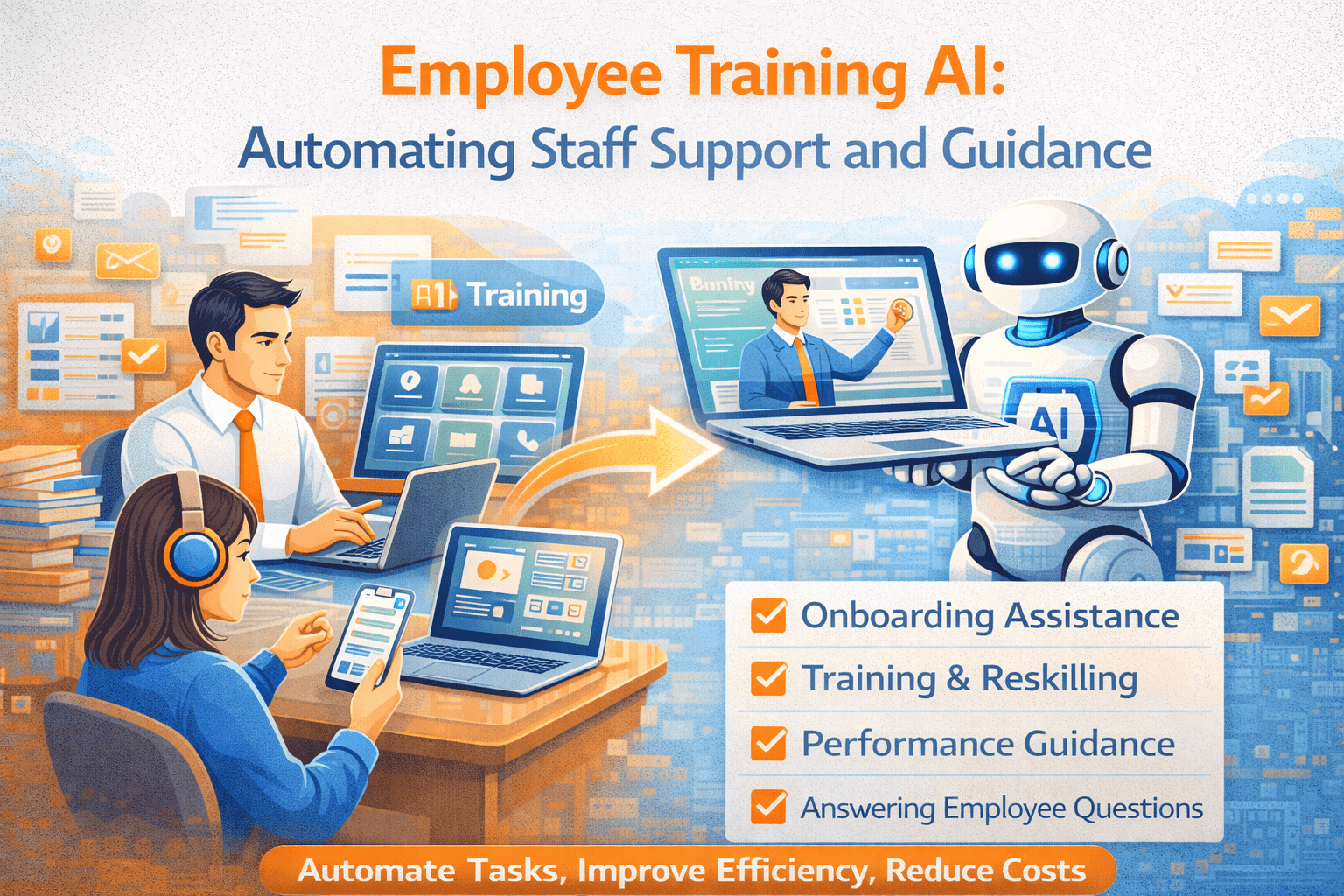
Employee onboarding, policy reinforcement, and workflow training consume significant management time. Traditional training models rely on static documentation, occasional workshops, and manual supervision. Knowledge gaps appear quickly, especially in growing organizations. AI-powered employee training transforms staff support into a continuous, accessible system.
The broader automation foundation is outlined in AI Process Automation for Business: Complete Guide to Operational Excellence, where operational excellence includes workforce enablement.
Automation must extend beyond processes into people support.
Why Traditional Employee Training Breaks Down
Conventional training models struggle with scale.
Common limitations include:
• Static documentation
Policies become outdated quickly.
• Limited accessibility
Employees cannot find answers instantly.
• Inconsistent knowledge retention
Staff forget procedures between sessions.
• Manager dependency
Leaders answer repetitive questions.
Workforce efficiency concerns are connected to AI Agent Implementation: Reducing Business Operational Overhead.
How AI Enhances Employee Training
AI training systems provide contextual, real-time guidance.
Capabilities include:
• On-demand knowledge assistance
Employees receive instant answers.
• Workflow-based prompts
Guidance appears during task execution.
• Automated policy reminders
Reinforce compliance behavior.
• Training progress tracking
Improve accountability.
Implementation sequencing is reinforced in The Business AI Automation Checklist for Leaders and Owners.
AI-Driven Staff Support in Practice
AI can assist in:
• HR onboarding
Guide new hires through documentation steps.
• Sales process alignment
Provide script or workflow prompts.
• Operations compliance
Flag missing documentation steps.
• Customer service support
Suggest response frameworks.
Process elimination strategies are expanded in How to Eliminate Manual Business Processes with AI Agents.
Reducing Managerial Burden
Managers often spend excessive time answering repeat questions.
AI reduces dependency by:
• Centralizing policy knowledge
Improve information accessibility.
• Automating FAQ responses
Reduce interruptions.
• Escalating only complex issues
Preserve leadership focus.
Provider evaluation for scalable workforce tools is discussed in Business AI Automation Providers: Comparing Enterprise and Local Options.
Measuring Training Effectiveness
AI-enabled training allows structured tracking.
Key metrics include:
• Reduction in repeat procedural errors
• Faster onboarding completion
• Decreased manager intervention
• Improved workflow compliance rates
• Increased employee confidence levels
Challenge mitigation discipline is reinforced in AI Automation Challenges in Business: Executive and Small Business Solutions.
Common Mistakes in Training Automation
• Overloading employees with notifications
• Replacing human leadership entirely
• Failing to update training datasets
• Ignoring feedback loops
• Implementing without change management
Balanced integration ensures success.
Key Takeaways
AI-powered employee training automates staff support by providing contextual guidance, on-demand knowledge access, workflow-based prompts, and compliance reinforcement. By reducing managerial interruption, accelerating onboarding, improving knowledge retention, and strengthening procedural consistency, AI training systems convert workforce development into a scalable operational advantage. When integrated thoughtfully within a broader automation framework, employee training AI enhances both efficiency and organizational confidence without eliminating human leadership.

