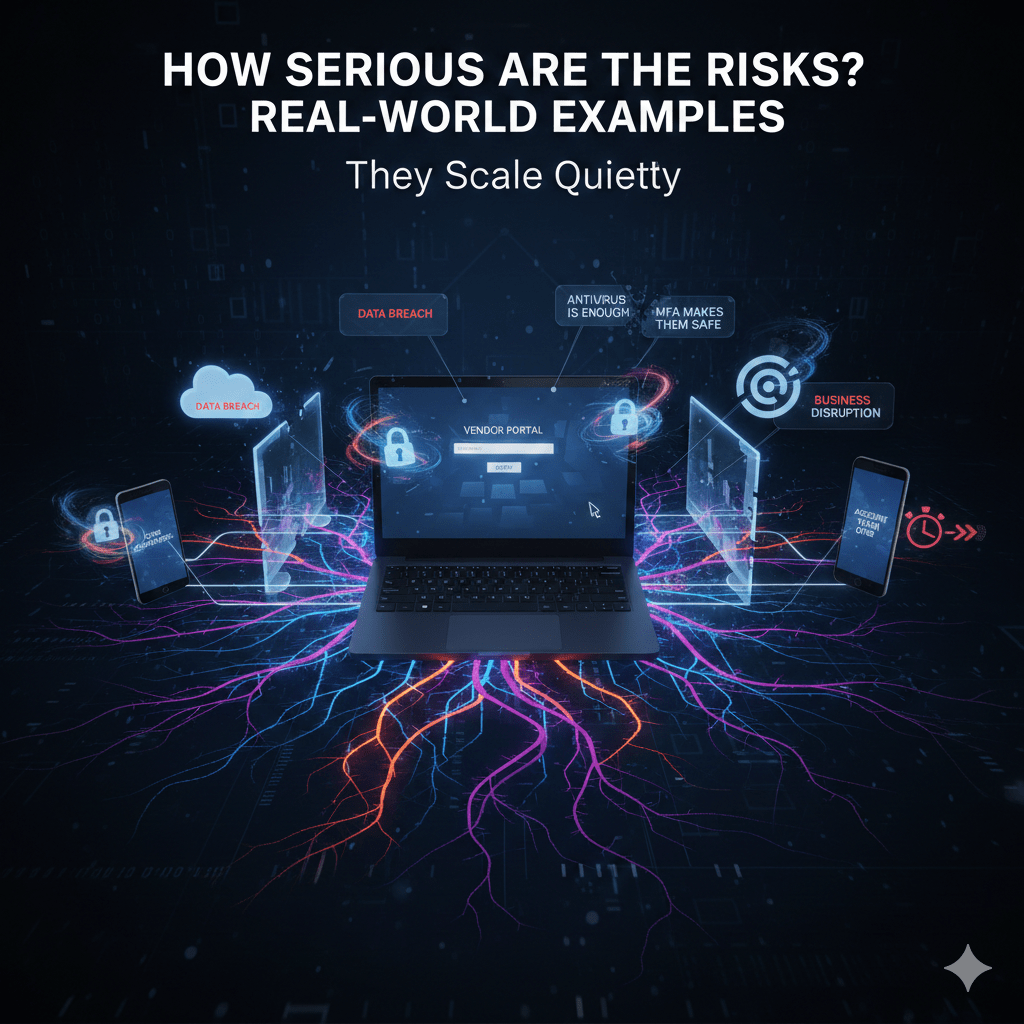
Computer security risks are not theoretical. They are not rare. And they are not limited to large enterprises. Most successful attacks exploit ordinary systems doing ordinary things, not exotic zero-day vulnerabilities.
At Mindcore Technologies, we see the same reality play out repeatedly: a single compromised computer becomes the entry point for data theft, ransomware, or prolonged business disruption. The damage is rarely immediate. It escalates quietly.
This article examines how serious computer security risks actually are using real-world patterns we see in the field—and what those examples reveal about modern threats.
Why Computer Security Risk Is Underestimated
Many users believe:
- Antivirus is enough
- MFA makes them safe
- Attackers only target “big companies”
- Nothing valuable lives on one computer
These assumptions are exactly what attackers exploit.
Modern attacks are designed to succeed without triggering alarms and without requiring advanced techniques.
Real-World Example #1: One Phishing Email, Full Business Disruption
What happened:
An employee received a convincing email that appeared to come from a known vendor. The link led to a fake login page. Credentials were entered once.
What followed:
- Attacker logged in legitimately
- Email rules were created to hide replies
- Cloud storage was accessed
- Malware deployed through trusted tools
- Ransomware executed days later
Impact:
- Multi-day outage
- Data restoration from backups
- Lost productivity and customer trust
Lesson:
A single computer with valid credentials is enough to compromise an entire environment.
Real-World Example #2: Unpatched Laptop Used as a Silent Entry Point
What happened:
A remote employee delayed OS updates on a personal laptop used for work. A known vulnerability remained unpatched.
What followed:
- Malware executed via a drive-by download
- Credential harvesting occurred silently
- VPN access was abused
- Internal systems were scanned
Impact:
- Sensitive internal data accessed
- Long investigation window
- Mandatory compliance notifications
Lesson:
Outdated endpoints create invisible access paths attackers rely on.
Real-World Example #3: Public Wi-Fi Session Hijacking
What happened:
An employee worked from a café using public Wi-Fi. No malware was installed. No warnings appeared.
What followed:
- Session tokens were captured
- Cloud applications were accessed without reauthentication
- MFA was bypassed using valid sessions
Impact:
- Email and file access for weeks
- Data exposure before detection
- Forced credential resets across the company
Lesson:
Session theft is just as dangerous as credential theft—and far harder to notice.
Real-World Example #4: Weak Local Admin Controls
What happened:
Multiple users shared local admin rights “for convenience.”
What followed:
- Malware executed with elevated privileges
- Security tools were disabled
- Persistence mechanisms installed
Impact:
- Extended dwell time
- Complete device rebuilds
- Loss of confidence in system integrity
Lesson:
Overprivileged computers dramatically increase attack impact.
Real-World Example #5: “It Was Just One Computer”
What happened:
A single workstation was infected with an infostealer. It appeared isolated.
What followed:
- Browser-stored credentials harvested
- VPN credentials reused
- Cloud admin accounts accessed
Impact:
- Multiple systems compromised
- Forced rotation of credentials company-wide
- Weeks of remediation
Lesson:
Attackers rarely stop at one device. They expand quietly.
Why Computers Remain the Primary Attack Surface
Despite cloud adoption, computers remain critical because they:
- Store credentials and sessions
- Access email, cloud, and internal apps
- Bridge secure systems through trusted access
Attackers target endpoints because they inherit trust.
The Most Common Computer Security Failures We See
- Outdated operating systems
- Excessive local admin rights
- Weak endpoint monitoring
- No session protection
- Inconsistent patching
- Overreliance on antivirus
These are structural issues, not user mistakes.
What These Examples All Have in Common
In every case:
- Access looked legitimate
- Alerts were minimal or nonexistent
- Damage escalated over time
- Detection came late
The risk was not the exploit. It was implicit trust.
How Serious Are the Risks, Really?
For businesses, computer security risks lead to:
- Ransomware and downtime
- Data theft and extortion
- Compliance violations
- Reputational damage
- Long recovery timelines
For individuals, they lead to:
- Identity theft
- Financial fraud
- Account takeovers
- Long-term digital exposure
The severity is not hypothetical. It is measurable.
What Actually Reduces Computer Security Risk
Effective protection focuses on:
- Keeping systems fully patched
- Removing unnecessary admin rights
- Enforcing strong identity controls
- Monitoring behavior, not just malware
- Protecting sessions as well as credentials
Security succeeds by limiting blast radius, not by assuming prevention is perfect.
How Mindcore Technologies Reduces Endpoint Risk
Mindcore helps organizations reduce computer security risk by implementing:
- Endpoint hardening and patch governance
- Identity-aware access controls
- Least-privilege enforcement
- Behavioral monitoring and response
- Secure remote and public network usage controls
We focus on containment, visibility, and recovery, not just prevention.
A Simple Reality Check
Your computer security risk is high if:
- Devices fall behind on updates
- Users have admin rights by default
- Public networks are used casually
- Sessions persist indefinitely
- Monitoring is minimal
These conditions exist in most environments today.
Final Takeaway
Computer security risks are serious because they scale quietly. One compromised device can unlock cloud platforms, internal systems, and sensitive data without triggering obvious alarms. Real-world attacks succeed not because defenses are absent, but because trust is misplaced.
Organizations that treat endpoint security as foundational dramatically reduce breach impact. Those that underestimate it often learn the cost only after damage is done.