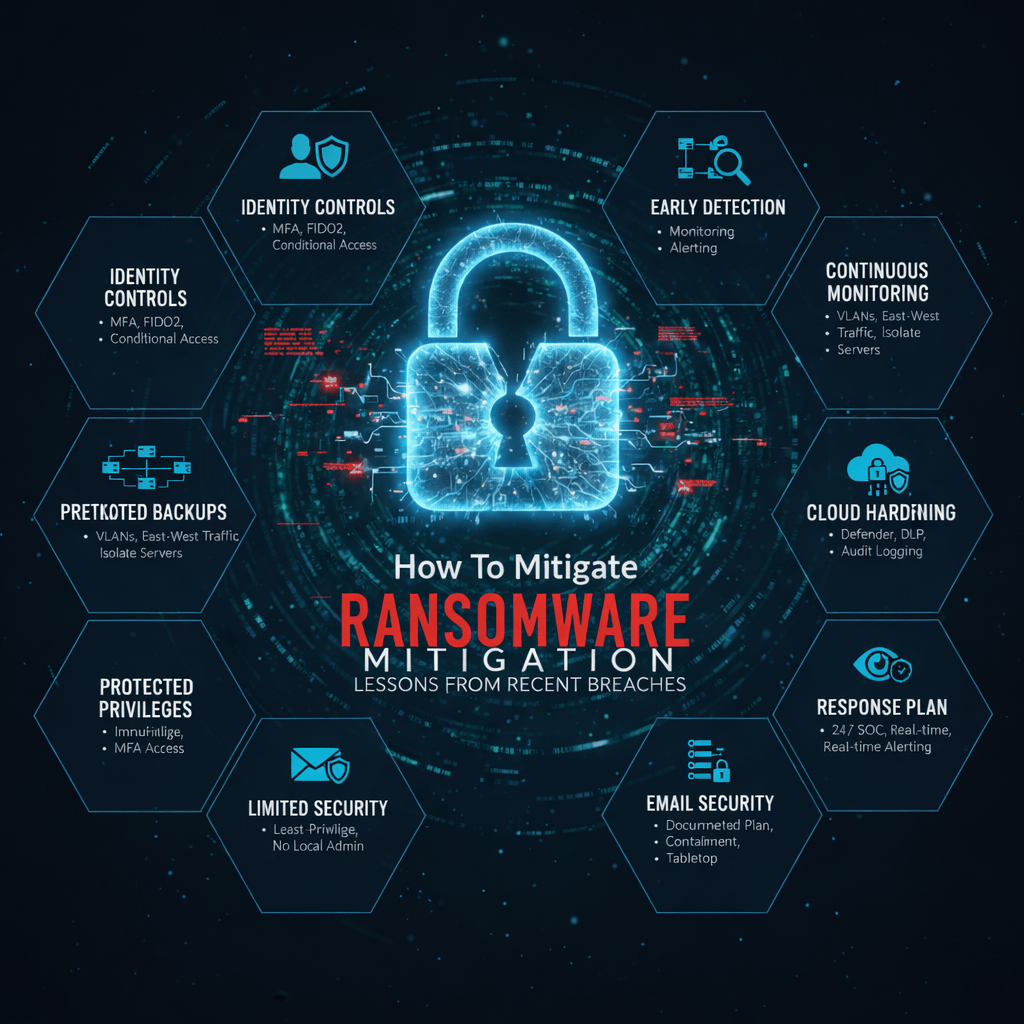
Ransomware mitigation is no longer theoretical. The breaches we’ve seen over the last 12 to 18 months follow the same patterns, regardless of industry. Attackers are not relying on exotic exploits. They are abusing identity gaps, unpatched systems, weak backups, and flat networks. When ransomware hits, it’s rarely the first failure. It’s the final one.
At Mindcore Technologies, we analyze real ransomware incidents weekly. The lesson is consistent: organizations that limit blast radius, detect early, and contain fast suffer dramatically less damage than those focused only on prevention.
This guide breaks down what actually failed in recent breaches and the controls that would have reduced impact or stopped the attack entirely.
Lesson 1: Ransomware Starts With Identity, Not Malware
In nearly every recent breach, ransomware operators logged in using stolen credentials. Infostealers, phishing, MFA fatigue, and reused passwords remain the dominant access vectors.
Mitigation controls that work:
- Enforce MFA on all accounts
- Require FIDO2 security keys for admins and executives
- Disable legacy authentication protocols
- Implement Conditional Access policies
- Block risky geographies and anonymous VPNs
- Separate admin accounts from daily-use accounts
When attackers cannot impersonate users, they cannot move or deploy ransomware.
Lesson 2: Detection Failed Long Before Encryption Began
Recent breaches show attackers sitting in networks for days or weeks before encrypting anything. Alerts were ignored, disabled, or never generated.
Mitigation controls that work:
- Endpoint Detection and Response (EDR) on all devices
- Identity behavior monitoring
- Alerts for abnormal PowerShell usage
- Detection of credential dumping tools
- Monitoring for lateral movement
- Centralized logging with real-time alerting
Mitigation is about time. The earlier you detect, the smaller the impact.
Lesson 3: Flat Networks Turn Incidents Into Disasters
In breach after breach, ransomware spread rapidly because internal systems trusted each other by default.
Mitigation controls that work:
- Network segmentation by role and sensitivity
- Firewall rules between VLANs
- Isolating servers from user networks
- Restricting east-west traffic
- Separating backup systems from production networks
Segmentation limits blast radius and keeps ransomware contained.
Lesson 4: Backups Were Accessible to the Attacker
Many recent victims technically had backups. They were still encrypted or deleted because they were online, unprotected, or shared credentials with production systems.
Mitigation controls that work:
- Immutable backups
- Offline or off-network storage
- MFA-protected backup access
- Separate credentials for backup systems
- Monthly restore testing
Backups must be unreachable from compromised accounts.
Lesson 5: Cloud Tenants Were Poorly Secured
Microsoft 365 and Google Workspace are now primary targets because they store sensitive data attackers can steal for extortion.
Mitigation controls that work:
- Defender for Office 365 or equivalent protections
- Blocking external forwarding rules
- Restricting SharePoint and OneDrive sharing
- Enabling audit logging
- Enforcing DLP policies
- Monitoring large data downloads
Cloud hardening reduces data theft leverage even if endpoints are compromised.
Lesson 6: Excessive Privileges Accelerated the Attack
Recent breaches show ransomware spreading quickly because users and service accounts had far more access than needed.
Mitigation controls that work:
- Least-privilege access everywhere
- No local admin rights for users
- Dedicated admin accounts
- Privileged Access Workstations (PAWs)
- Regular access reviews
Privilege reduction slows attackers and prevents mass encryption.
Lesson 7: Email Security Remains a Weak Point
Phishing continues to be the most common ransomware entry method.
Mitigation controls that work:
- Advanced anti-phishing filters
- Attachment sandboxing
- URL rewriting and scanning
- DMARC, DKIM, SPF enforcement
- Impersonation protection
Email hardening eliminates the most common ransomware delivery mechanism.
Lesson 8: Incident Response Was Unprepared or Unrehearsed
Organizations that struggled most lacked a clear response plan. Delays increased damage, regulatory exposure, and recovery time.
Mitigation controls that work:
- A documented ransomware response plan
- Clear containment procedures
- Defined communication channels
- Backup restoration playbooks
- Legal and compliance escalation paths
- Regular tabletop exercises
Prepared teams respond faster and recover cleaner.
Lesson 9: Monitoring Was Reactive Instead of Continuous
In many breaches, attackers triggered multiple warning signs that went unnoticed.
Mitigation controls that work:
- 24/7 SOC monitoring
- Correlation of identity, endpoint, and network events
- Automated containment actions
- Real-time alert escalation
Continuous monitoring transforms ransomware from a crisis into a contained incident.
What Recent Breaches Make Clear
Ransomware mitigation is about reducing impact, not chasing perfection. The organizations that suffered the least had:
✔ Strong identity controls
✔ Early detection
✔ Network segmentation
✔ Protected backups
✔ Cloud tenant hardening
✔ Limited privileges
✔ Continuous monitoring
✔ A tested response plan
Those that didn’t paid the price.
Mindcore Technologies: Ransomware Mitigation Built From Real Incidents
Mindcore helps organizations reduce ransomware impact with:
- Identity-first security frameworks
- Endpoint Detection and Response deployment
- Network segmentation and zero-trust design
- Immutable backup architecture
- Microsoft 365 and Google Workspace hardening
- Privilege and access governance
- 24/7 SOC monitoring
- Incident response planning and execution
We build defenses based on what actually fails in the real world.
Final Takeaway
Recent ransomware breaches make one thing clear: mitigation works when it is layered, monitored, and enforced consistently. Organizations that assume ransomware is unavoidable are usually missing the controls that limit damage.
The goal is not just to stop ransomware — it’s to survive it with minimal impact if it ever reaches your environment.