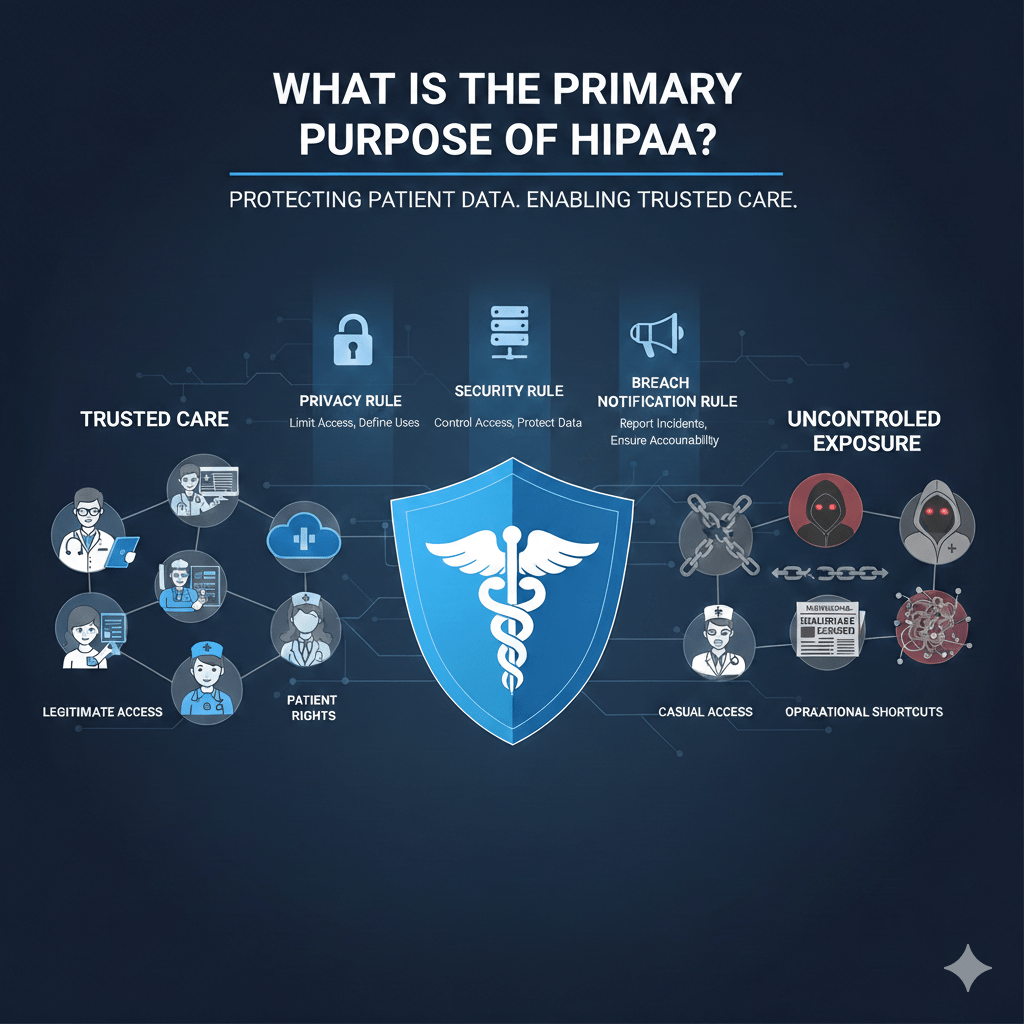
The primary purpose of HIPAA is to protect patients by controlling how their health information is accessed, used, and disclosed in real-world healthcare operations.
HIPAA is often misunderstood as a compliance checklist or a cybersecurity law. It is neither. HIPAA is a risk-control mandate designed to ensure that patient data is handled intentionally, not conveniently.
At Mindcore Technologies, HIPAA failures almost always trace back to environments where access expanded faster than governance. HIPAA exists to prevent that outcome.
HIPAA’s Core Objective, In Plain Terms
HIPAA was created to answer a single question:
How do we allow healthcare organizations to operate efficiently while preventing unnecessary exposure of patient data?
To do that, HIPAA establishes enforceable expectations that:
- Patient data is accessed only for legitimate purposes
- Access is limited to the minimum necessary
- Organizations can prove how data is protected and used
- Patients retain rights over their information
Everything else in HIPAA flows from this objective.
What HIPAA Is Primarily Trying to Prevent
HIPAA is not focused only on hackers. It is focused on uncontrolled exposure.
The law exists to prevent:
- Casual or excessive access to patient data
Data should not be accessible simply because it is convenient. - Untraceable use of PHI
Organizations must be able to show who accessed data and why. - Improper sharing or disclosure
Data movement must be intentional and authorized. - Operational shortcuts that compromise privacy
Speed cannot justify exposure.
Most HIPAA violations occur during normal operations, not attacks.
Why Patient Trust Is Central to HIPAA
Healthcare data is different from other data types.
HIPAA recognizes that:
- Patients cannot opt out of data collection
- Data is deeply personal and permanent
- Misuse can cause financial, medical, and emotional harm
- Trust is essential to care delivery
HIPAA exists to preserve that trust by making privacy enforceable, not optional.
How HIPAA Balances Care Delivery and Privacy
HIPAA does not aim to restrict care. It aims to control access without slowing treatment.
This balance is achieved by:
- Allowing necessary access for treatment, payment, and operations
- Requiring safeguards proportional to risk
- Enforcing accountability rather than prohibition
HIPAA accepts that access is required. It demands that access is justified.
The Role of the HIPAA Security Rule
The Security Rule operationalizes HIPAA’s purpose for electronic data.
It requires organizations to:
- Control access to electronic PHI
Only authorized users can access sensitive systems. - Protect data integrity and availability
Data must be accurate and accessible when needed. - Maintain auditability
Activity must be traceable and reviewable.
The Security Rule exists to ensure HIPAA’s intent is enforceable in modern systems.
What HIPAA Is Not Trying to Do
Clarity here matters.
HIPAA is not intended to:
- Mandate specific technologies
- Prevent all data access
- Eliminate operational risk entirely
- Replace good security architecture
HIPAA defines outcomes, not tools. Organizations are responsible for how those outcomes are achieved.
Why HIPAA Still Matters Today
HIPAA remains critical because:
- Healthcare data is more distributed than ever
- Cloud, telehealth, and third parties expanded access paths
- Credential theft and misuse are now primary threats
- Regulatory scrutiny continues to increase
HIPAA’s purpose is more relevant now than when it was written.
How Architecture Determines Whether HIPAA’s Purpose Is Met
Organizations meet HIPAA’s intent when:
- Access is identity-based, not network-based
- Permissions reflect job roles and purpose
- Sessions are limited and auditable
- Data is contained within controlled environments
They fail when trust is assumed instead of enforced.
How Mindcore Technologies Helps Organizations Align With HIPAA’s Purpose
Mindcore helps healthcare organizations meet HIPAA’s primary purpose by:
- Reducing unnecessary access to PHI
Limiting exposure by design. - Enforcing least-privilege access consistently
Access aligns with responsibility. - Improving visibility into PHI usage
Audit trails are clear and centralized. - Containing data inside secure access environments
PHI does not freely reach endpoints.
The focus is not just compliance. It is controlled, defensible access.
A Simple HIPAA Purpose Reality Check
HIPAA’s primary purpose is not being met if:
- Users can access PHI beyond their role
- Access is long-lived and rarely reviewed
- Data reaches unmanaged devices
- Activity cannot be easily audited
- Compliance depends on policy reminders
These conditions violate HIPAA’s intent, even if no breach has occurred.
Final Takeaway
The primary purpose of HIPAA is to ensure patient data is accessed deliberately, protected consistently, and exposed only when necessary.
Organizations that understand this treat HIPAA as an architectural discipline. Organizations that do not treat it as paperwork, until an incident forces them to learn the difference.