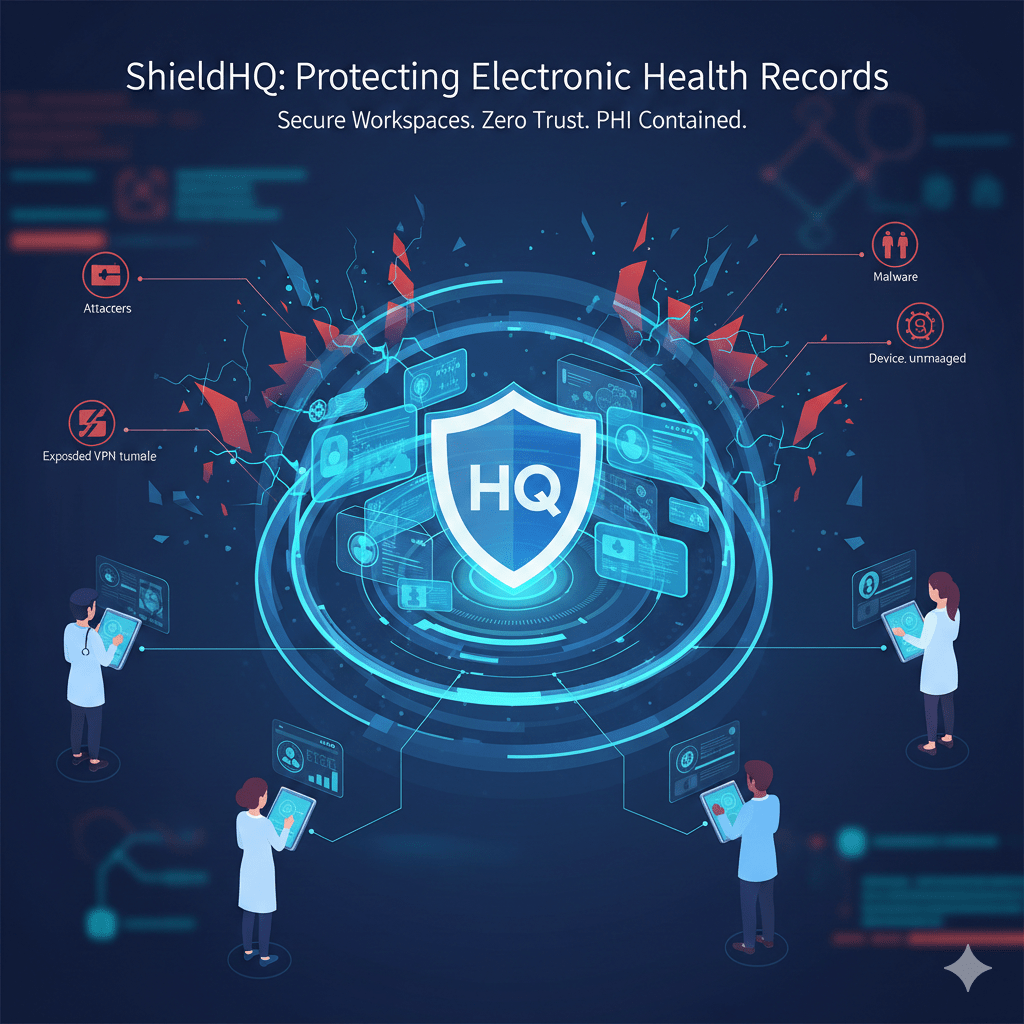
Electronic Health Records are not breached because attackers are clever. They are breached because EHR access is too broad, too persistent, and too difficult to monitor in real time. Once credentials are stolen, most environments offer attackers far more access than they need to cause damage.
That model no longer works in healthcare.
At Mindcore Technologies, EHR-related incidents follow the same pattern: access was legitimate, sessions were trusted indefinitely, and PHI was reachable from endpoints that should never have seen it. ShieldHQ exists to break that chain by redesigning how EHR access is delivered.
Why EHR Systems Are a Prime Target
EHR platforms sit at the intersection of high value and high exposure.
Healthcare attackers target EHRs because:
- They contain regulated, monetizable PHI
Patient records carry both financial value and extortion leverage, making them a preferred ransomware target. - Access is widespread across roles
Clinicians, billing teams, administrators, and third parties all require access, increasing the risk of over-permissioning. - Availability is mission-critical
Downtime directly impacts patient care, which attackers exploit through ransomware pressure. - Legacy access models assume trust
VPNs and flat networks allow access far beyond what is required once credentials are compromised.
Security tools often detect activity late because the access itself appears normal.
The Core Problem with Traditional EHR Access
Most healthcare organizations protect EHRs by securing the network around them.
That approach fails because:
- VPNs extend the network to endpoints
Once connected, devices inherit internal access even if they are unmanaged or compromised. - Authentication grants standing access
Sessions remain active for long periods, increasing the value of stolen credentials. - EHR access is rarely scoped tightly enough
Users can often reach supporting systems, file shares, or databases they do not need. - Monitoring focuses on malware, not misuse
Legitimate access abuse blends into normal activity.
ShieldHQ addresses these failures by removing network trust entirely.
How ShieldHQ Protects Electronic Health Records
ShieldHQ Powered by Dispersive® Stealth Networking secures EHR access through a secure workspace model that changes the architecture, not just the controls.
EHR Access Without Network Exposure
- Applications are isolated inside a secure workspace
EHR systems are not directly reachable from user devices or networks. - No routable paths to EHR infrastructure
Unauthorized users cannot scan, probe, or discover EHR systems. - VPNs are eliminated
There is no network extension, reducing attack surface immediately.
This removes the most common EHR breach entry points.
Identity-Driven, Session-Based Access
- Access is tied to verified identity and role
Clinicians, billing staff, and administrators receive only the access their role requires. - Sessions are short-lived and continuously evaluated
Access is not assumed indefinitely after login. - Context matters
Device posture, location, and behavior influence access decisions.
Stolen credentials lose value quickly.
PHI Containment by Design
- EHR data stays inside the secure workspace
PHI is not downloaded, cached, or stored on endpoints. - Reduced risk of exfiltration and encryption
Ransomware cannot encrypt what it cannot reach. - No clipboard or file leakage
Data movement is controlled and observable.
This directly limits breach severity.
How ShieldHQ Stops Common EHR Attack Scenarios
Infostealer-Based Credential Theft
- Credentials alone do not provide network access
- Sessions are tightly scoped to specific applications
- Lateral movement paths do not exist
Attackers gain nothing beyond the exact access granted.
Phishing and Session Hijacking
- Sessions are monitored and can be terminated instantly
- Abnormal behavior triggers access revocation
- Long-lived sessions are eliminated
MFA bypass attempts lose effectiveness.
Ransomware Deployment
- No access to underlying servers or file systems
- No lateral movement across the environment
- No ability to enumerate additional targets
Ransomware cannot spread.
Why ShieldHQ Improves HIPAA Alignment for EHR Access
HIPAA requires organizations to demonstrate control, not intent.
ShieldHQ supports this by providing:
- Application-level audit trails
Clear records of which users accessed EHR systems and when. - Session visibility
Detailed insight into access duration and behavior. - Least privilege enforcement
Users cannot access data outside their approved scope. - Reduced exposure footprint
PHI is accessible only through controlled pathways.
Audits become defensible instead of reactive.
Why Secure Workspaces Are Better Than “Hardening” EHR Systems
Traditional approaches focus on:
- Hardening servers
- Adding monitoring tools
- Layering controls on exposed infrastructure
ShieldHQ focuses on:
- Removing exposure
- Eliminating network trust
- Containing access by default
It is easier to protect what attackers cannot reach.
How Mindcore Technologies Deploys ShieldHQ for EHR Protection
Mindcore implements ShieldHQ for healthcare organizations by:
- Mapping EHR workflows and access needs
Security aligns with clinical reality, not assumptions. - Defining role-based access to PHI
Permissions reflect responsibility, not convenience. - Replacing VPN-based access with secure workspaces
Network exposure is removed from EHR access entirely. - Enforcing device and session controls
Access adapts dynamically to risk. - Providing centralized monitoring and governance
Security and compliance teams maintain full visibility.
The result is stronger EHR protection without disrupting care delivery.
A Quick EHR Security Reality Check
Your EHR environment is at risk if:
- VPN access is still required
- EHR servers are reachable from endpoints
- Sessions persist indefinitely
- Users can access supporting systems they do not need
- Audits rely on screenshots and assumptions
These are architectural risks, not awareness gaps.
Final Takeaway
Protecting Electronic Health Records requires more than securing the perimeter around them. It requires removing unnecessary access, eliminating network exposure, and containing PHI by design.
ShieldHQ Powered by Dispersive® Stealth Networking delivers this through secure workspaces that enforce zero trust without disrupting clinical operations. For healthcare organizations under constant ransomware and compliance pressure, this approach is no longer optional. It is how EHR security must be done moving forward.