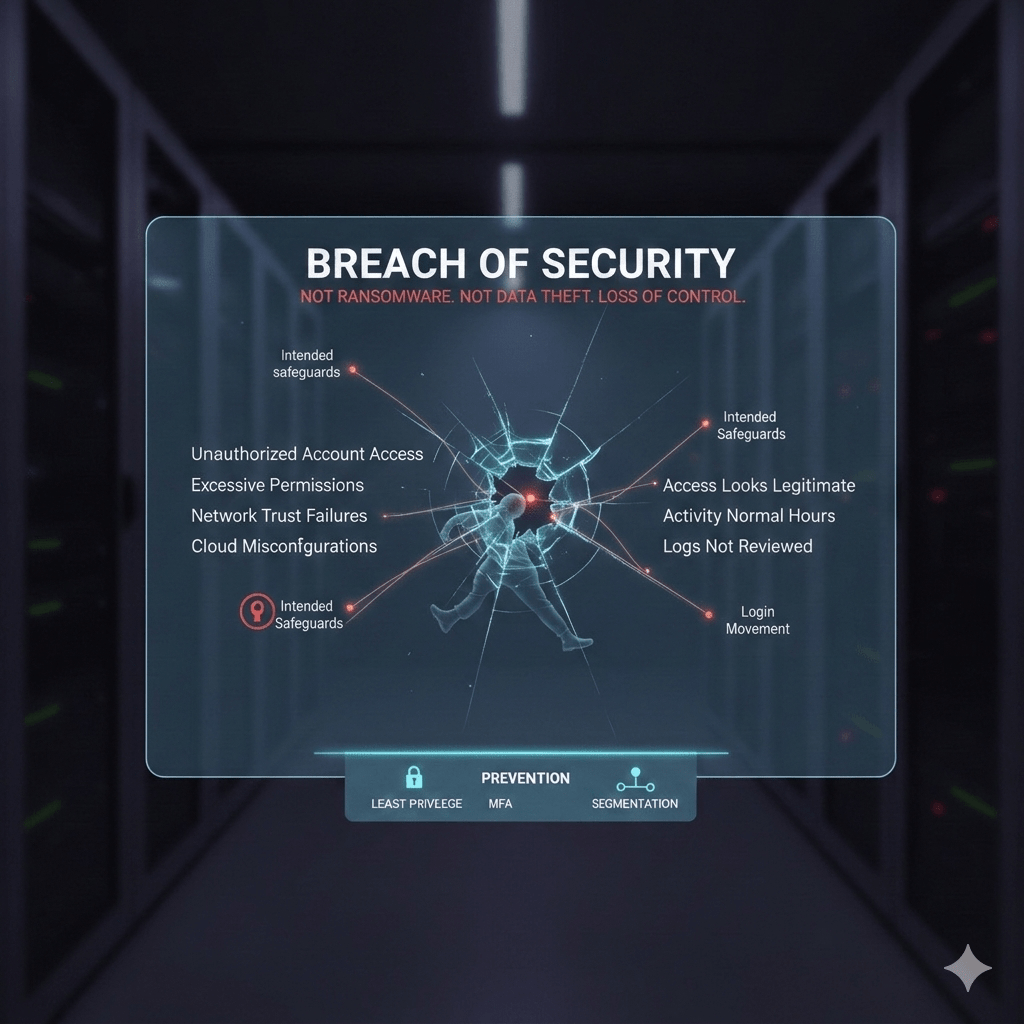
A breach of security occurs the moment controls fail to prevent unauthorized access, use, or movement within a system. It does not require data theft. It does not require ransomware. And it often happens long before anyone realizes something is wrong.
In real environments, breaches of security are quiet trust failures, not dramatic break-ins.
At Mindcore Technologies, post-incident reviews consistently show the same reality: the breach didn’t start when damage appeared. It started when access existed that should not have.
The Straightforward Definition
A breach of security happens when:
- A person, system, or process bypasses intended safeguards
- Access exceeds what was explicitly authorized
- A trust boundary is crossed without proper validation
The breach exists even if nothing is changed, deleted, or stolen yet.
What a Breach of Security Is Not
Many people confuse a security breach with its consequences.
A breach of security is not:
- Only ransomware
- Only data leaks
- Only system outages
- Only malware infections
Those are outcomes.
A breach is the loss of control that makes those outcomes possible.
Common Real-World Breaches of Security
1. Unauthorized Account Access
The most common breach today.
How it happens:
- Phishing captures credentials
- Password reuse exposes accounts
- Session tokens are hijacked
Why it’s a breach:
Systems accept access they should not.
2. Excessive or Misused Permissions
Access exists—but it’s wrong.
Examples:
- Users accessing systems outside their role
- Old permissions never removed
- Temporary access made permanent
This is a breach even if the user is internal.
3. Network Trust Failures
Internal traffic is trusted by default.
Examples:
- Flat networks with no segmentation
- Open internal ports
- No monitoring of lateral movement
Once inside, attackers move freely.
4. Endpoint Compromise Without Malware
Modern breaches don’t need exploits.
How it happens:
- Outdated operating systems
- Overprivileged local admin access
- Session persistence abuse
Endpoints inherit trust across environments.
5. Cloud and SaaS Misconfigurations
Speed creates exposure.
Examples:
- Publicly accessible storage
- Over-shared documents
- No access logging or review
No intrusion required—just access.
6. Third-Party and Vendor Access Abuse
Trust extends beyond your perimeter.
Common scenario:
- Vendor credentials compromised
- Legitimate integrations abused
- Access used exactly as designed—but by the wrong party
Supply-chain trust is a frequent breach vector.
Why Breaches of Security Go Unnoticed
Breaches persist because:
- Access looks legitimate
- Activity happens during normal hours
- Security tools focus on malware, not behavior
- Logs exist but aren’t actively reviewed
By the time damage is visible, the breach is old.
Breach of Security vs Data Breach
This distinction matters:
- Breach of security: Controls fail and unauthorized access occurs
- Data breach: Sensitive data is accessed, exposed, or exfiltrated
A data breach is a result of an unresolved security breach.
What Turns a Security Breach Into a Major Incident
A breach escalates when:
- Access is broad instead of scoped
- Systems trust each other implicitly
- Monitoring is minimal
- Response is slow or unclear
Architecture—not intent—determines impact.
How Breaches of Security Usually Progress
Most follow this pattern:
- Trust is exploited (credentials, sessions, permissions)
- Access blends in as normal behavior
- Lateral movement expands reach
- Data discovery begins
- Impact occurs later
Stopping breaches early breaks this chain.
What Actually Prevents Breaches of Security
Effective prevention focuses on reducing implicit trust, not adding more tools:
- Identity-based access with least privilege
- Phishing-resistant MFA
- Short-lived sessions and continuous validation
- Network segmentation
- Monitoring for abnormal access patterns
- Restricting outbound data movement
Assume access will be tested. Design accordingly.
How Mindcore Technologies Reduces Security Breach Risk
Mindcore helps organizations reduce breaches of security by addressing the structural causes:
- Identity-centric security design
- Endpoint hardening and posture enforcement
- Network segmentation and visibility
- Cloud and SaaS access governance
- Behavioral monitoring and response readiness
We design environments where unauthorized access is difficult, visible, and containable.
A Quick Reality Check
Your environment is at risk if:
- Credentials unlock broad access
- Permissions accumulate over time
- Internal traffic isn’t monitored
- Cloud sharing is uncontrolled
- Endpoints aren’t consistently managed
These conditions are common—and correctable.
Final Takeaway
A breach of security is not defined by damage. It is defined by unauthorized trust. Once safeguards fail and access exists where it shouldn’t, the breach has already occurred—even if nothing appears broken yet.
Organizations that understand this focus on limiting trust, validating access continuously, and watching behavior closely. Those that wait for visible impact usually discover the breach too late.