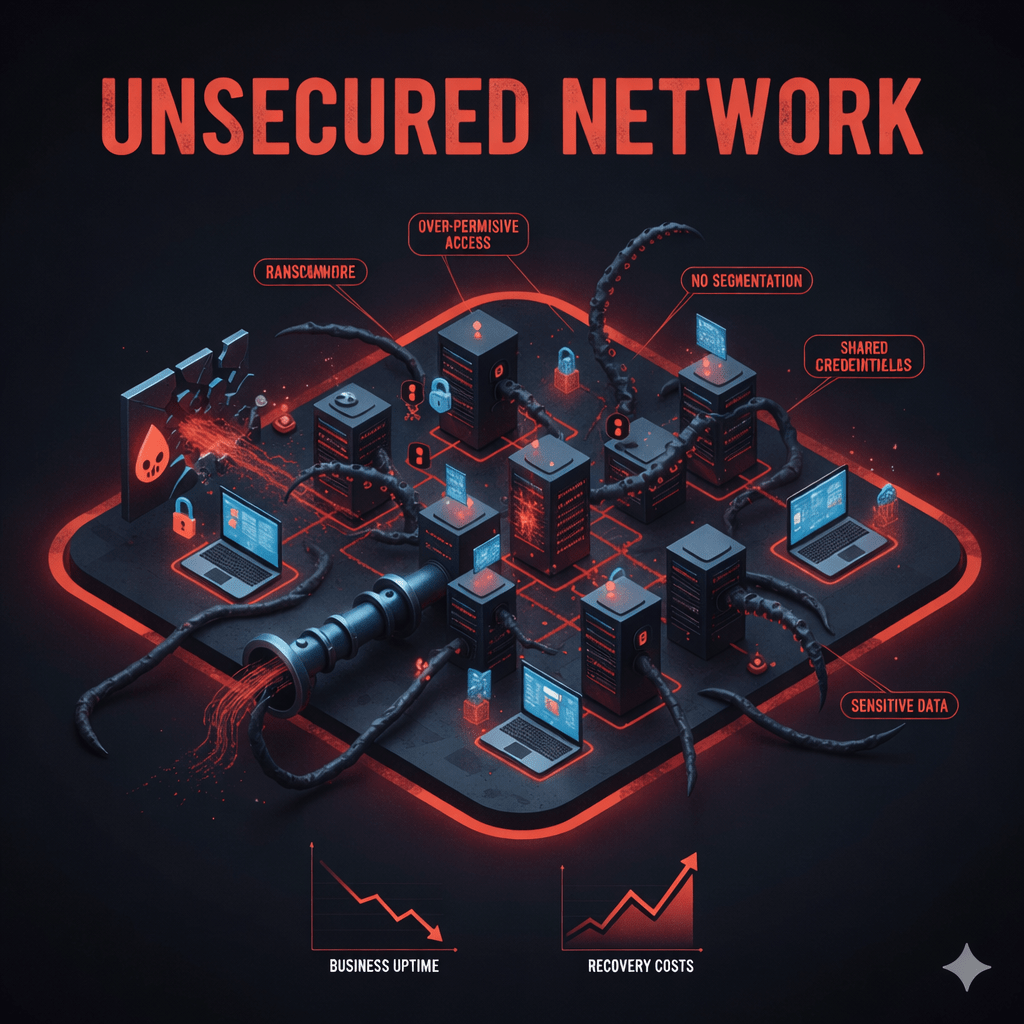
An unsecured network is not one without security tools. It is a network that trusts too much, exposes too much, and controls too little. Many organizations believe they are protected because they have a firewall or antivirus. In reality, their network design quietly enables attackers to move freely once they gain access.
At Mindcore Technologies, we see unsecured networks as the root cause behind most ransomware incidents, data breaches, and prolonged outages. The danger is not theoretical. It is operational.
This article explains what an unsecured network actually is, how attackers exploit it, and why the damage is usually far worse than expected.
What an Unsecured Network Really Means
An unsecured network is one where:
- Access is overly permissive
- Internal systems trust each other by default
- Traffic is not monitored or controlled
- Segmentation is minimal or nonexistent
It does not mean there is “no security.” It means security exists without structure.
Unsecured networks often look functional and stable until they are abused.
Common Signs of an Unsecured Network
We consistently find unsecured networks with these characteristics:
- Flat internal networks where everything can talk to everything
- Shared credentials or static access rules
- No separation between users, servers, and critical systems
- Wi-Fi networks shared between guests and employees
- Little to no monitoring of internal traffic
- Firewall rules that have not been reviewed in years
Each of these creates opportunity. Together, they create inevitability.
Why Unsecured Networks Are So Dangerous
1. They Turn Small Incidents Into Major Breaches
Most attacks start small.
An unsecured network allows:
- One compromised device to access many systems
- Stolen credentials to unlock wide access
- Malware to spread laterally without resistance
Without containment, minor compromises escalate quickly.
2. They Enable Ransomware to Spread Freely
Ransomware thrives on flat networks.
Once inside, attackers:
- Scan for accessible systems
- Move laterally using legitimate tools
- Encrypt as much as possible
Unsecured networks remove friction. Encryption becomes fast and widespread.
3. They Make Data Theft Easy to Hide
Data exfiltration rarely triggers alarms in unsecured networks.
Because:
- Outbound traffic is unrestricted
- Encrypted traffic is uninspected
- Abnormal behavior blends in
Attackers can steal data quietly for weeks before extortion begins.
4. They Undermine Every Other Security Control
Endpoint protection, MFA, and monitoring all depend on network controls.
In unsecured networks:
- Stolen credentials work everywhere
- Trusted sessions are never questioned
- Alerts lack context
The network becomes the weakest link.
5. They Increase Downtime and Recovery Costs
When incidents spread:
- More systems are impacted
- Recovery takes longer
- Business operations stall
Unsecured networks turn security incidents into business crises.
How Attackers Exploit Unsecured Networks
Attackers do not need zero-day exploits.
They rely on:
- Overly trusted internal traffic
- Valid credentials
- Unrestricted access paths
- Poor visibility
Once inside, they look like normal users. The network allows it.
Why Perimeter-Only Security Fails
Many organizations still rely on perimeter defenses.
This fails because:
- Users work remotely
- Cloud services bypass the perimeter
- Phishing delivers valid credentials
- Encrypted traffic hides malicious activity
If internal traffic is trusted, attackers blend in immediately.
What Secures a Network Properly
Securing a network is about control and containment, not blocking everything.
1. Segmentation
Secure networks:
- Separate users, servers, and sensitive systems
- Restrict east-west traffic
- Limit blast radius
Segmentation is the single most effective containment control.
2. Identity-Aware Access
Access must depend on who and what is connecting.
This includes:
- User identity
- Device posture
- Contextual conditions
Trust should never be permanent.
3. Controlled Outbound Traffic
Secure networks:
- Restrict unnecessary outbound connections
- Monitor for abnormal data movement
- Block known malicious destinations
Outbound control reduces extortion leverage.
4. Continuous Monitoring
Security requires visibility.
Secure networks:
- Monitor internal and external traffic
- Alert on abnormal patterns
- Provide context for response
You cannot defend what you cannot see.
5. Secure Wireless and Remote Access
Wi-Fi and VPNs are frequent entry points.
Secure networks:
- Use modern encryption standards
- Enforce identity-based authentication
- Isolate guest and internal access
Wireless is part of the perimeter.
The Business Impact of an Unsecured Network
Beyond security, unsecured networks cause:
- Increased downtime
- Lost productivity
- Compliance failures
- Customer trust erosion
- Higher long-term costs
The financial impact often exceeds the technical damage.
How Mindcore Technologies Identifies and Fixes Unsecured Networks
Mindcore Technologies helps organizations uncover and remediate unsecured network conditions through:
- Network architecture reviews
- Segmentation and Zero Trust design
- Identity-centric access enforcement
- Secure Wi-Fi and remote access configuration
- Monitoring and incident response integration
- Ongoing optimization and governance
We focus on removing implicit trust, not just adding tools.
A Simple Reality Check
Your network is unsecured if:
- Internal systems can communicate freely
- Access is trusted after login
- Segmentation is minimal
- Monitoring is limited
- One compromise would spread quickly
These conditions are far more common than most organizations realize.
Final Takeaway
An unsecured network is dangerous because it silently amplifies risk. It allows small mistakes, stolen credentials, or single-device compromises to cascade into widespread outages, ransomware, and data breaches.
Secure networks are not restrictive. They are intentional. They control access, limit movement, protect data, and contain damage when incidents occur.
Organizations that address network insecurity proactively reduce risk dramatically. Those that ignore it often learn its cost the hard way.