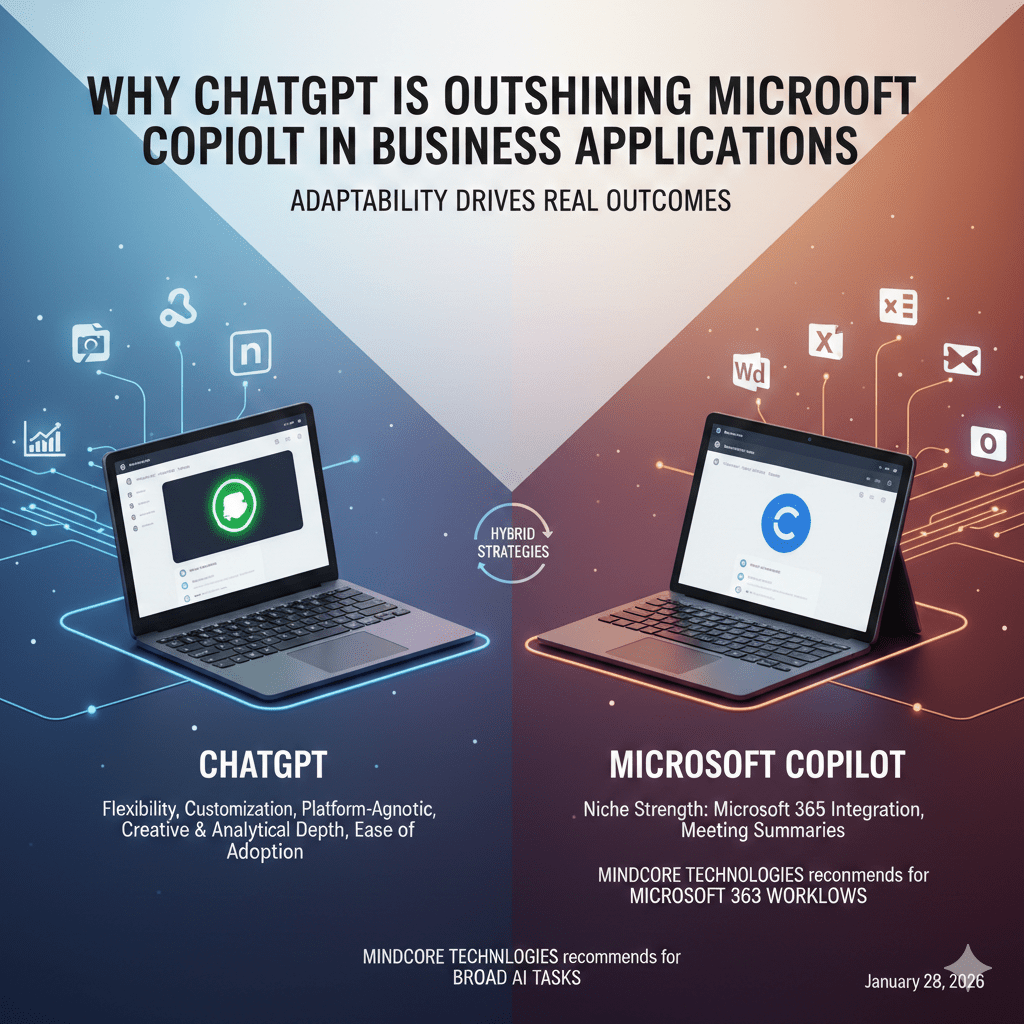
Why ChatGPT Is Gaining Ground in Business
1. Businesses Use AI for Real Outcomes
Sales, marketing, operations, and support teams are using AI to:
- Draft emails, proposals, and campaign copy
- Brainstorm and refine strategic plans
- Summarize customer conversations
These are results-focused activities — not just tool enhancements — and ChatGPT serves them with broad command flexibility.
2. Customization Across Roles
ChatGPT allows teams to build “custom GPTs” tailored to business rules, ethical guidelines, and workflow logic — from customer support to marketing automatons — so it becomes specific to your business needs.
3. Platform Independence = Broader Adoption
Unlike Copilot, which is largely embedded in Microsoft 365, ChatGPT:
- Works outside of Microsoft ecosystems
- Integrates with Slack, Notion, Google Docs, Zoom, and project tools
- Doesn’t force teams to standardize tech stacks before use
This makes adoption faster and friction-free across diverse environments.
4. Stronger Creative and Analytical Capabilities
While Microsoft Copilot enhances productivity inside Word, Excel, and Teams, ChatGPT can:
- Draft full proposals or training documents
- Analyze raw data from spreadsheets without file import constraints
These broader capabilities help teams solve business problems, not just enhance app usage.
5. Integration With Existing Workflows
ChatGPT’s ecosystem — including:
- Plugin marketplaces
- Open APIs
- No-code connectors
— enables companies to embed AI across internal tools, not just Office apps.
6. Transparent Interaction and Trust
Users often appreciate ChatGPT because:
- They can see and edit prompts directly
- They understand how outcomes are generated
This visibility and control builds trust and makes adoption smoother than assistants that run in the background.
7. Copilot’s Niche Strength
Microsoft Copilot remains valuable for:
- Summarizing meetings in Teams
- Assisting with structured tasks inside Microsoft apps
- Surface context within the Microsoft ecosystem
But its usefulness is inherently tied to that ecosystem, which isn’t the primary environment for many businesses.
How This Matters for Business Strategy
- Teams that use many different tools prefer ChatGPT because it meets people where they already work.
- Customization and extensibility mean companies can tailor AI assistants to specific business roles.
- Copilot adds value where Microsoft 365 drives core work, but it doesn’t replace flexible, multi-platform support.
Mindcore Technologies Perspective
At Mindcore Technologies, we recommend choosing the AI tool based on business context and workflow patterns — not brand alone:
- Use ChatGPT for broad AI tasks: creative content, cross-platform workflows, adaptable assistants, and custom role-based AI.
- Use Copilot when your team lives inside Microsoft 365 and needs tight integration with Word, Excel, Outlook, and Teams.
- Consider hybrid strategies: Both tools can coexist and complement each other depending on function and access control.
This strategic alignment ensures AI investments deliver real business outcomes — from efficiency gains to improved decision support — rather than just new software boxes.
Final Thought
ChatGPT is outshining Microsoft Copilot in many business settings because it is:
- Flexible
- Customizable
- Platform-agnostic
- Easy to adopt
…while still delivering deep analytical and creative support.
Copilot remains a strong complement where Microsoft workflows dominate, but ChatGPT’s adaptability makes it the go-to choice for many modern teams in 2025.