

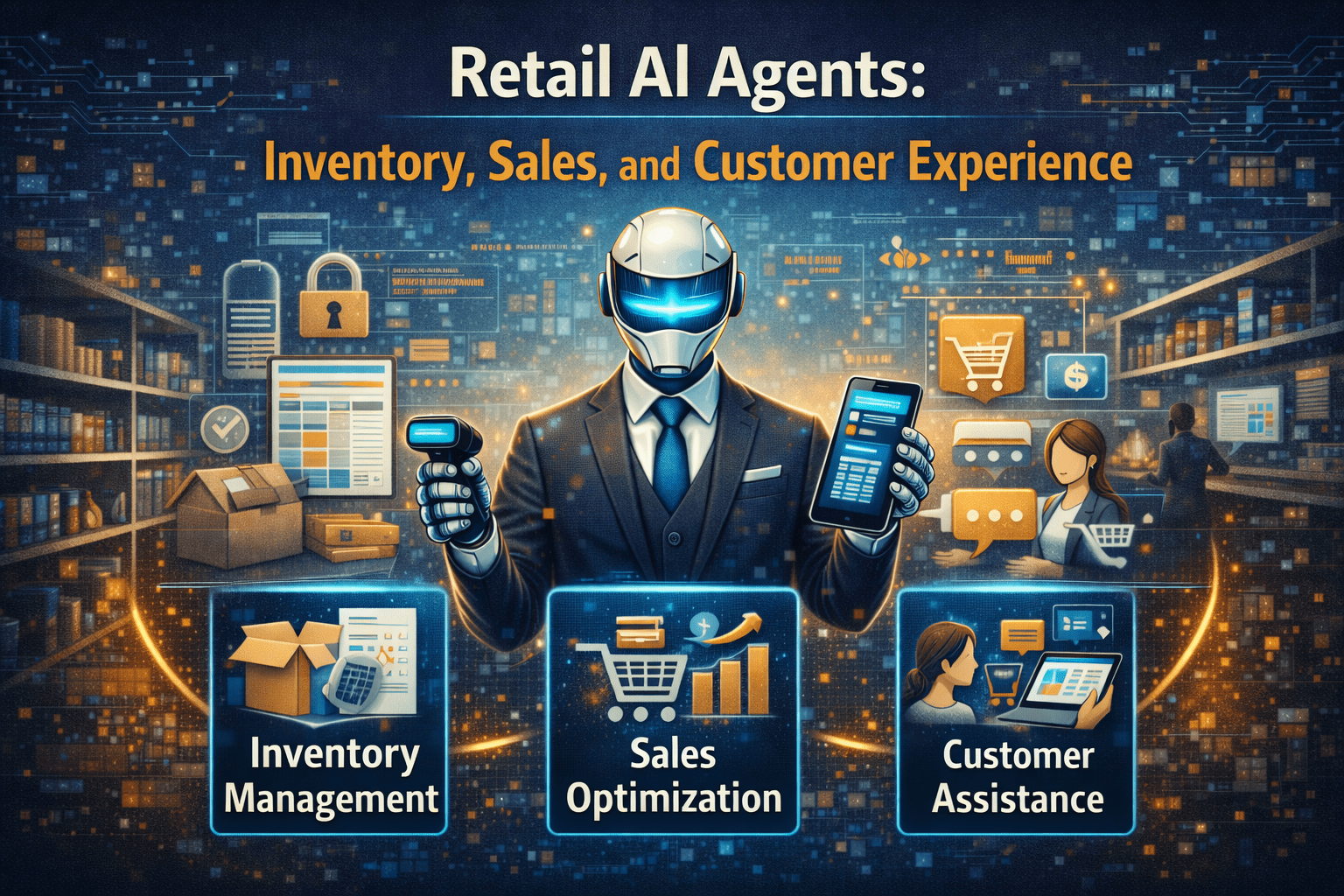
Retail operates on speed, demand accuracy, and customer experience. Stockouts reduce revenue. Overstocking reduces cash flow. Poor customer engagement reduces loyalty. AI agents in retail must balance inventory precision, sales forecasting, and omnichannel customer interaction.
The broader sector framework is introduced in AI Agents by Industry: Tailored Solutions for Every Business Sector, where AI is positioned as industry-aligned infrastructure.
Retail requires demand-aware automation.
Core Retail Challenges
Common friction points include:
• Inventory misalignment
Stockouts and excess inventory impact margins.
• Seasonal demand fluctuations
Forecasting errors increase waste.
• Disconnected sales channels
Online and in-store data fragmentation.
• Customer engagement inconsistency
Reduced repeat business.
Sector evaluation methodology is reinforced in Industry-Specific AI Automation: Finding the Right Fit for Your Sector.
Inventory Optimization Automation
AI agents improve inventory precision.
Capabilities include:
• Real-time stock monitoring
Track inventory levels continuously.
• Automated reorder triggers
Prevent stockouts.
• Demand forecasting models
Align purchasing with sales patterns.
• Supplier performance monitoring
Identify delivery delays early.
Operational parallels in supply chain automation are explored in Manufacturing AI Automation: Streamlining Production and Operations.
Sales Forecasting and Revenue Intelligence
Retail success depends on accurate forecasting.
AI agents can:
• Analyze historical sales data
Predict seasonal demand shifts.
• Monitor promotional performance
Identify high-conversion campaigns.
• Track pricing elasticity
Optimize margin strategies.
• Generate revenue performance dashboards
Improve executive clarity.
Sector selection discipline is reinforced in How Different Industries Choose AI Agent Solutions.
Customer Experience Automation
Retail customers expect personalized engagement.
AI supports:
• Customer segmentation automation
Target marketing more effectively.
• Automated follow-up campaigns
Improve retention rates.
• Loyalty program tracking
Enhance repeat purchases.
• Real-time customer service routing
Reduce response time.
Service parallels appear in Financial Services AI Automation: Compliance and Customer Service.
Omnichannel Reporting Consolidation
Retail businesses often operate across platforms.
AI agents enable:
• Unified sales dashboards
Consolidate online and offline performance.
• Automated KPI alerts
Flag underperforming categories.
• Cross-location comparison reports
Support expansion strategy.
• Performance anomaly detection
Identify sales disruptions quickly.
Construction and multi-site parallels appear in AI Agents for Construction Companies: Project Management and Operations.
Integration Requirements in Retail
Retail AI must integrate with:
• Point-of-sale systems
Capture transaction data.
• Inventory management platforms
Track stock movement.
• E-commerce systems
Align online and in-store sales.
• CRM platforms
Monitor customer engagement.
Integration validation aligns with principles in Industry-Specific AI Automation: Finding the Right Fit for Your Sector.
Measuring ROI in Retail AI
Retail performance metrics include:
• Reduced stockouts
• Lower excess inventory
• Increased conversion rates
• Improved customer retention
• Faster reporting cycles
Sector ROI discipline is reinforced in How Different Industries Choose AI Agent Solutions.
Common Retail AI Mistakes
• Ignoring data cleanliness
• Over-automating pricing decisions
• Failing to align online and offline systems
• Scaling without pilot validation
• Neglecting staff training
Retail automation must remain customer-focused.
Key Takeaways
Retail AI agents enhance inventory accuracy, sales forecasting precision, customer engagement consistency, and omnichannel reporting visibility through sector-specific automation architecture. By integrating POS systems, inventory platforms, CRM tools, and e-commerce data, retail businesses reduce stockouts, optimize margins, and improve customer retention. When implemented strategically, retail AI automation strengthens profitability while maintaining customer-centric operations.

