


AI-Powered Disaster Recovery Services
Businesses searching for backup and disaster recovery near me can prepare to respond during the critical first 72 hours after a natural or man made event. Mindcore provides disaster recovery and business continuity services that help organizations minimize downtime and restore full operations quickly after disruption, backed by tested plans instead of assumptions.





Your privacy is important. We keep your personal information safe.
30 Years of Disaster Recovery Services
Organizations searching for backup and disaster recovery near me can rely on Mindcore’s 30 years of experience keeping businesses resilient and operational during crises. Backup and recovery services near me can include backup infrastructure, geographic redundancy, rapid failover, secure data replication, regular testing, and plan updates based on evolving risks. Trust our decades long expertise to build resilient systems that protect your business continuity and safeguard your reputation.
What Is Business Continuity and Disaster Recovery?
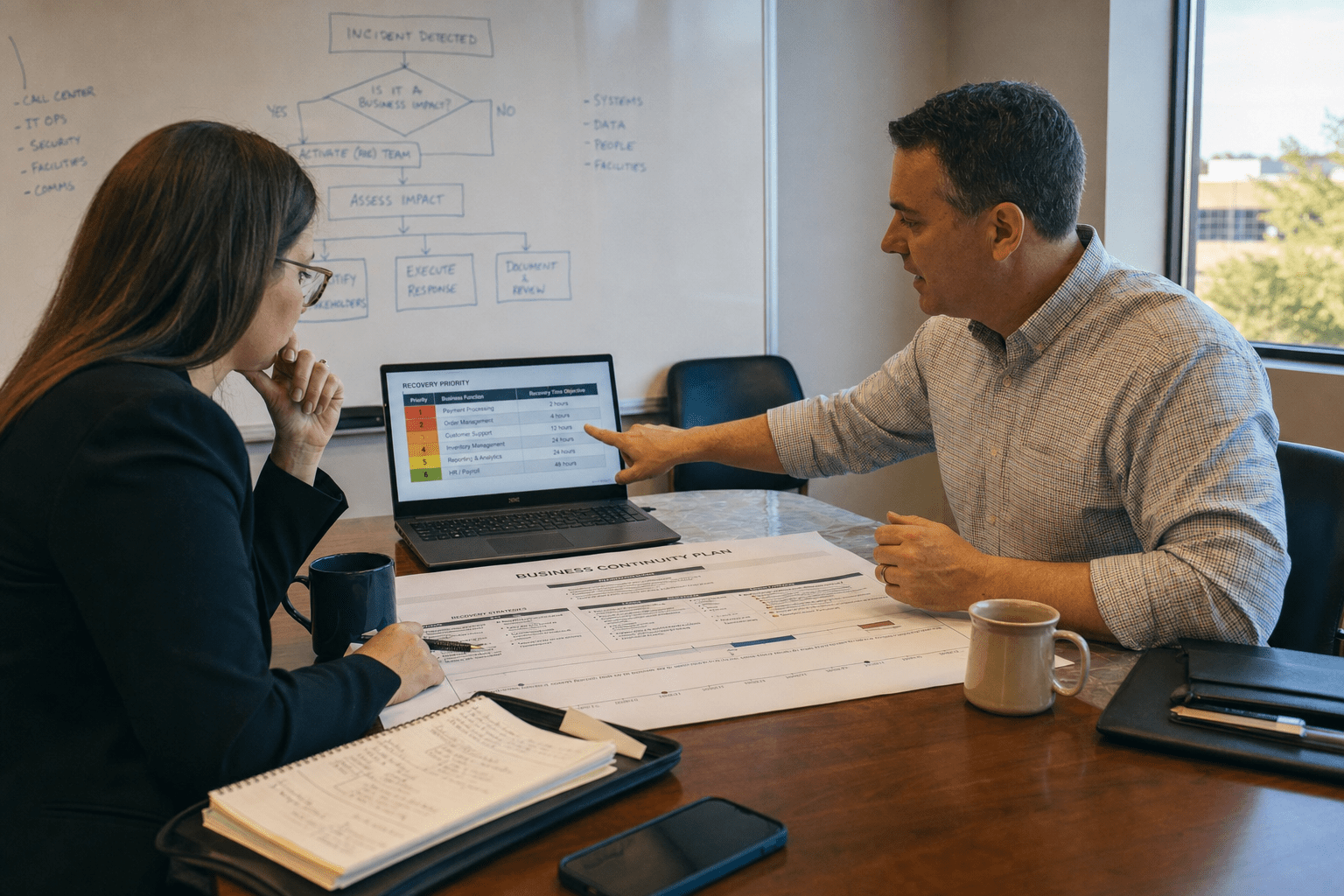
Business continuity and disaster recovery are two connected but distinct capabilities that together determine how an organization survives and recovers from a major disruption.
Business continuity keeps critical operations running during an incident. It answers the question: what is the minimum viable operation that must continue while systems are down, and how does the organization maintain it?
Disaster recovery restores full operational capability after an incident. It answers the question: what is the sequence, the timeline, and the verified process for bringing systems back to a fully functional state?
Businesses evaluating backup and disaster recovery near me should ensure continuity and disaster recovery plans are designed together rather than treated separately. An organization that can keep minimum viable operations running but cannot restore full systems has a continuity plan without a recovery plan. An organization that can restore full systems but never defined minimum viable operations during the outage suffers avoidable operational and revenue loss throughout the recovery window.
Why Most Disaster Recovery Plans Fail When They Are Needed
Most organizations discover their disaster recovery plan has critical gaps at the worst possible moment. The most common failure points are:

Recovery time objectives and recovery point objectives are set based on what leadership believes is possible, not what the actual backup architecture can deliver under pressure.

Backup and recovery services near me should include restoration testing because a backup that has never been restored remains an assumption. Ransomware attackers frequently target backup systems before deploying the main payload specifically because organizations do not verify backup integrity regularly.

When everything is down, teams without a documented recovery priority sequence waste critical hours debating which system to restore first instead of executing a tested plan.

Who declares the disaster? Who notifies regulators? Who speaks to customers? Who approves the decision to pay a ransom? Plans without clear authority and communication workflows create decision paralysis at the moment speed matters most.
A plan written two years ago for an environment that has since migrated to the cloud, added a new ERP system, or expanded to new locations is not a current plan, it is a historical document.
Disaster Recovery Planning
Backup and disaster recovery near me should include structured disaster recovery planning that connects every part of the recovery process. Mindcore designs recovery workflows that define who does what, in what order, using what systems, to restore full operations after any disruption, whether that is a ransomware attack, hardware failure, or natural disaster.
Every disaster recovery plan Mindcore builds starts with your actual infrastructure, not a generic template. We document your critical systems, map dependencies between them, and set Recovery Time Objectives and Recovery Point Objectives based on your real business requirements. Those targets are then tested against your actual environment before an incident forces the test to happen live. Disaster recovery planning is not a document that sits in a drawer. It is a living plan, reviewed as infrastructure changes and tested on a defined schedule, so the day it is needed is not the first day anyone finds out whether it works.
This planning work connects directly to the IT Infrastructure Services Mindcore manages day to day, since a disaster recovery plan is only as strong as the infrastructure and documentation behind it.

Our Disaster Recovery Services
Our Disaster Recovery Services use resilient infrastructure, encrypted data protection tools, employee education, and clear communication to strengthen security. Mindcore’s Disaster Recovery Services provide complete IT continuity solutions for businesses facing cyber incidents, outages, or infrastructure failures.
Backup and recovery services near me can help organizations store, protect, and recover critical data quickly while keeping vital systems available after a disruptive event.
Cloud disaster recovery services near me can use cloud based environments to provide secure access to data and applications from approved devices and locations. Businesses searching for cloud disaster recovery services near me can benefit from cloud environments designed to provide stronger reliability and built in security than traditional on premise data centers.
We document your critical business functions, identify the IT systems and processes they depend on, and design continuity procedures that keep those functions operational during a system outage, cyberattack, or physical disaster. Plans are written for your specific industry, regulatory environment, and actual infrastructure, not adapted from a generic template.
Backup and recovery services near me can include backup systems designed around the 3-2-1-1 principle for stronger data protection and recovery readiness. Backup and recovery services near me should include scheduled backup integrity verification rather than assuming recovery data is usable.
A plan that has never been tested is a liability, not an asset. Mindcore conducts tabletop exercises that simulate ransomware attacks, network failures, and data center outages, walking your team through the actual response procedures under realistic pressure before an incident forces improvisation. Full recovery tests validate RTOs and RPOs against real systems, not theoretical targets.
Disaster recovery services include incident response planning that defines recovery steps, responsibilities, and procedures for managing cyberattacks, closely tied to our IT & Cybersecurity Emergency Services.
Mindcore manages disaster recovery and business continuity as a continuous program, including annual plan reviews, infrastructure change tracking, scheduled backup verification, regular tabletop exercises, and regulatory update monitoring as frameworks evolve.
Understanding RTO and RPO
Recovery Time Objective and Recovery Point Objective are the two metrics that define what your disaster recovery plan must deliver. Most organizations set targets for both without ever testing whether their current infrastructure can meet them.
Recovery Time Objective is the maximum acceptable length of time your systems can be down before the business impact becomes unacceptable. RTO drives your recovery infrastructure investment. The shorter the RTO, the more redundancy and automation your environment requires.
Recovery Point Objective is the maximum acceptable amount of data loss measured in time. An RPO of four hours means your organization can tolerate losing up to four hours of transactions. RPO drives your backup frequency. The shorter the RPO, the more frequently your environment must back up and replicate data.
Cloud disaster recovery services near me can test RTO and RPO targets against real environments, identify recovery gaps, and build the infrastructure needed to close them.

The 3-2-1-1 Backup Rule
The standard 3-2-1 backup rule has been the industry benchmark for years: three copies of data, on two different media types, with one copy offsite. In the ransomware era, that standard is no longer sufficient on its own.
The additional 1 is an air gapped or immutable backup copy that ransomware cannot reach even when it has compromised your primary environment, your secondary backup, and your cloud storage. Attackers know the 3-2-1 rule. They target backup systems deliberately before deploying ransomware because organizations that lose their backups have no recovery path that bypasses the ransom demand.
Backup and disaster recovery near me can include 3-2-1-1 backup architectures, scheduled integrity verification, and restoration testing from immutable copies.
Disaster Recovery and Business Continuity by Industry
Requirements, regulatory obligations, and recovery priorities differ significantly by industry. Mindcore has active experience in:

Clinical system continuity during outages, EHR recovery prioritization, HIPAA required contingency planning, and OCR audit documentation
Trading system recovery, payment processing continuity, SOX and GLBA compliance, and zero tolerance RTO requirements for revenue critical systems
Document management recovery, client communication continuity, court filing deadline protection, and privilege aware data handling throughout the recovery process
OT and IT system recovery sequencing, production line continuity, supply chain communication, and contractual penalty avoidance through tested RTOs
CMMC aligned continuity planning, DFARS incident reporting integration, and classified environment recovery procedures, tied closely to our Cybersecurity Compliance work
Choosing Us Makes a Difference
Organizations that invest in disaster recovery services gain stronger operational resilience and faster recovery during unexpected events.
Custom Disaster Plan
A customized action plan that helps protect your company from future disasters
Recover Instantly
Bounce back from disruption within minutes instead of months
Minimize Impact
Isolate vulnerabilities so disasters stay contained and operations continue
Save Money
Protect your bottom line by shielding your business from potential disasters while saving time and money

Meet our CEO, Matt Rosenthal
With more than 30 years of experience in business and technology leadership, Matt Rosenthal has helped organizations build resilient IT environments that remain operational even when unexpected disruptions occur. As President and CEO of Mindcore Technologies, Matt has direct experience managing enterprise disaster recovery and business continuity programs across healthcare, financial services, manufacturing, and government. Matt has spent years helping organizations discover before a crisis, not during one, that their disaster recovery plan was untested, undocumented, or fundamentally misaligned with their actual recovery requirements. Under his leadership, Mindcore helps businesses implement reliable backup systems, failover infrastructure, and tested recovery plans that protect operations and ensure long term business continuity, because the cost of preparation is a fraction of the cost of discovering the gaps during an active disaster. Cloud disaster recovery services near me can help businesses build recovery capabilities into infrastructure from the start instead of adding them after an incident exposes a gap.
Frequently Asked Questions
Disaster recovery is the process of restoring a business’s IT infrastructure and data after a disaster. Disasters can include natural events such as hurricanes, floods, and earthquakes, as well as man made events such as cyberattacks and fires.
Business continuity keeps critical operations running during an incident, defining the minimum viable operation that must continue while systems are down. Disaster recovery restores full operational capability after an incident, defining the sequence, timeline, and verified process for bringing systems back to a fully functional state. Both must be designed together or they fail together.
There are two main types: on premise DR and cloud based DR. On premise DR involves creating a backup copy of data and systems at a separate location, which could be a secondary data center, a cloud environment, or a different office building. Cloud based DR involves backing up data and systems to a platform such as AWS, Microsoft Azure, or Google Cloud, often a more cost effective and scalable option.
Three copies of your data, stored on two different media types, with one copy offsite, and one copy air gapped or immutable. The fourth copy is the critical addition in the ransomware era, since it is the copy attackers cannot reach even when they have compromised your primary environment and secondary backups.
Mindcore recommends tabletop exercises at least annually, with full recovery tests for critical systems at least once per year. Regulated industries including healthcare, finance, and defense typically require more frequent testing to maintain compliance. Plans should also be reviewed any time a significant infrastructure change occurs.
A disaster recovery plan should include a risk assessment identifying potential threats and their impact, a Recovery Time Objective defining acceptable downtime, a Recovery Point Objective defining acceptable data loss, documented recovery procedures, and a communication plan for employees, customers, and other stakeholders.
Cloud backups are a necessary component but not a complete disaster recovery strategy. Cloud backups can be deleted by compromised credentials, excluded from coverage during major cloud provider outages, or inadequately versioned to meet your RPO requirements. Mindcore assesses your backup posture against your actual recovery requirements and identifies the gaps.
Yes. Mindcore reviews, updates, and assumes management of existing plans. We assess current RTO and RPO targets, validate backup integrity, update documentation to reflect your current environment, and schedule the testing needed to confirm the plan is functional before an incident makes that confirmation critical.
Incident response addresses the active threat: containment, investigation, and remediation. Business continuity keeps operations running during the response. Disaster recovery restores full operations once the threat is resolved. Mindcore manages all three as a connected workflow, since organizations that treat them as separate programs consistently face longer downtime and higher recovery costs.
Common mistakes include not having a plan in place, not testing the plan regularly, not backing up data frequently enough, not having a communication plan in place, and not training employees on disaster recovery procedures.
Trusted Disaster Recovery Experts for Businesses
At Mindcore, we deliver enterprise grade IT solutions designed to keep your organization secure, resilient, and operational under pressure. When business leaders search for disaster recovery services, they are typically looking for structured continuity planning, rapid recovery capabilities, and a partner that can protect critical systems from prolonged downtime. Cloud disaster recovery services near me can include continuity planning, backup strategy development, and recovery testing to support long term operational resilience.
Florida
Mindcore Technologies provides IT consulting and managed IT services to companies in Florida and throughout the United States. Our office is located in Delray Beach, FL, helping businesses solve their IT problems with our cyber security services, cloud services, Microsoft 365 solutions, and IT consulting services.
Kansas
Mindcore Technologies provides IT consulting and managed IT services to companies in Wichita and throughout the United States. Our office is located in Wichita, KS, helping businesses solve their IT problems with our cyber security services, cloud services, Microsoft 365 solutions, and IT consulting services.
Kansas
Mindcore Technologies provides IT consulting and managed IT services to companies in Manhattan and throughout the United States. Our office is located in Manhattan, KS, helping businesses solve their IT problems with our cyber security services, cloud services, Microsoft 365 solutions, and IT consulting services.
Florida
Mindcore Technologies provides IT consulting and managed IT services to companies in Wellington and throughout the United States. Our office is located in Alabama AL, helping businesses solve their IT problems with our cyber security services, cloud services, Microsoft 365 solutions, and IT consulting services.
Contact Us
Missouri
Mindcore Technologies provides IT consulting and managed IT services to companies in St. Louis and throughout the United States. Our office is located in St. Louis, MO, helping businesses solve their IT problems with our cyber security services, cloud services, Microsoft 365 solutions, and IT consulting services.
Missouri
Mindcore Technologies provides IT consulting and managed IT services to companies in Springfield and throughout the United States. Our office is located in Springfield, MO, helping businesses solve their IT problems with our cyber security services, cloud services, Microsoft 365 solutions, and IT consulting services.
Kansas
Mindcore Technologies provides IT consulting and managed IT services to companies in Hutchinson and throughout the United States. Our office is located in Hutchinson, KS, helping businesses solve their IT problems with our cyber security services, cloud services, Microsoft 365 solutions, and IT consulting services.
Missouri
Mindcore Technologies provides IT consulting and managed IT services to companies in St. Charles and throughout the United States. Our office is located in St. Charles, MO, helping businesses solve their IT problems with our cyber security services, cloud services, Microsoft 365 solutions, and IT consulting services.
Missouri
Mindcore Technologies provides IT consulting and managed IT services to companies in O’Fallon and throughout the United States. Our office is located in O’Fallon, MO, helping businesses solve their IT problems with our cyber security services, cloud services, Microsoft 365 solutions, and IT consulting services.
Missouri
Mindcore Technologies provides IT consulting and managed IT services to companies in Independence and throughout the United States. Our office is located in Independence, MO, helping businesses solve their IT problems with our cyber security services, cloud services, Microsoft 365 solutions, and IT consulting services.
Missouri
Mindcore Technologies provides IT consulting and managed IT services to companies in Columbia and throughout the United States. Our office is located in Columbia, MO, helping businesses solve their IT problems with our cyber security services, cloud services, Microsoft 365 solutions, and IT consulting services.
Missouri
Mindcore Technologies provides IT consulting and managed IT services to companies in Lee’s Summit and throughout the United States. Our office is located in Lee’s Summit, MO, helping businesses solve their IT problems with our cyber security services, cloud services, Microsoft 365 solutions, and IT consulting services.
Kansas
Mindcore Technologies provides IT consulting and managed IT services to companies in Lenexa and throughout the United States. Our office is located in Lenexa, KS, helping businesses solve their IT problems with our cyber security services, cloud services, Microsoft 365 solutions, and IT consulting services.
Kansas
Mindcore Technologies provides IT consulting and managed IT services to companies in Salina and throughout the United States. Our office is located in Salina, KS, helping businesses solve their IT problems with our cyber security services, cloud services, Microsoft 365 solutions, and IT consulting services.
Kansas
Mindcore Technologies provides IT consulting and managed IT services to companies in Olathe and throughout the United States. Our office is located in Olathe, KS, helping businesses solve their IT problems with our cyber security services, cloud services, Microsoft 365 solutions, and IT consulting services.
Missouri
Mindcore Technologies provides IT consulting and managed IT services to companies in Kansas City and throughout the United States. Our office is located in Kansas City, MO, helping businesses solve their IT problems with our cyber security services, cloud services, Microsoft 365 solutions, and IT consulting services.
Kansas
Mindcore Technologies provides IT consulting and managed IT services to companies in Shawnee and throughout the United States. Our office is located in Shawnee, KS, helping businesses solve their IT problems with our cyber security services, cloud services, Microsoft 365 solutions, and IT consulting services.
Kansas
Mindcore Technologies provides IT consulting and managed IT services to companies in Overland Park and throughout the United States. Our office is located in Overland Park, KS, helping businesses solve their IT problems with our cyber security services, cloud services, Microsoft 365 solutions, and IT consulting services.
Missouri
Mindcore Technologies provides IT consulting and managed IT services to companies in Joplin and throughout the United States. Our office is located in Joplin, MO, helping businesses solve their IT problems with our cyber security services, cloud services, Microsoft 365 solutions, and IT consulting services.
Kansas
Mindcore Technologies provides IT consulting and managed IT services to companies in Lawrence and throughout the United States. Our office is located in Lawrence, KS, helping businesses solve their IT problems with our cyber security services, cloud services, Microsoft 365 solutions, and IT consulting services.
Kansas
Mindcore Technologies provides IT consulting and managed IT services to companies in Topeka and throughout the United States. Our office is located in Topeka, KS, helping businesses solve their IT problems with our cyber security services, cloud services, Microsoft 365 solutions, and IT consulting services.
Missouri
Mindcore Technologies provides IT consulting and managed IT services to companies in Blue Springs and throughout the United States. Our office is located in Blue Springs, MO, helping businesses solve their IT problems with our cyber security services, cloud services, Microsoft 365 solutions, and IT consulting services.
Florida
Mindcore Technologies provides IT consulting and managed IT services to companies in Florida and throughout the United States. Our office is located in Boca Raton, FL, helping businesses solve their IT problems with our cyber security services, cloud services, Microsoft 365 solutions, and IT consulting services.
New Jersey
Mindcore Technologies provides IT consulting and managed IT services to companies in New Jersey and throughout the United States. Our office is located in Fairfield, NJ, helping organizations gain a critical competitive advantage with our cyber security services, cloud services, Microsoft 365 solutions, and IT support.
Contact Us
Maryland
Mindcore Technologies provides IT consulting and managed IT services to companies in Maryland and throughout the United States. Our office is located in Catonsville, MD, helping organizations gain a critical competitive advantage with our cyber security services, cloud services, Microsoft 365 solutions, and IT support.
Contact Us
South Carolina
Mindcore Technologies provides IT consulting and managed IT services to companies in South Carolina and throughout the United States. Our office is located in Simpsonville, SC, helping organizations gain a critical competitive advantage with our managed cyber security services, cloud services, Microsoft 365 solutions, and IT support.
Maryland
Mindcore Technologies provides IT consulting and managed IT services to companies in Maryland and throughout the United States. Our office is located in Germantown, MD, helping organizations gain a critical competitive advantage with our cyber security services, cloud services, Microsoft 365 solutions, and IT support.
Maryland
Mindcore Technologies provides IT consulting and managed IT services to companies in Maryland and throughout the United States. Our office is located in Towson, MD, helping organizations gain a critical competitive advantage with our cyber security services, cloud services, Microsoft 365 solutions, and IT support.
Maryland
Mindcore Technologies provides IT consulting and managed IT services to companies in Maryland and throughout the United States. Our office is located in Frederick, MD, helping organizations gain a critical competitive advantage with our cyber security services, cloud services, Microsoft 365 solutions, and IT support.
Maryland
Mindcore Technologies provides IT consulting and managed IT services to companies in Maryland and throughout the United States. Our office is located in Gaithersburg, MD, helping organizations gain a critical competitive advantage with our cyber security services, cloud services, Microsoft 365 solutions, and IT support.
Maryland
Mindcore Technologies provides IT consulting and managed IT services to companies in Maryland and throughout the United States. Our office is located in Annapolis, MD, helping organizations gain a critical competitive advantage with our cyber security services, cloud services, Microsoft 365 solutions, and IT support.
Maryland
Mindcore Technologies provides IT consulting and managed IT services to companies in Maryland and throughout the United States. Our office is located in Silver Spring, MD, helping organizations gain a critical competitive advantage with our cyber security services, cloud services, Microsoft 365 solutions, and IT support.
Maryland
Mindcore Technologies provides IT consulting and managed IT services to companies in Maryland and throughout the United States. Our office is located in Rockville, MD, helping organizations gain a critical competitive advantage with our cyber security services, cloud services, Microsoft 365 solutions, and IT support.
Maryland
Mindcore Technologies provides IT consulting and managed IT services to companies in Maryland and throughout the United States. Our office is located in Bethesda, MD, helping organizations gain a critical competitive advantage with our cyber security services, cloud services, Microsoft 365 solutions, and IT support.
Maryland
Mindcore Technologies provides IT consulting and managed IT services to companies in Maryland and throughout the United States. Our office is located in Baltimore, MD, helping organizations gain a critical competitive advantage with our cyber security services, cloud services, Microsoft 365 solutions, and IT support.
South Carolina
Mindcore Technologies provides IT consulting and managed IT services to companies in South Carolina and throughout the United States. Our office is located in Myrtle Beach, SC, helping organizations gain a critical competitive advantage with our managed cyber security services, cloud services, Microsoft 365 solutions, and IT support.
Contact Us
South Carolina
Mindcore Technologies provides IT consulting and managed IT services to companies in South Carolina and throughout the United States. Our office is located in Rock Hill, SC, helping organizations gain a critical competitive advantage with our managed cyber security services, cloud services, Microsoft 365 solutions, and IT support.
Contact Us
South Carolina
Mindcore Technologies provides IT consulting and managed IT services to companies in South Carolina and throughout the United States. Our office is located in Hilton Head Island, SC, helping organizations gain a critical competitive advantage with our managed cyber security services, cloud services, Microsoft 365 solutions, and IT support.
Contact Us
South Carolina
Mindcore Technologies provides IT consulting and managed IT services to companies in South Carolina and throughout the United States. Our office is located in Summerville, SC, helping organizations gain a critical competitive advantage with our managed cyber security services, cloud services, Microsoft 365 solutions, and IT support.
Contact Us
South Carolina
Mindcore Technologies provides IT consulting and managed IT services to companies in South Carolina and throughout the United States. Our office is located in Spartanburg, SC, helping organizations gain a critical competitive advantage with our managed cyber security services, cloud services, Microsoft 365 solutions, and IT support.
Contact Us
South Carolina
Mindcore Technologies provides IT consulting and managed IT services to companies in South Carolina and throughout the United States. Our office is located in North Charleston, SC, helping organizations gain a critical competitive advantage with our managed cyber security services, cloud services, Microsoft 365 solutions, and IT support.
Contact Us
South Carolina
Mindcore Technologies provides IT consulting and managed IT services to companies in South Carolina and throughout the United States. Our office is located in Mount Pleasant, SC, helping organizations gain a critical competitive advantage with our managed cyber security services, cloud services, Microsoft 365 solutions, and IT support.
Contact Us
South Carolina
Mindcore Technologies provides IT consulting and managed IT services to companies in South Carolina and throughout the United States. Our office is located in Columbia, SC, helping organizations gain a critical competitive advantage with our managed cyber security services, cloud services, Microsoft 365 solutions, and IT support.
Contact Us
South Carolina
Mindcore Technologies provides IT consulting and managed IT services to companies in South Carolina and throughout the United States. Our office is located in Charleston, SC, helping organizations gain a critical competitive advantage with our managed cyber security services, cloud services, Microsoft 365 solutions, and IT support.
Contact Us
South Carolina
Mindcore Technologies provides IT consulting and managed IT services to companies in South Carolina and throughout the United States. Our office is located in Greenville, SC, helping organizations gain a critical competitive advantage with our managed cyber security services, cloud services, Microsoft 365 solutions, and IT support.
Florida
Mindcore Technologies provides IT consulting and managed IT services to companies in Florida and throughout the United States. Our office is located in Sarasota, FL, helping businesses solve their IT problems with our cyber security services, cloud services, Microsoft 365 solutions, and IT consulting services.
Contact Us
Florida
Mindcore Technologies provides IT consulting and managed IT services to companies in Florida and throughout the United States. Our office is located in Jacksonville, FL, helping businesses solve their IT problems with our cyber security services, cloud services, Microsoft 365 solutions, and IT consulting services.
Contact Us
Florida
Mindcore Technologies provides IT consulting and managed IT services to companies in Florida and throughout the United States. Our office is located in Tallahassee, FL, helping businesses solve their IT problems with our cyber security services, cloud services, Microsoft 365 solutions, and IT consulting services.
Contact Us
Florida
Mindcore Technologies provides IT consulting and managed IT services to companies in Florida and throughout the United States. Our office is located in Boca Raton, FL, helping businesses solve their IT problems with our cyber security services, cloud services, Microsoft 365 solutions, and IT consulting services.
Contact Us
Florida
Mindcore Technologies provides IT consulting and managed IT services to companies in Florida and throughout the United States. Our office is located in Boca Raton, FL, helping businesses solve their IT problems with our cyber security services, cloud services, Microsoft 365 solutions, and IT consulting services.
Contact Us
Florida
Mindcore Technologies provides IT consulting and managed IT services to companies in Florida and throughout the United States. Our office is located in Gainesville, FL, helping businesses solve their IT problems with our cyber security services, cloud services, Microsoft 365 solutions, and IT consulting services.
Contact Us
Florida
Mindcore Technologies provides IT consulting and managed IT services to companies in Florida and throughout the United States. Our office is located in Boca Raton, FL, helping businesses solve their IT problems with our cyber security services, cloud services, Microsoft 365 solutions, and IT consulting services.
Contact Us
Florida
Mindcore Technologies provides IT consulting and managed IT services to companies in Florida and throughout the United States. Our office is located in Boca Raton, FL, helping businesses solve their IT problems with our cyber security services, cloud services, Microsoft 365 solutions, and IT consulting services.
Contact Us
Florida
Mindcore Technologies provides IT consulting and managed IT services to companies in Florida and throughout the United States. Our office is located in Boca Raton, FL, helping businesses solve their IT problems with our cyber security services, cloud services, Microsoft 365 solutions, and IT consulting services.
Contact Us
Louisiana
Mindcore Technologies provides IT consulting and managed IT services to companies in Louisiana and throughout the United States. Our office is located in New Orleans LA, helping businesses solve their IT problems with our cyber security services, cloud services, Microsoft 365 solutions, and IT consulting services.
Contact Us
Louisiana
Mindcore Technologies provides IT consulting and managed IT services to companies in Florida and throughout the United States. Our office is located in Metairie LA, helping businesses solve their IT problems with our cyber security services, cloud services, Microsoft 365 solutions, and IT consulting services.
Louisiana
Mindcore Technologies provides IT consulting and managed IT services to companies in Louisiana and throughout the United States. Our office is located in Kenner LA, helping businesses solve their IT problems with our cyber security services, cloud services, Microsoft 365 solutions, and IT consulting services.
Louisiana
Mindcore Technologies provides IT consulting and managed IT services to companies in Louisiana and throughout the United States. Our office is located in Gretna LA, helping businesses solve their IT problems with our cyber security services, cloud services, Microsoft 365 solutions, and IT consulting services.
Louisiana
Mindcore Technologies provides IT consulting and managed IT services to companies in Louisiana and throughout the United States. Our office is located in Marrero LA, helping businesses solve their IT problems with our cyber security services, cloud services, Microsoft 365 solutions, and IT consulting services.
Louisiana
Mindcore Technologies provides IT consulting and managed IT services to companies in Florida and throughout the United States. Our office is located in Harvey LA, helping businesses solve their IT problems with our cyber security services, cloud services, Microsoft 365 solutions, and IT consulting services.
Louisiana
Mindcore Technologies provides IT consulting and managed IT services to companies in Louisiana and throughout the United States. Our office is located in Slidell LA, helping businesses solve their IT problems with our cyber security services, cloud services, Microsoft 365 solutions, and IT consulting services.
Louisiana
Mindcore Technologies provides IT consulting and managed IT services to companies in Louisiana and throughout the United States. Our office is located in Covington LA, helping businesses solve their IT problems with our cyber security services, cloud services, Microsoft 365 solutions, and IT consulting services.
Louisiana
Mindcore Technologies provides IT consulting and managed IT services to companies in Louisiana and throughout the United States. Our office is located in Baton Rouge LA, helping businesses solve their IT problems with our cyber security services, cloud services, Microsoft 365 solutions, and IT consulting services.
Louisiana
Mindcore Technologies provides IT consulting and managed IT services to companies in Florida and throughout the United States. Our office is located in Lafayette LA, helping businesses solve their IT problems with our cyber security services, cloud services, Microsoft 365 solutions, and IT consulting services.
Mississippi
Mindcore Technologies provides IT consulting and managed IT services to companies in Jackson and throughout the United States. Our office is located in Mississippi MS, helping businesses solve their IT problems with our cyber security services, cloud services, Microsoft 365 solutions, and IT consulting services.
Texas
Mindcore Technologies provides IT consulting and managed IT services to companies in Texas and throughout the United States. Our office is located in San Antonio, TX, helping businesses solve their IT problems with our cyber security services, cloud services, Microsoft 365 solutions, and IT consulting services.
Texas
Mindcore Technologies provides IT consulting and managed IT services to companies in Texas and throughout the United States. Our office is located in Austin, TX, helping businesses solve their IT problems with our cyber security services, cloud services, Microsoft 365 solutions, and IT consulting services.
Texas
Mindcore Technologies provides IT consulting and managed IT services to companies in Texas and throughout the United States. Our office is located in Houston, TX, helping businesses solve their IT problems with our cyber security services, cloud services, Microsoft 365 solutions, and IT consulting services.
Texas
Mindcore Technologies provides IT consulting and managed IT services to companies in Texas and throughout the United States. Our office is located in Dallas, TX, helping businesses solve their IT problems with our cyber security services, cloud services, Microsoft 365 solutions, and IT consulting services.
Texas
Mindcore Technologies provides IT consulting and managed IT services to companies in Texas and throughout the United States. Our office is located in Fort Worth, TX, helping businesses solve their IT problems with our cyber security services, cloud services, Microsoft 365 solutions, and IT consulting services.
Texas
Mindcore Technologies provides IT consulting and managed IT services to companies in Texas and throughout the United States. Our office is located in Arlington, TX, helping businesses solve their IT problems with our cyber security services, cloud services, Microsoft 365 solutions, and IT consulting services.
Texas
Mindcore Technologies provides IT consulting and managed IT services to companies in Texas and throughout the United States. Our office is located in El Paso, TX, helping businesses solve their IT problems with our cyber security services, cloud services, Microsoft 365 solutions, and IT consulting services.
Texas
Mindcore Technologies provides IT consulting and managed IT services to companies in Texas and throughout the United States. Our office is located in Corpus Christi, TX, helping businesses solve their IT problems with our cyber security services, cloud services, Microsoft 365 solutions, and IT consulting services.
Texas
Mindcore Technologies provides IT consulting and managed IT services to companies in Texas and throughout the United States. Our office is located in Waco, TX, helping businesses solve their IT problems with our cyber security services, cloud services, Microsoft 365 solutions, and IT consulting services.
Texas
Mindcore Technologies provides IT consulting and managed IT services to companies in Texas and throughout the United States. Our office is located in Brownsville, TX, helping businesses solve their IT problems with our cyber security services, cloud services, Microsoft 365 solutions, and IT consulting services.
Mississippi
Mindcore Technologies provides IT consulting and managed IT services to companies in Gulfport and throughout the United States. Our office is located in Mississippi MS, helping businesses solve their IT problems with our cyber security services, cloud services, Microsoft 365 solutions, and IT consulting services.
Mississippi
Mindcore Technologies provides IT consulting and managed IT services to companies in Southaven and throughout the United States. Our office is located in Mississippi MS, helping businesses solve their IT problems with our cyber security services, cloud services, Microsoft 365 solutions, and IT consulting services.
Mississippi
Mindcore Technologies provides IT consulting and managed IT services to companies in Hattiesburg and throughout the United States. Our office is located in Mississippi MS, helping businesses solve their IT problems with our cyber security services, cloud services, Microsoft 365 solutions, and IT consulting services.
Mississippi
Mindcore Technologies provides IT consulting and managed IT services to companies in Biloxi and throughout the United States. Our office is located in Mississippi MS, helping businesses solve their IT problems with our cyber security services, cloud services, Microsoft 365 solutions, and IT consulting services.
Mississippi
Mindcore Technologies provides IT consulting and managed IT services to companies in Tupelo and throughout the United States. Our office is located in Mississippi MS, helping businesses solve their IT problems with our cyber security services, cloud services, Microsoft 365 solutions, and IT consulting services.
Mississippi
Mindcore Technologies provides IT consulting and managed IT services to companies in Meridian and throughout the United States. Our office is located in Mississippi MS, helping businesses solve their IT problems with our cyber security services, cloud services, Microsoft 365 solutions, and IT consulting services.
Mississippi
Mindcore Technologies provides IT consulting and managed IT services to companies in Madison and throughout the United States. Our office is located in Mississippi MS, helping businesses solve their IT problems with our cyber security services, cloud services, Microsoft 365 solutions, and IT consulting services.
Mississippi
Mindcore Technologies provides IT consulting and managed IT services to companies in Greenville and throughout the United States. Our office is located in Mississippi MS, helping businesses solve their IT problems with our cyber security services, cloud services, Microsoft 365 solutions, and IT consulting services.
Mississippi
Mindcore Technologies provides IT consulting and managed IT services to companies in Oxford and throughout the United States. Our office is located in Mississippi MS, helping businesses solve their IT problems with our cyber security services, cloud services, Microsoft 365 solutions, and IT consulting services.
Alabama
Mindcore Technologies provides IT consulting and managed IT services to companies in Huntsville and throughout the United States. Our office is located in Alabama AL, helping businesses solve their IT problems with our cyber security services, cloud services, Microsoft 365 solutions, and IT consulting services.
North Carolina
Mindcore Technologies provides IT consulting and managed IT services to companies in Chapel Hill and throughout the United States. Our office is located in North Carolina, helping businesses solve their IT problems with our cyber security services, cloud services, Microsoft 365 solutions, and IT consulting services.
Georgia
Mindcore Technologies provides IT consulting and managed IT services to companies in Augusta and throughout the United States. Our office is located in Augusta GA, helping businesses solve their IT problems with our cyber security services, cloud services, Microsoft 365 solutions, and IT consulting services.
Alabama
Mindcore Technologies provides IT consulting and managed IT services to companies in Birmingham and throughout the United States. Our office is located in Alabama AL, helping businesses solve their IT problems with our cyber security services, cloud services, Microsoft 365 solutions, and IT consulting services.
North Carolina
Mindcore Technologies provides IT consulting and managed IT services to companies in North Carolina and throughout the United States. Our office is located in North Carolina, helping businesses solve their IT problems with our cyber security services, cloud services, Microsoft 365 solutions, and IT consulting services.
Georgia
Mindcore Technologies provides IT consulting and managed IT services to companies in Atlanta and throughout the United States. Our office is located in Atlanta GA, helping businesses solve their IT problems with our cyber security services, cloud services, Microsoft 365 solutions, and IT consulting services.
Georgia
Mindcore Technologies provides IT consulting and managed IT services to companies in Columbus and throughout the United States. Our office is located in Columbus GA, helping businesses solve their IT problems with our cyber security services, cloud services, Microsoft 365 solutions, and IT consulting services.
Louisiana
Mindcore Technologies provides IT consulting and managed IT services to companies in Hammond and throughout the United States. Our office is located in Louisiana, helping businesses solve their IT problems with our cyber security services, cloud services, Microsoft 365 solutions, and IT consulting services.
North Carolina
Mindcore Technologies provides IT consulting and managed IT services to companies in Charlotte and throughout the United States. Our office is located in North Carolina, helping businesses solve their IT problems with our cyber security services, cloud services, Microsoft 365 solutions, and IT consulting services.
Georgia
Mindcore Technologies provides IT consulting and managed IT services to companies in Athens and throughout the United States. Our office is located in Athens GA, helping businesses solve their IT problems with our cyber security services, cloud services, Microsoft 365 solutions, and IT consulting services.
North Carolina
Mindcore Technologies provides IT consulting and managed IT services to companies in Raleigh and throughout the United States. Our office is located in North Carolina, helping businesses solve their IT problems with our cyber security services, cloud services, Microsoft 365 solutions, and IT consulting services.
Georgia
Mindcore Technologies provides IT consulting and managed IT services to companies in Roswell and throughout the United States. Our office is located in Roswell GA, helping businesses solve their IT problems with our cyber security services, cloud services, Microsoft 365 solutions, and IT consulting services.
North Carolina
Mindcore Technologies provides IT consulting and managed IT services to companies in Asheville and throughout the United States. Our office is located in North Carolina, helping businesses solve their IT problems with our cyber security services, cloud services, Microsoft 365 solutions, and IT consulting services.
North Carolina
Mindcore Technologies provides IT consulting and managed IT services to companies in Wilmington and throughout the United States. Our office is located in North Carolina, helping businesses solve their IT problems with our cyber security services, cloud services, Microsoft 365 solutions, and IT consulting services.
North Carolina
Mindcore Technologies provides IT consulting and managed IT services to companies in Fayetteville and throughout the United States. Our office is located in North Carolina, helping businesses solve their IT problems with our cyber security services, cloud services, Microsoft 365 solutions, and IT consulting services.
Alabama
Mindcore Technologies provides IT consulting and managed IT services to companies in Montgomery and throughout the United States. Our office is located in Alabama AL, helping businesses solve their IT problems with our cyber security services, cloud services, Microsoft 365 solutions, and IT consulting services.
Georgia
Mindcore Technologies provides IT consulting and managed IT services to companies in Savannah and throughout the United States. Our office is located in Savannah GA, helping businesses solve their IT problems with our cyber security services, cloud services, Microsoft 365 solutions, and IT consulting services.
Alabama
Mindcore Technologies provides IT consulting and managed IT services to companies in Tuscaloosa and throughout the United States. Our office is located in Alabama AL, helping businesses solve their IT problems with our cyber security services, cloud services, Microsoft 365 solutions, and IT consulting services.
Alabama
Mindcore Technologies provides IT consulting and managed IT services to companies in Hoover and throughout the United States. Our office is located in Alabama AL, helping businesses solve their IT problems with our cyber security services, cloud services, Microsoft 365 solutions, and IT consulting services.
North Carolina
Mindcore Technologies provides IT consulting and managed IT services to companies in Durham and throughout the United States. Our office is located in North Carolina, helping businesses solve their IT problems with our cyber security services, cloud services, Microsoft 365 solutions, and IT consulting services.
Alabama
Mindcore Technologies provides IT consulting and managed IT services to companies in Auburn and throughout the United States. Our office is located in Alabama AL, helping businesses solve their IT problems with our cyber security services, cloud services, Microsoft 365 solutions, and IT consulting services.
Alabama
Mindcore Technologies provides IT consulting and managed IT services to companies in Dothan and throughout the United States. Our office is located in Alabama AL, helping businesses solve their IT problems with our cyber security services, cloud services, Microsoft 365 solutions, and IT consulting services.
Alabama
Mindcore Technologies provides IT consulting and managed IT services to companies in Florence and throughout the United States. Our office is located in Alabama AL, helping businesses solve their IT problems with our cyber security services, cloud services, Microsoft 365 solutions, and IT consulting services.
Alabama
Mindcore Technologies provides IT consulting and managed IT services to companies in Madison and throughout the United States. Our office is located in Alabama AL, helping businesses solve their IT problems with our cyber security services, cloud services, Microsoft 365 solutions, and IT consulting services.
North Carolina
Mindcore Technologies provides IT consulting and managed IT services to companies in Cary and throughout the United States. Our office is located in North Carolina, helping businesses solve their IT problems with our cyber security services, cloud services, Microsoft 365 solutions, and IT consulting services.
North Carolina
Mindcore Technologies provides IT consulting and managed IT services to companies in Winston-Salem and throughout the United States. Our office is located in North Carolina, helping businesses solve their IT problems with our cyber security services, cloud services, Microsoft 365 solutions, and IT consulting services.
Georgia
Mindcore Technologies provides IT consulting and managed IT services to companies in Sandy Springs and throughout the United States. Our office is located in Sandy Springs GA, helping businesses solve their IT problems with our cyber security services, cloud services, Microsoft 365 solutions, and IT consulting services.
Georgia
Mindcore Technologies provides IT consulting and managed IT services to companies in Marietta and throughout the United States. Our office is located in Marietta GA, helping businesses solve their IT problems with our cyber security services, cloud services, Microsoft 365 solutions, and IT consulting services.
Georgia
Mindcore Technologies provides IT consulting and managed IT services to companies in Macon and throughout the United States. Our office is located in Macon GA, helping businesses solve their IT problems with our cyber security services, cloud services, Microsoft 365 solutions, and IT consulting services.
Georgia
Mindcore Technologies provides IT consulting and managed IT services to companies in Alpharetta and throughout the United States. Our office is located in Alpharetta GA, helping businesses solve their IT problems with our cyber security services, cloud services, Microsoft 365 solutions, and IT consulting services.
Florida
Mindcore Technologies provides IT consulting and managed IT services to companies in Florida and throughout the United States. Our office is located in St. Petersburg, FL, helping businesses solve their IT problems with our cyber security services, cloud services, Microsoft 365 solutions, and IT consulting services.
Contact Us
Florida
Mindcore Technologies provides IT consulting and managed IT services to companies in Florida and throughout the United States. Our office is located in Boca Raton, FL, helping businesses solve their IT problems with our cyber security services, cloud services, Microsoft 365 solutions, and IT consulting services.
Contact Us
Florida
Mindcore Technologies provides IT consulting and managed IT services to companies in Florida and throughout the United States. Our office is located in Boca Raton, FL, helping businesses solve their IT problems with our cyber security services, cloud services, Microsoft 365 solutions, and IT consulting services.
Contact Us
New Jersey
Mindcore Technologies provides IT consulting and managed IT services to companies in New Jersey and throughout the United States. Our office is located in Montclair, NJ, helping organizations gain a critical competitive advantage with our cyber security services, cloud services, Microsoft 365 solutions, and IT support.
New Jersey
Mindcore Technologies provides IT consulting and managed IT services to companies in New Jersey and throughout the United States. Our office is located in New Brunswick, NJ, helping organizations gain a critical competitive advantage with our cyber security services, cloud services, Microsoft 365 solutions, and IT support.
New Jersey
Mindcore Technologies provides IT consulting and managed IT services to companies in New Jersey and throughout the United States. Our office is located in Toms River, NJ, helping organizations gain a critical competitive advantage with our cyber security services, cloud services, Microsoft 365 solutions, and IT support.
New Jersey
Mindcore Technologies provides IT consulting and managed IT services to companies in New Jersey and throughout the United States. Our office is located in Atlantic City, NJ, helping organizations gain a critical competitive advantage with our cyber security services, cloud services, Microsoft 365 solutions, and IT support.
New Jersey
Mindcore Technologies provides IT consulting and managed IT services to companies in New Jersey and throughout the United States. Our office is located in Lakewood, NJ, helping organizations gain a critical competitive advantage with our cyber security services, cloud services, Microsoft 365 solutions, and IT support.
New Jersey
Mindcore Technologies provides IT consulting and managed IT services to companies in New Jersey and throughout the United States. Our office is located in Trenton, NJ, helping organizations gain a critical competitive advantage with our cyber security services, cloud services, Microsoft 365 solutions, and IT support.
New Jersey
Mindcore Technologies provides IT consulting and managed IT services to companies in New Jersey and throughout the United States. Our office is located in Jersey, NJ, helping organizations gain a critical competitive advantage with our cyber security services, cloud services, Microsoft 365 solutions, and IT support.
New Jersey
Mindcore Technologies provides IT consulting and managed IT services to companies in New Jersey and throughout the United States. Our office is located in Summit, NJ, helping organizations gain a critical competitive advantage with our cyber security services, cloud services, Microsoft 365 solutions, and IT support.
New Jersey
Mindcore Technologies provides IT consulting and managed IT services to companies in New Jersey and throughout the United States. Our office is located in Parsippany, NJ, helping organizations gain a critical competitive advantage with our cyber security services, cloud services, Microsoft 365 solutions, and IT support.
New Jersey
Mindcore Technologies provides IT consulting and managed IT services to companies in New Jersey and throughout the United States. Our office is located in Newark, NJ, helping organizations gain a critical competitive advantage with our cyber security services, cloud services, Microsoft 365 solutions, and IT support.
New Jersey
Mindcore Technologies provides IT consulting and managed IT services to companies in New Jersey and throughout the United States. Our office is located in Morristown, NJ, helping organizations gain a critical competitive advantage with our cyber security services, cloud services, Microsoft 365 solutions, and IT support.
New Jersey
Mindcore Technologies provides IT consulting and managed IT services to companies in New Jersey and throughout the United States. Our office is located in Hoboken, NJ, helping organizations gain a critical competitive advantage with our cyber security services, cloud services, Microsoft 365 solutions, and IT support.

What Our Clients Are Saying


Explore Mindcore’s Managed IT Services
From backup management to security updates, the mundane tasks required to keep up with your technology can be a tremendous drain on resources and time. Mindcore’s managed IT services are here to help along the way. We take over your IT operations and make them more efficient and reliable to help keep your business running smoothly. Let us help you keep your organization status quo with our managed IT services.