

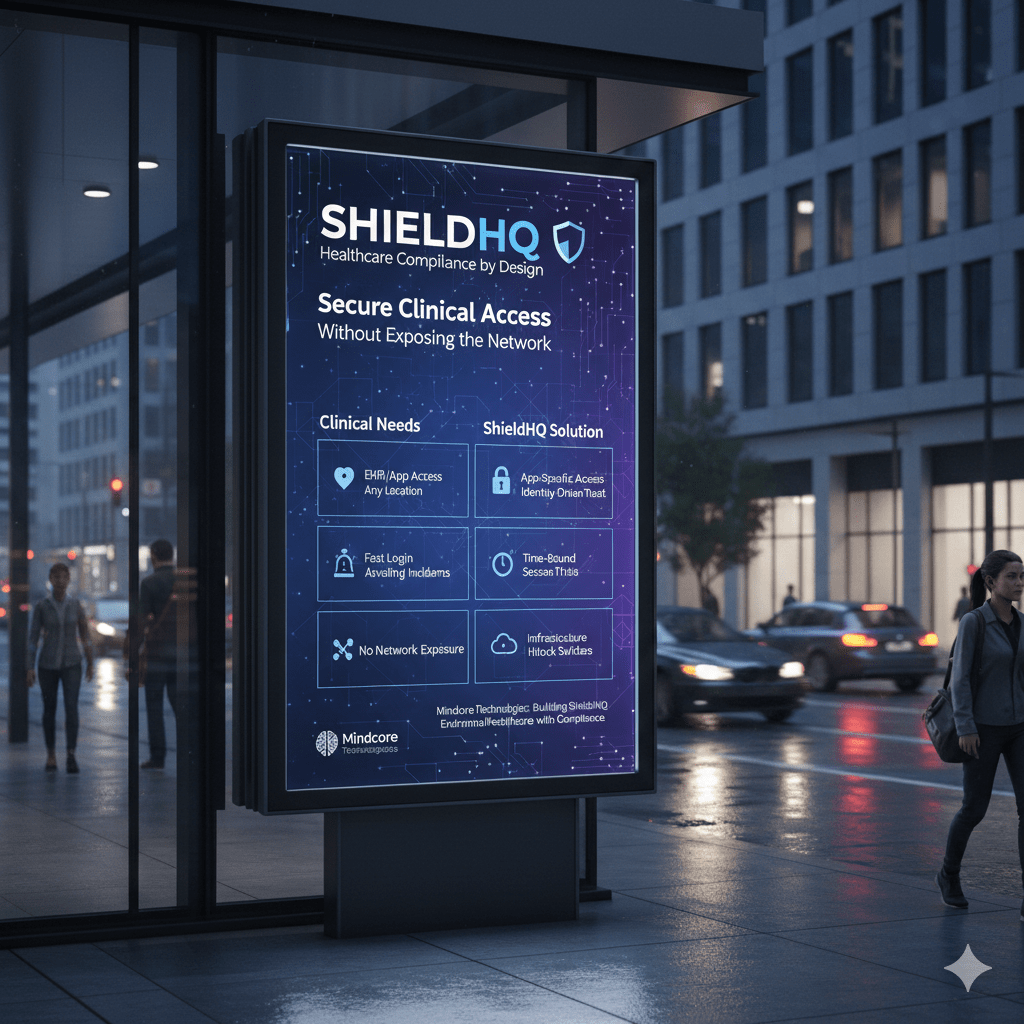
Most healthcare security failures start with a simple mistake: giving clinicians network access when they only need application access. VPNs, internal Wi-Fi trust, and flat networks expose far more than clinical workflows require. Once access exists, attackers inherit it.
Secure clinical access must deliver speed and reliability without turning the internal network into the attack surface.
At Mindcore Technologies, breach reviews consistently show that organizations exposing networks for clinical access experience wider incidents, slower containment, and higher HIPAA impact than those that isolate access at the workspace and application layer.
Why Network-Based Clinical Access Is Failing
Healthcare networks were designed for on-site care delivery. Modern healthcare is not.
Network-based access fails because:
- VPNs extend full internal trust
Clinicians gain visibility into systems unrelated to care delivery. - Wi-Fi access implies legitimacy
Being on the network equals access, regardless of identity context. - Flat internal networks enable lateral movement
One compromised device can reach many systems. - Endpoints are treated as trusted
Infections or misconfigurations undermine all controls.
The network becomes the weakest link in clinical access.
What Clinicians Actually Need to Do Their Jobs
Most clinical workflows do not require network access.
They require:
- Reliable access to EHR and clinical applications
Not file servers or infrastructure. - Consistent performance from any location
Clinics, homes, and partner sites. - Fast authentication without friction
Security cannot delay care. - Availability during incidents
Access must continue even when security teams are responding.
Exposing the network is unnecessary to meet these needs.
What Secure Clinical Access Really Means
Secure clinical access means delivering exactly what clinicians need, and nothing more.
In practice, this means:
- Access is application-specific
Clinicians connect to systems, not networks. - Trust is identity-driven
Access depends on who the clinician is and their role. - Sessions are time-bound
Access expires automatically. - Infrastructure remains hidden
Networks, servers, and devices are unreachable.
This model removes the network from the trust equation.
How Secure Workspaces Enable Clinical Access Safely
Secure workspaces replace network-based access entirely.
They work by:
- Isolating clinical applications inside controlled environments
Clinicians interact with apps, not infrastructure. - Keeping PHI inside the workspace
Data never touches endpoints. - Eliminating internal network visibility
No scanning, browsing, or discovery is possible. - Supporting rapid session termination
Compromised access is revoked instantly.
Clinical access becomes precise and contained.
Protecting PHI Without Slowing Care
Security fails when it interferes with patient care.
Secure workspaces protect PHI while preserving workflow by:
- Providing consistent access regardless of location
No VPN troubleshooting or network dependencies. - Reducing login friction with identity-based access
Authentication is strong but predictable. - Preventing accidental data handling
Copying, downloading, and exporting PHI is controlled. - Removing endpoint dependency
Device issues do not equal data exposure.
Care delivery continues without compromise.
Stopping Lateral Movement Through Clinical Accounts
Clinical accounts are valuable targets.
Secure access stops lateral movement by:
- Preventing network discovery entirely
Attackers cannot map internal systems. - Restricting access to defined workflows only
One application does not lead to another. - Blocking privilege escalation paths
Credentials do not unlock infrastructure. - Containing compromise to a single session
Damage cannot spread.
This dramatically reduces ransomware impact.
Supporting Remote and On-Call Clinicians Safely
Remote and on-call access increases risk when done through networks.
Secure clinical access supports it by:
- Eliminating VPN-based connectivity
Clinicians never join internal networks. - Delivering identical access everywhere
Home, clinic, or emergency location makes no difference. - Reducing credential blast radius
One compromised account does not expose everything. - Allowing rapid access revocation
Sessions can be shut down without disrupting others.
Remote care stops increasing attack surface.
Improving HIPAA Outcomes Through Access Containment
HIPAA expects minimum necessary access and clear auditability.
Secure clinical access supports this by:
- Enforcing minimum necessary access automatically
Clinicians see only what their role requires. - Containing PHI inside approved environments
Data location is controlled. - Providing session-level audit trails
Who accessed what, when, and for how long is clear. - Reducing breach scope
Fewer systems and records are affected.
Compliance becomes easier when access is contained.
Why Detection Alone Cannot Protect Clinical Access
Monitoring tools alert after access already exists.
They fail because:
- Alerts occur post-access
- Normal clinical activity blends with misuse
- Response depends on human speed
Secure clinical access removes the ability to cause widespread damage, reducing reliance on rapid detection.
How Mindcore Technologies Enables Secure Clinical Access
Mindcore helps healthcare organizations secure clinical access by:
- Identifying where network exposure exists today
Mapping unnecessary trust. - Replacing VPN and network-based access with secure workspaces
Removing internal visibility. - Designing role-based, session-limited clinical access
Aligning access with care delivery needs. - Containing PHI inside controlled environments
Preventing sprawl and misuse. - Centralizing visibility for security and compliance teams
Making access auditable and defensible.
The objective is access that supports care without creating risk.
A Simple Clinical Access Reality Check
Your clinical access model is still high-risk if:
- VPNs expose internal networks
- Clinicians can reach systems outside care workflows
- PHI exists on endpoints
- Compromised accounts enable lateral movement
- Incident response requires access shutdowns
These are access design failures, not training issues.
Final Takeaway
Secure clinical access does not require exposing the network. In fact, doing so creates unnecessary risk.
Healthcare organizations that move clinical access to secure, identity-driven workspaces protect PHI, reduce ransomware impact, and maintain care delivery even during incidents. Those that continue to rely on network-based access models remain vulnerable through trust assumptions attackers already exploit.

