

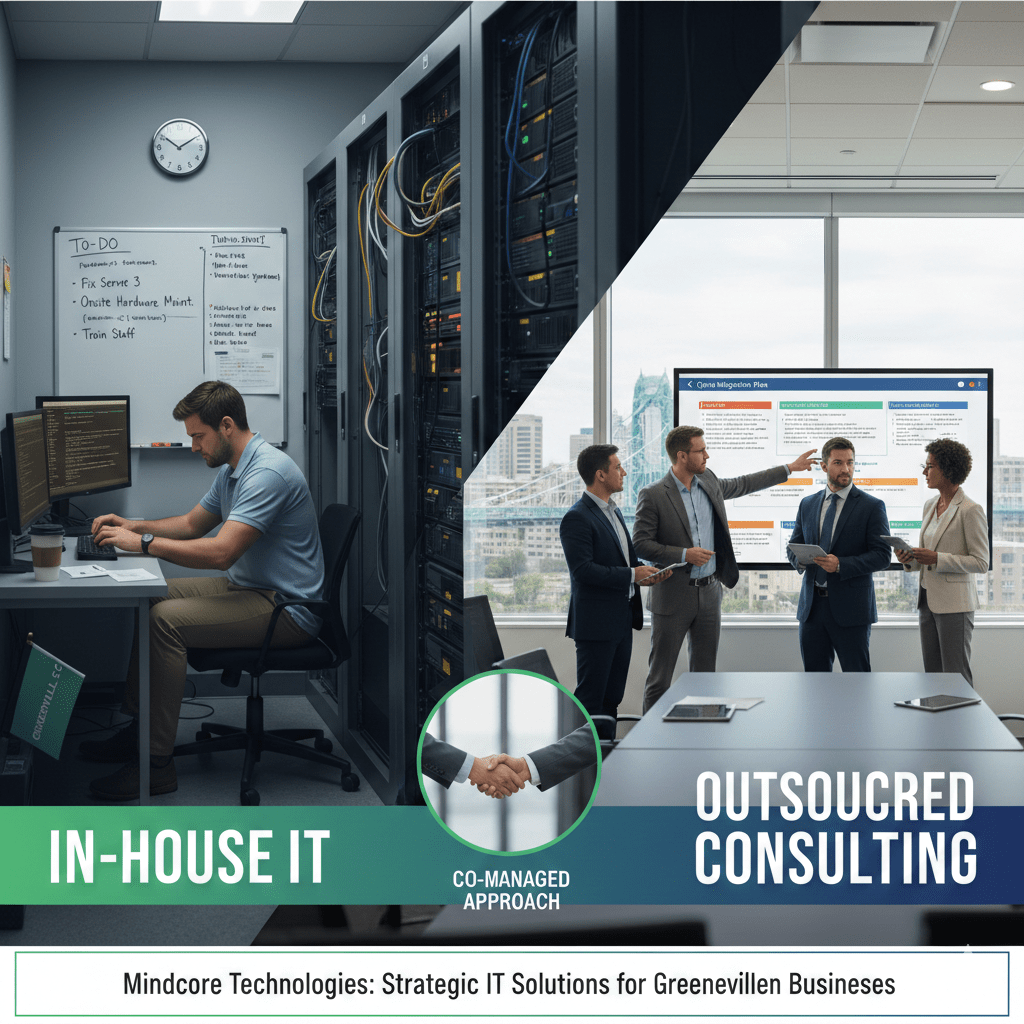
Greenville businesses often reach a decision point: hire more internal IT staff or outsource strategic IT consulting.
This is not just a staffing decision. It is a risk, cost, and scalability decision.
At Mindcore Technologies, we frequently work with companies that hired internally too late or outsourced too broadly without structure. The right choice depends on business maturity, growth trajectory, compliance demands, and risk tolerance.
Below is a practical breakdown to help Greenville leadership teams decide.
When Hiring In-House IT Makes Sense
Building internal IT capability can be valuable when aligned properly with long-term strategy.
1. You Need Daily, Hands-On Operational Control
- Constant onsite hardware management
If your environment requires frequent physical intervention, internal staff may provide faster response. - Industry-specific systems expertise
Highly specialized applications may benefit from in-house knowledge. - Direct alignment with internal workflows
Embedded staff often understand business nuances deeply.
Internal IT can provide high operational familiarity.
2. Your Environment Is Stable And Mature
- Well-defined infrastructure architecture
Stable environments reduce need for outside specialization. - Predictable support volume
Consistent workloads justify full-time staffing. - Limited regulatory complexity
Fewer compliance pressures reduce need for outside consulting depth.
Hiring works best when complexity is controlled.
3. You Have Budget For Full Lifecycle Costs
- Competitive salary and benefits
IT talent retention requires strong compensation packages. - Training and certification expenses
Skillsets must evolve continuously. - Tooling and monitoring platform investments
Internal teams still require enterprise-grade systems.
Hiring involves more than base salary.
When Outsourcing IT Consulting Makes More Sense
Outsourcing does not mean giving up control. It means gaining structured expertise.
1. You Need Specialized Expertise Without Full-Time Headcount
- Cybersecurity architecture design
Advanced threat modeling and segmentation require niche expertise. - Cloud migration planning
Cloud governance and cost optimization benefit from experience. - Compliance readiness
Healthcare, financial, and regulated industries need structured oversight.
Outsourcing provides depth that small internal teams cannot maintain alone.
2. Your IT Team Is Overloaded
- Reactive ticket management dominates time
Strategic projects stall. - After-hours incidents lack coverage
Security events may go undetected overnight. - Burnout risk increases
Sustained overload reduces operational quality.
Outsourcing extends capacity without replacing internal talent.
3. Your Business Is Scaling Rapidly
- New offices or acquisitions
Infrastructure must evolve quickly. - Cloud adoption expansion
Governance must scale with user growth. - Increased security exposure
Attack surface expands as headcount grows.
Rapid growth demands structured planning.
4. You Need Executive-Level IT Strategy
- No long-term IT roadmap exists
Technology decisions are reactive. - Budget forecasting lacks clarity
Infrastructure investment becomes unpredictable. - Leadership lacks technical risk visibility
Decision-making is uninformed.
Outsourced consulting provides strategic alignment.
Cost Comparison: Hire vs Outsource
Hiring In-House
- Salary, benefits, and recruitment costs.
- Ongoing training and certification expenses.
- Paid leave and coverage gaps during absence.
- Limited skill diversity within a small team.
Internal staffing can become expensive quickly.
Outsourced IT Consulting
- Predictable service-based pricing models.
- Access to multiple specialists instead of one generalist.
- Scalable service levels aligned with demand.
- Reduced recruitment and turnover risk.
Outsourcing shifts cost from fixed payroll to operational flexibility.
Security And Risk Considerations
From a cybersecurity standpoint:
- Single-person internal IT teams create concentration risk
One departure can disrupt operations. - Limited monitoring coverage increases dwell time
Threats go undetected outside business hours. - Skill gaps in emerging threats create blind spots
AI-driven attacks and cloud risks require advanced expertise.
Consulting partnerships reduce single-point-of-failure risk.
Hybrid Approach: Co-Managed IT As A Middle Ground
Many Greenville businesses benefit from a hybrid model.
- Internal IT retains operational control
Maintains familiarity and responsiveness. - External consultants provide strategic and security oversight
Adds expertise and monitoring depth. - Shared responsibility reduces overload
Improves long-term sustainability.
This model often delivers the strongest balance.
How Mindcore Technologies Supports Greenville Businesses
Mindcore helps Greenville organizations decide and execute effectively by:
- Conducting IT maturity assessments to identify capability gaps.
- Providing strategic advisory services aligned with growth objectives.
- Offering co-managed support models to reinforce internal teams.
- Delivering cybersecurity architecture and compliance guidance.
- Building multi-year IT roadmaps for scalable infrastructure.
Consulting is about strengthening operational foundations.
Decision Framework For Greenville Leadership
Consider outsourcing IT consulting if:
- Your team is consistently reactive.
- Security incidents are increasing.
- Growth is outpacing infrastructure planning.
- Compliance requirements are intensifying.
- You lack executive-level IT strategy visibility.
Consider hiring internally if:
- Infrastructure is stable and predictable.
- You require daily hands-on physical support.
- Budget supports long-term lifecycle staffing.
Strategic clarity reduces costly missteps.
Final Takeaway
For Greenville businesses, the decision between hiring in-house IT and outsourcing consulting depends on growth rate, security exposure, budget structure, and internal capacity.
Hiring provides embedded familiarity. Outsourcing delivers scalable expertise and strategic oversight. Many companies achieve optimal results with a co-managed approach.
IT should accelerate growth, not constrain it.

