

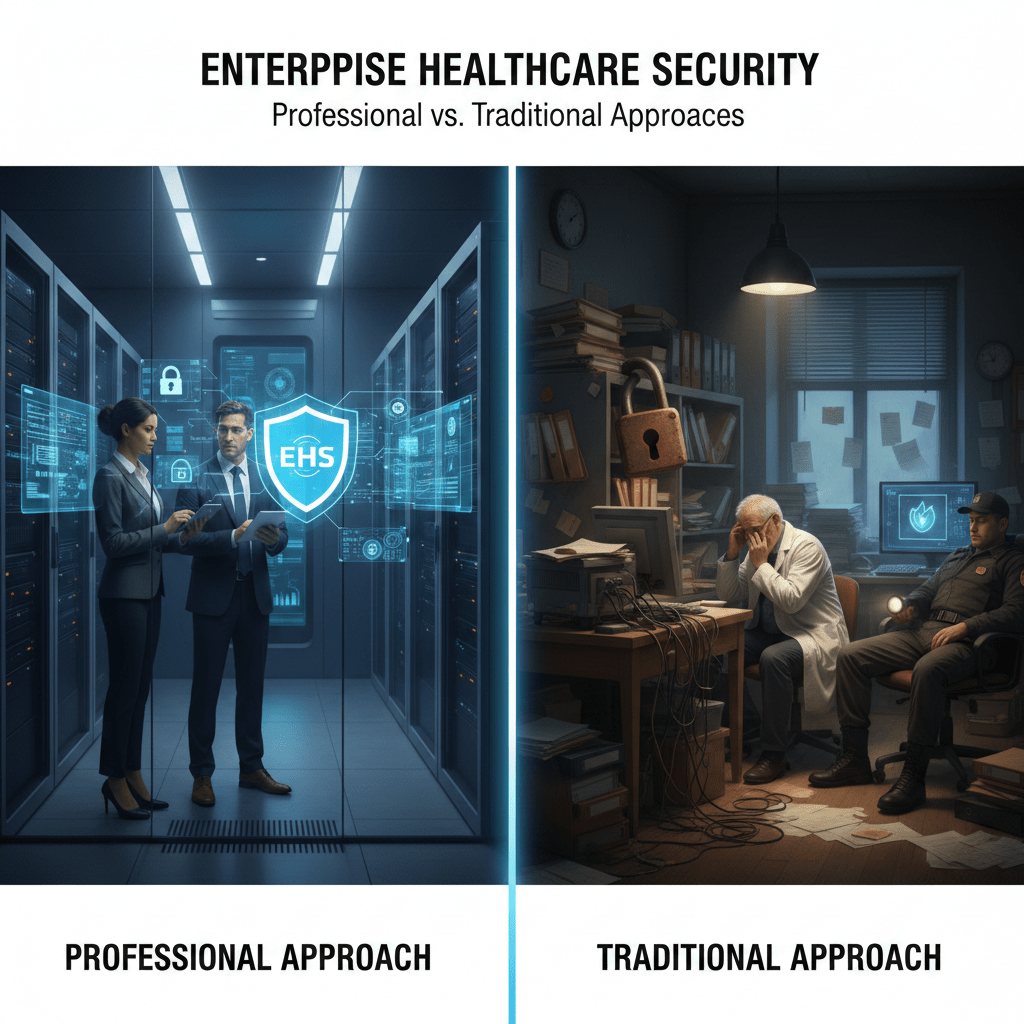
Enterprise healthcare security has evolved beyond perimeter firewalls and antivirus platforms. Healthcare systems with multiple facilities, hybrid cloud deployments, telehealth integrations, and vendor dependencies cannot rely on outdated security philosophies. The difference between professional and traditional approaches is architectural, not cosmetic.
Traditional security was built for centralized offices and predictable access patterns. Enterprise healthcare environments are distributed, mobile, and deeply integrated. A compromised credential in a flat network can cascade across departments, imaging systems, billing environments, and backup infrastructure within minutes.
This is why Professional Cybersecurity Solutions for Healthcare Enterprises: Executive Guide emphasizes structural containment over perimeter reinforcement.
Understanding the architectural difference between professional and traditional models is critical for executive leadership making modernization decisions.
Traditional Healthcare Security Model
Traditional approaches prioritize boundary defense.
• Firewall-heavy perimeter protection
Focuses on blocking threats at the network edge.
• VPN-based remote access
Extends internal trust to remote users.
• Flat internal network architecture
Allows unrestricted lateral movement.
• Reactive monitoring systems
Identify incidents after damage occurs.
• Manual compliance reporting workflows
Create documentation gaps and delays.
While this model was once sufficient, it struggles at enterprise scale. It cannot contain credential compromise effectively.
These limitations often surface in the operational strain described in Top Cybersecurity Pain Points Facing Healthcare Compliance Officers.
Professional Enterprise Security Architecture
Professional security focuses on containment and automation.
• Network segmentation by function
Isolates clinical, administrative, and vendor systems.
• Secure enclave isolation for sensitive workloads
Limits breach blast radius.
• Zero-trust access enforcement
Validates every session continuously.
• Phishing-resistant authentication mechanisms
Reduce credential-based compromise.
• AI-driven anomaly detection systems
Identify abnormal behavior instantly.
• Centralized executive compliance dashboards
Provide structured governance visibility.
These architectural controls align directly with large-scale environments described in Healthcare Cybersecurity Strategy for 500+ Employee Organizations.
Containment vs Lateral Exposure
The most significant difference between traditional and professional models is containment capability.
Traditional model:
• Internal networks trust authenticated users broadly.
• Once inside, attackers can move laterally.
• Backup systems are often reachable from production environments.
Professional model:
• Systems are segmented into controlled zones.
• Access privileges are limited to job-specific requirements.
• Backup environments are isolated from production networks.
• Vendor access is restricted through dedicated pathways.
Containment significantly reduces breach severity and regulatory exposure.
These containment principles also influence executive evaluation criteria discussed in Professional Healthcare Security Providers: Executive Evaluation Guide.
Identity Governance Comparison
Credential compromise drives most breaches.
Traditional identity controls:
• Password-based authentication
• Inconsistent MFA enforcement
• Static access privileges
Professional identity controls:
• Phishing-resistant MFA
• Automated Role-Based Access Control (RBAC)
• Privilege revocation upon role change
• Continuous login anomaly monitoring
Strong identity governance reduces compliance strain and strengthens regulatory defensibility.
Monitoring and Visibility Differences
Monitoring maturity defines executive confidence.
Traditional monitoring:
• Fragmented logging systems
• Manual report generation
• Limited anomaly detection capabilities
Professional monitoring:
• Centralized SIEM integration
• AI-powered anomaly detection
• Automated compliance reporting dashboards
• Real-time executive alerts
Visibility improvements directly support the trust-building initiatives described in Professional Healthcare Security Solutions: Building Executive Trust.
Vendor Risk Exposure
Vendor integration is often overlooked.
Traditional vendor model:
• Broad VPN access
• Limited activity monitoring
• Irregular reassessment cycles
Professional vendor governance:
• Segmented vendor access zones
• Continuous vendor session monitoring
• Annual vendor risk reassessments
• Structured Business Associate Agreement tracking
Vendor governance discipline reinforces serious compliance posture and supports themes expanded in Enterprise Healthcare Compliance: Serious Solutions for Serious Challenge.
Why Professional Architecture Is Required for 500+ Employee Organizations
Scale changes everything.
• Larger workforces increase credential exposure risk.
• More facilities increase network complexity.
• Expanded vendor ecosystems increase third-party risk.
• Higher PHI volume increases regulatory impact.
Professional containment architecture becomes non-negotiable at enterprise scale.
Key Takeaways
Traditional perimeter-based security models cannot adequately protect enterprise healthcare environments operating across distributed facilities and cloud ecosystems. Professional cybersecurity architecture prioritizes containment through segmentation, phishing-resistant identity governance, AI-driven anomaly detection, vendor risk isolation, and centralized executive reporting dashboards. Healthcare organizations with 500 or more employees must modernize beyond reactive defenses to sustain resilience, regulatory defensibility, and executive confidence.

