

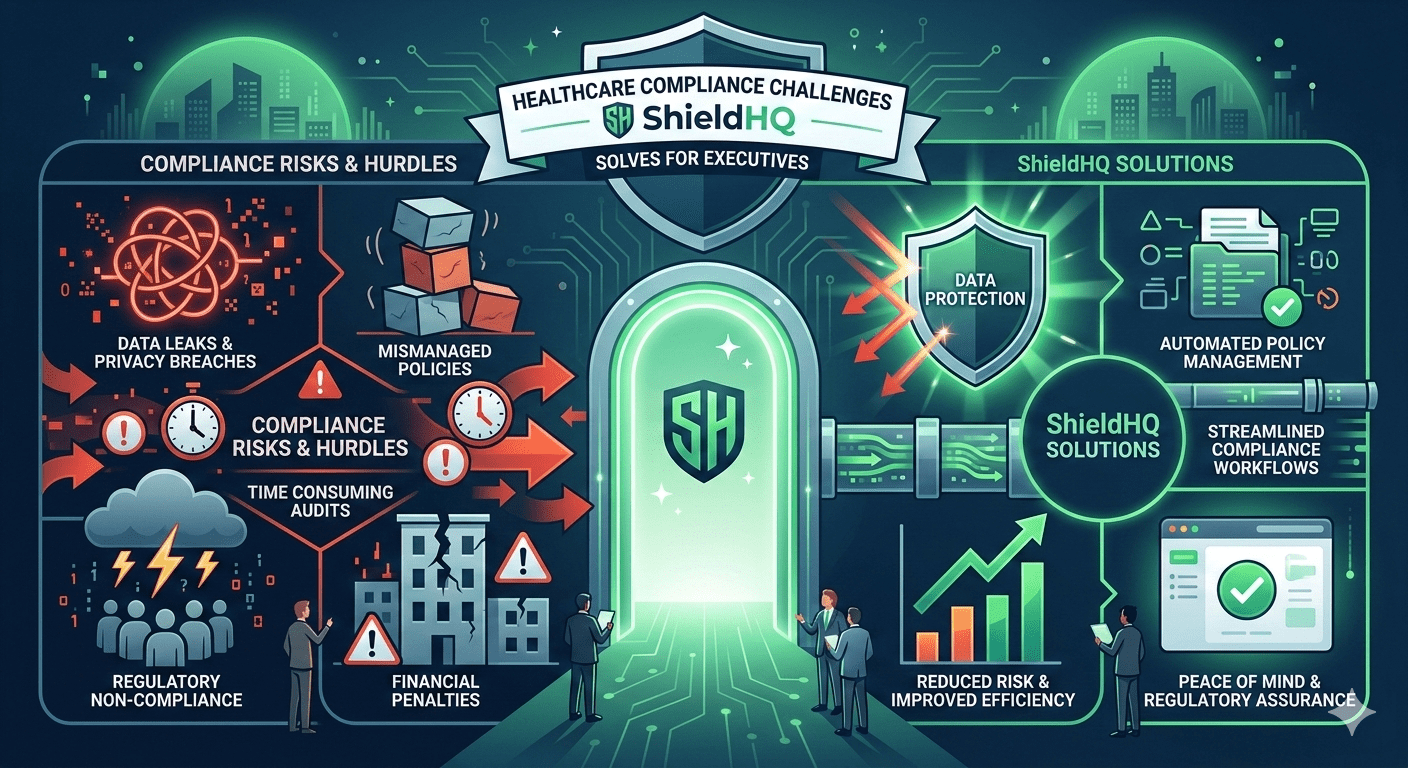
Healthcare executives are not concerned with firewall settings. They are concerned with regulatory exposure, operational disruption, board scrutiny, cyber insurance pressure, and reputational risk. Compliance in enterprise healthcare environments is no longer a back-office function. It is a leadership-level responsibility.
Most executive stress does not originate from known threats. It originates from uncertainty. Uncertainty about credential compromise exposure. Uncertainty about vendor access. Uncertainty about lateral movement risk. Uncertainty about audit readiness. Uncertainty about whether reporting systems provide accurate visibility.
ShieldHQ for Enterprise Healthcare: Complete Compliance and Security Platform was designed to eliminate that uncertainty by structuring compliance into enforceable architecture rather than policy documents.
Challenge 1: Lack of Infrastructure Visibility
Executives often lack a unified view of risk.
• Fragmented log storage systems
Delay incident identification.
• Manual compliance reporting workflows
Create documentation gaps.
• Disconnected monitoring tools
Reduce situational awareness.
ShieldHQ addresses visibility gaps through:
• Centralized SIEM integration
• AI-powered anomaly detection engines
• Executive compliance dashboards
• Automated documentation workflows
These capabilities are expanded in ShieldHQ Enterprise Solutions: Comprehensive Healthcare Security Guide.
Challenge 2: Lateral Movement Risk in Flat Networks
Flat network design amplifies breach severity.
• Compromised credentials move freely.
• Backup environments remain reachable.
• Clinical systems lack segmentation boundaries.
ShieldHQ Powered by Dispersive® Stealth Networking solves this by enforcing:
• Secure enclave isolation
• Segmented clinical and administrative environments
• Isolated backup infrastructure
• Restricted vendor access zones
Architectural comparison with traditional approaches is examined in ShieldHQ vs. Traditional Healthcare Security: Enterprise Comparison.
Challenge 3: Credential Compromise Exposure
Credential misuse is the most frequent breach entry point.
• Weak password reliance
• Inconsistent MFA enforcement
• Delayed privilege revocation
ShieldHQ enforces identity governance discipline through:
• Enterprise-wide phishing-resistant MFA
• Automated Role-Based Access Control (RBAC)
• Immediate privilege lifecycle automation
• Continuous authentication anomaly detection
Identity enforcement at workforce scale is detailed in ShieldHQ Implementation Guide for Healthcare Organizations Over 500 Employees.
Challenge 4: Vendor Risk and Third-Party Exposure
Vendor ecosystems increase systemic risk.
• Broad VPN vendor access
• Limited session monitoring
• Infrequent risk reassessments
ShieldHQ reduces vendor uncertainty through:
• Segmented vendor access pathways
• Continuous vendor session monitoring
• Structured Business Associate Agreement oversight
• Annual vendor risk reassessment cycles
This governance maturity reinforces the serious compliance posture outlined in The ShieldHQ Approach: Serious Healthcare Security for Serious Organizations.
Challenge 5: Audit Stress and Regulatory Scrutiny
Audit readiness must operate continuously.
• Missing documentation
• Inconsistent encryption validation
• Delayed reporting preparation
• Lack of centralized evidence repositories
ShieldHQ supports audit defensibility through:
• Automated log retention enforcement
• Centralized risk assessment documentation
• Real-time compliance dashboards
• Quarterly reporting workflows
These governance improvements also strengthen executive confidence themes described in How Healthcare Executives Build Trust with ShieldHQ Professional Solutions.
Challenge 6: Cyber Insurance and Board Oversight Pressure
Insurance carriers and boards require structured reporting.
• MFA enforcement verification
• Encryption coverage documentation
• Incident response testing evidence
• Vendor risk governance proof
ShieldHQ simplifies reporting through:
• Centralized compliance dashboards
• Automated safeguard validation
• Structured executive briefing cycles
• Integrated anomaly detection reporting
Visibility reduces leadership anxiety and improves governance confidence.
Challenge 7: Scalability in 500+ Employee Environments
Enterprise healthcare systems require:
• Workforce-wide identity enforcement
• Multi-facility segmentation
• Hybrid cloud monitoring
• High-volume log ingestion capability
ShieldHQ is built for scalability, as evaluated in How to Choose ShieldHQ for Your Healthcare Organization’s Compliance Needs.
Executive Outcomes ShieldHQ Delivers
When compliance operates structurally rather than reactively, executives gain:
• Reduced breach severity exposure
• Faster anomaly detection
• Lower audit preparation strain
• Clear board-level reporting
• Stronger cyber insurance positioning
• Improved regulatory defensibility
ShieldHQ converts compliance from uncertainty into structured enforcement.
Key Takeaways
Healthcare executives face structural compliance challenges driven by visibility gaps, lateral movement risk, credential compromise exposure, vendor vulnerability, audit stress, and governance pressure. ShieldHQ Powered by Dispersive® Stealth Networking resolves these challenges by implementing containment architecture, phishing-resistant identity governance, AI-driven anomaly detection, vendor risk segmentation, automated compliance documentation, and executive-level reporting dashboards. By embedding compliance into enforceable infrastructure, ShieldHQ transforms regulatory uncertainty into measurable resilience and leadership confidence.

