

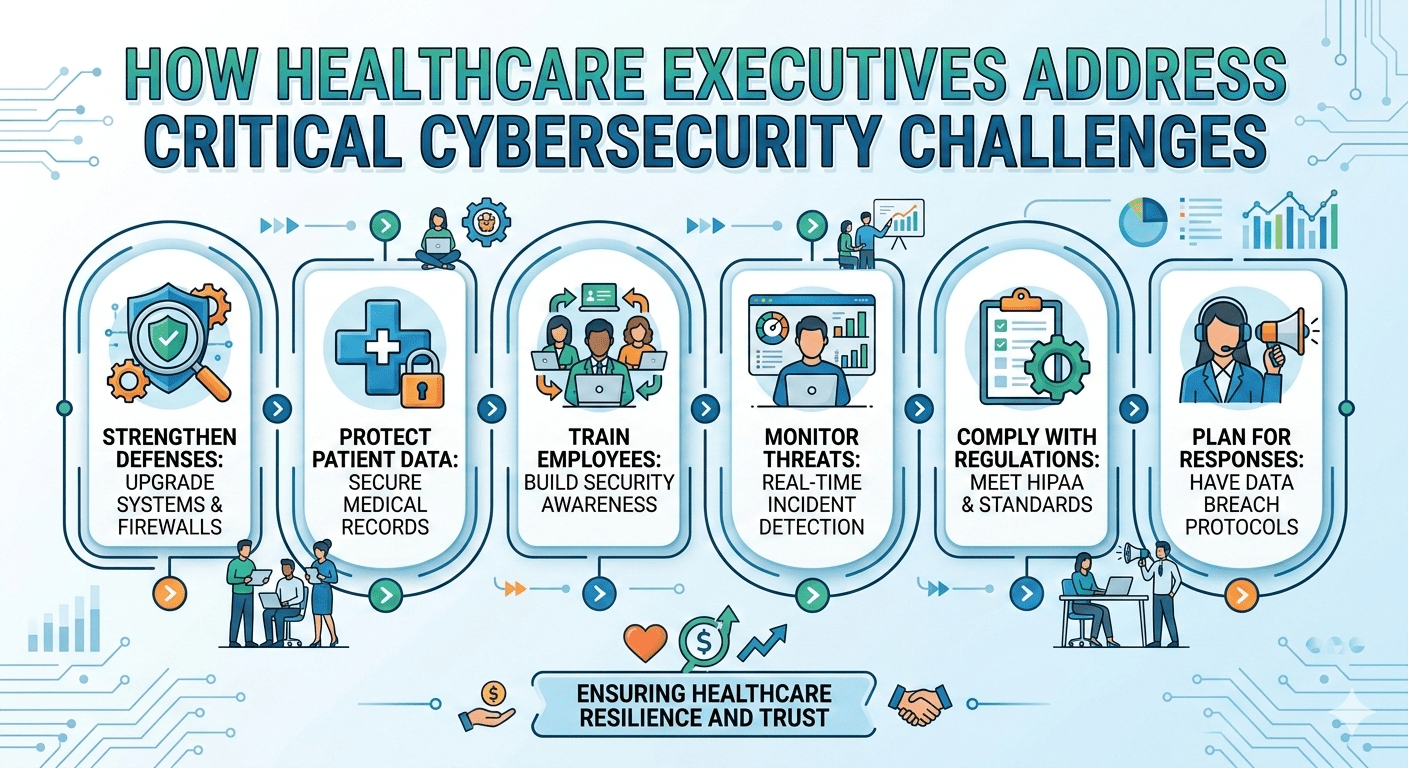
Healthcare executives cannot delegate cybersecurity accountability. Regulatory agencies, cyber insurance carriers, and boards increasingly view cybersecurity as a leadership function. When ransomware disrupts care delivery or PHI is exposed, scrutiny begins at the executive level.
The challenge is not identifying risk. Most executives already know their organizations face credential compromise exposure, vendor vulnerability, flat network architecture, and audit fatigue. The challenge is converting awareness into structured enforcement.
The broader leadership framework is introduced in Healthcare Executive Guide: Solving Critical Compliance and Security Pain Points, where systemic weaknesses are mapped to executive-level solutions.
Executive Challenge 1: Credential Compromise Risk
Compromised credentials remain the most common breach entry point.
Executives typically encounter:
• Inconsistent MFA deployment
Leaves authentication gaps.
• Shared administrative accounts
Increase accountability ambiguity.
• Delayed privilege revocation
Creates orphaned access.
• No login anomaly detection
Delays breach discovery.
Effective executive response includes:
• Enterprise-wide phishing-resistant MFA enforcement
Reduce credential replay attacks.
• Automated Role-Based Access Control (RBAC)
Align access with job responsibility.
• Privilege lifecycle automation
Remove access immediately when roles change.
Identity enforcement expectations are detailed further in Top Security Pain Points Facing Healthcare CTOs and CIOs.
Executive Challenge 2: Lateral Movement and Architectural Weakness
Flat networks amplify breach severity.
Executives often discover:
• Clinical systems lack segmentation
Increase cross-department compromise risk.
• Backup systems share production trust
Endanger recovery capability.
• Vendor VPN access is overly broad
Expand systemic exposure.
Structured response requires:
• Secure enclave segmentation
Limit breach blast radius.
• Backup infrastructure isolation
Protect disaster recovery integrity.
• Segmented vendor access zones
Restrict unnecessary visibility.
Architectural modernization strategies are explored in Professional Solutions for Healthcare Compliance Pain Points.
Executive Challenge 3: Audit Defensibility Gaps
Compliance fatigue erodes executive confidence.
Common stress points include:
• Spreadsheet-based audit preparation
Create documentation inconsistency.
• Fragmented log storage
Delay evidence collection.
• Infrequent encryption validation
Risk safeguard gaps.
• No centralized compliance dashboard
Obscure governance visibility.
Executive solutions include:
• Automated log retention enforcement
Maintain timestamp integrity.
• Centralized SIEM integration
Consolidate hybrid logs.
• Real-time compliance dashboards
Provide board-ready reporting.
Structured audit frameworks are outlined in Healthcare Compliance Challenges: Executive Solutions and Providers.
Executive Challenge 4: Vendor Risk Exposure
Third-party vendors introduce unpredictable exposure.
Healthcare leaders must address:
• Unmonitored vendor sessions
Increase breach likelihood.
• Outdated Business Associate Agreements
Weaken contractual defensibility.
• No annual vendor reassessment cycle
Miss evolving vulnerabilities.
Executive-level vendor discipline includes:
• Continuous vendor session monitoring
Detect abnormal behavior.
• Segmented vendor network pathways
Limit systemic access.
• Annual vendor risk review processes
Sustain oversight.
Vendor governance is reinforced within Professional Healthcare Solutions: Building Executive Confidence.
Executive Challenge 5: Delayed Organizational Action
Many healthcare organizations understand risk but hesitate to act.
Barriers include:
• Fear of operational disruption
• Budget prioritization conflicts
• Leadership misalignment
• Underestimation of ransomware impact
Triggering decisive action is examined in How to Trigger Action on Healthcare Security Challenges.
Building Executive-Level Cybersecurity Governance Rhythm
Sustainable cybersecurity discipline requires structure.
• Quarterly executive risk reviews
Institutionalize oversight.
• Annual infrastructure modernization assessments
Sustain progress.
• Quarterly access governance audits
Validate identity discipline.
• Continuous AI-driven anomaly detection
Maintain real-time visibility.
• Annual vendor reassessment cycles
Preserve third-party discipline.
When governance rhythm is institutionalized, uncertainty decreases.
Executive Outcomes of Structured Enforcement
Healthcare executives who implement structured modernization observe:
• Reduced breach severity exposure
• Faster detection timelines
• Lower audit preparation stress
• Clearer board-level reporting
• Improved cyber insurance positioning
• Increased regulatory defensibility
Leadership confidence improves when enforcement becomes systemic.
Key Takeaways
Healthcare executives address critical cybersecurity challenges by replacing reactive controls with structural containment, phishing-resistant identity governance, centralized monitoring, automated compliance documentation, disciplined vendor oversight, and institutionalized governance cycles. By embedding cybersecurity into enforceable architecture rather than policy-driven management, healthcare leaders reduce uncertainty, strengthen regulatory defensibility, and improve executive-level confidence across enterprise environments.

